If you drive in Wake Forest, you have almost certainly been “read.”
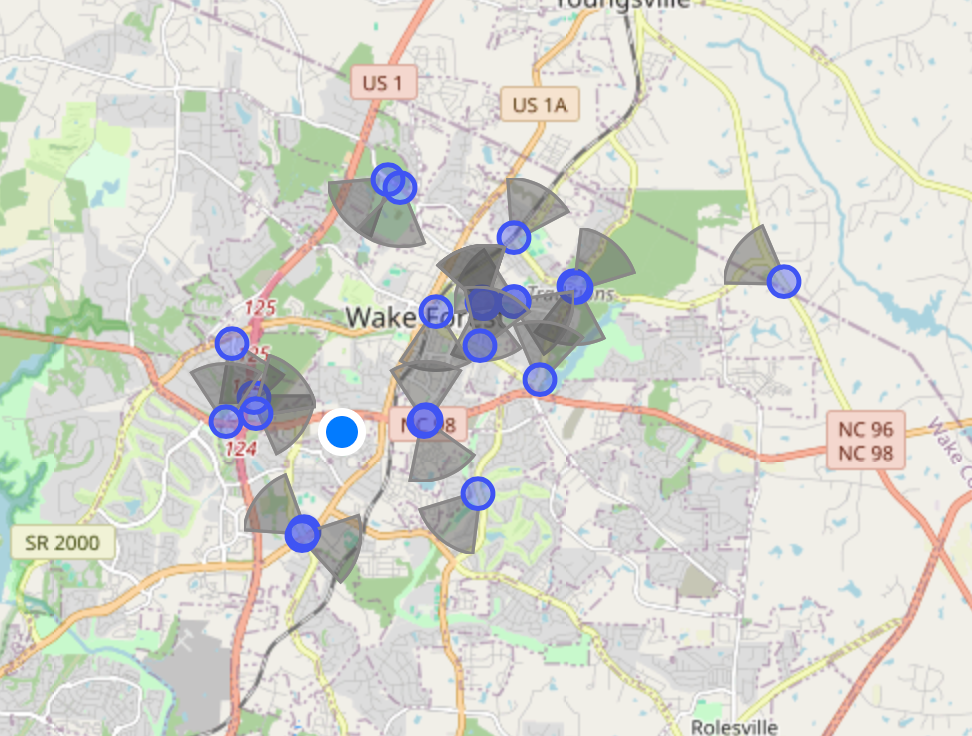
A map of the Wake Forest “Digital Fence,” showing the geographical distribution of surveillance cameras at nearly every major entry point into the town. Source: https://deflock.me/map#map=12/35.964530/-78.524780
According to documents obtained through public records requests, the 25 solar-powered Automatic License Plate Readers installed by the Wake Forest Police Department logged 28,957,133 vehicle reads in 2025. These cameras, provided by Flock Safety, are part of a program to recover stolen vehicles and solve crimes by functioning as a high-speed digital dragnet.
The system works by using motion-activated sensors to capture still images of every passing vehicle’s rear. Sophisticated software then performs Optical Character Recognition (OCR) to digitize license plate numbers while simultaneously “fingerprinting” the vehicle—identifying its make, model, color, and unique features like roof racks or bumper stickers. These digital signatures are instantly compared against national and state “hot lists“ for stolen cars or wanted persons; if a match is found, an alert is sent to officers’ patrol cars within seconds.
A data dashboard tracking vehicle volume from November 23 to December 21, 2025, showing a 30-day total of 1.85 million vehicles and a year-to-date volume approaching 29 million.
To achieve those 32 recoveries, the system executed a staggering 29 million scans, effectively a digital dragnet logging 80,000 vehicles every single day. While the utility for law enforcement is clear, the data suggests that for every one stolen car recovered, nearly one million innocent movements are cataloged, forcing a difficult conversation about whether such pervasive, daily surveillance of the general population is a proportionate cost for the specific results achieved.
Approximately 29 million vehicle scans annually, averaging 80,000 per day, contrasted against a much smaller number of vehicle recoveries.
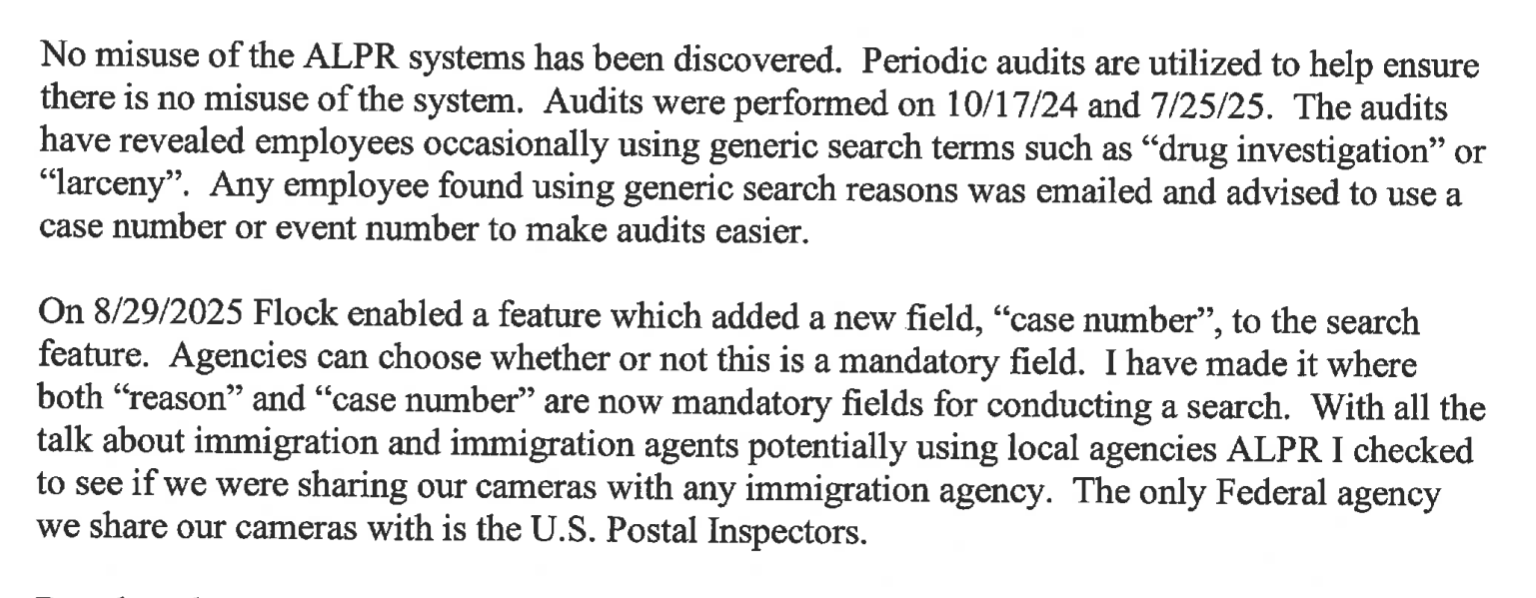
The Department deserves significant credit for not only running routine internal audits but also for swiftly tightening policies when those audits revealed a compliance gap. While no malicious misuse was found, the discovery that staff were relying on broad, generic search terms like ‘drug investigation’ or ‘larceny’ highlighted a critical vulnerability in oversight.
An excerpt from the 2025 annual Flock ALPR report for the Wake Forest Police Department. The document confirms that no system misuse was discovered following audits on October 17, 2024, and July 25, 2025, and notes that search fields for “reason” and “case number” are now mandatory to improve transparency.
Allowing such vague justifications creates a ‘gray area’ where officers could theoretically conduct fishing expeditions or personal checks without a verified predicate. By transitioning to a system where a specific case number or event number is a mandatory field, the Department has effectively closed this loophole. This shift is vital because it forces a direct, digital link between every database query and an active, documented police report.
This ensures that powerful surveillance tools like Flock are used strictly for legitimate law enforcement tasks, protects citizens from arbitrary monitoring, and establishes a clear, auditable paper trail that holds every user accountable for their digital footprint.”
An internal email from a Wake Forest Police Department Captain to the Town’s Purchasing Manager justifying the procurement of the Flock ALPR system. The communication details a two-year lease costing less than $90,000 annually and argues for a bidding exception based on the need for “standardization and compatibility” with neighboring law enforcement agencies.
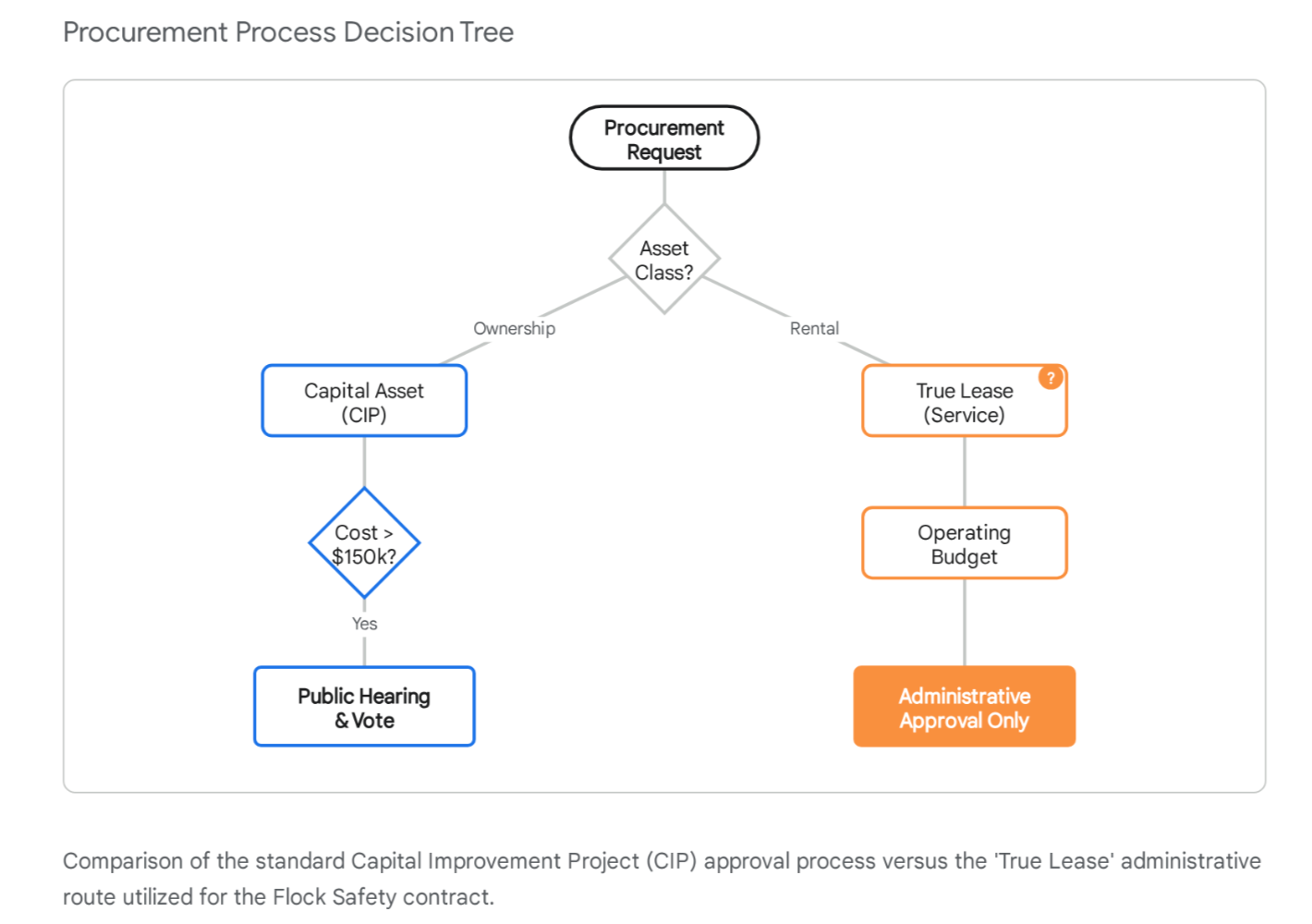
Internal emails reveal that town staff classified the contract as a “true lease.” In a message to the purchasing manager, department leadership noted: “This is a true lease with no option to buy at the end… I believe no bidding is required due to it being a lease.”
By labeling the surveillance grid as a service rather than an asset, the decision was made administratively. While this might be efficient, it locked taxpayers into a subscription model with an out of state vendor without the friction or the sunshine of a public debate. For a town that prides itself on fiscal responsibility, this “subscription” loophole is a precedent that deserves scrutiny.
A summary of guidance from the North Carolina Department of Transportation (NC DOT) regarding License Plate Readers (LPRs) in the right of way, stating that such requests should be denied according to state rules.
Internal notes detail the consensus reached between the Streets Department and Wake Forest Power. While the Streets Director expressed uncertainty about whether encroachment agreements were required for poles between sidewalks and streets, the Power Director identified that utility companies typically do not seek DOT approval to attach cable lines to town poles. Therefore, the town reasoned, the police shouldn’t have to either.
While the official inventory lists 25 town-owned cameras, a forensic analysis of the network reveals that the “digital fence” around Wake Forest does not stop at the town limits. The grid has effectively merged with the private sector, creating a seamless public-private hybrid.
The “Bird Scooter” of Surveillance
This pattern of aggressive deployment isn’t just a local phenomenon; it is the core business strategy of the surveillance industry. Much like how Bird and Lime scooters suddenly appeared on Raleigh street corners before local ordinances were even drafted, the Flock surveillance grid was rapidly deployed in a regulatory vacuum.
The most striking example occurred in November 2023, when a Wake County Superior Court judge ordered Flock Safety to stop all new installations in North Carolina. The ruling was the result of a years-long battle with the state’s Alarm Systems Licensing Board, which found that Flock had been operating as an unlicensed “alarm systems” business, avoiding the background checks and professional vetting required for technicians who handle sensitive security data.
This legal “halt” arrived just weeks after Wake Forest activated its 25-camera network on September 28, 2023. While our local leaders were celebrating the first vehicle recoveries, the technology itself was technically operating in defiance of state regulators. The company eventually settled and obtained its license in August 2024, but the damage of the “deploy first, ask later” approach was done: the infrastructure was already in the ground, the data was already flowing, and the public’s opportunity to question the system before it became a fixture of our streets had been successfully bypassed.
This is a fundamental challenge to how we govern. When technology is allowed to outpace the law by design, we aren’t just adopting new tools; we are surrendering our ability to regulate them.
The Anatomy of a Dragnet
Our analysis of the active surveillance nodes identifies a specific “surveillance sprawl.” While WFPD controls the major arterial choke points (monitoring traffic flow at 0° North and 180° South to catch vehicles crossing town lines), major corporate retailers are filling in the gaps.
Data confirms that Lowe’s Home Improvement is operating its own Flock nodes that feed into the broader regional network. This creates a functional “handoff.” A vehicle exiting US-1 is tracked by WFPD infrastructure, but as it pulls into a commercial lot, the monitoring is handed off to corporate loss-prevention systems.
What this means for residents is simple: You are not just being watched by the government. You are being watched by a patchwork alliance of corporate security teams and town police, all operating on the same standardized platform. If you drive from the highway to the hardware store, you are scanned by two different entities, but the data ultimately feeds the same centralized network.
The Federal Side Door: Mass Deportation and ICE
We are often told that these systems are ‘local’ and isolated tools for property crime abatement. The data suggests otherwise. While the town’s audit states that the U.S. Postal Inspection Service is the only federal agency with direct access, this reflects a fundamental misunderstanding of the ‘networked’ nature of modern surveillance. The architecture of Flock Safety creates a functional ‘Federal Side Door,’a mechanism that bypasses local privacy promises through complex, inter-agency sharing agreements.
Third-party audit logs from HaveIBeenFlocked? reveal that Wake Forest officers have conducted 9,642 searches across the nationwide network, querying cameras from locations as far away as Arkansas and Virginia. This participation creates a reciprocal obligation: by accessing the national grid, we effectively enroll every driver in Wake Forest into a national data-sharing experiment.
The danger lies in the ‘daisy-chain’ effect of data liquidity. Even if Wake Forest does not contract directly with ICE, our data is accessible to regional partners who feed into the North Carolina Information Sharing and Analysis Center (NC ISAAC). As a DHS-recognized fusion center, NC ISAAC acts as a data laundry, ingesting local traffic data and outputting federal intelligence. Furthermore, if Wake Forest shares data with the Wake County Sheriff’s Office, a standard practice for ‘mutual aid,’ that data becomes accessible to federal systems linked to the Sheriff’s office, nullifying our local restrictions.
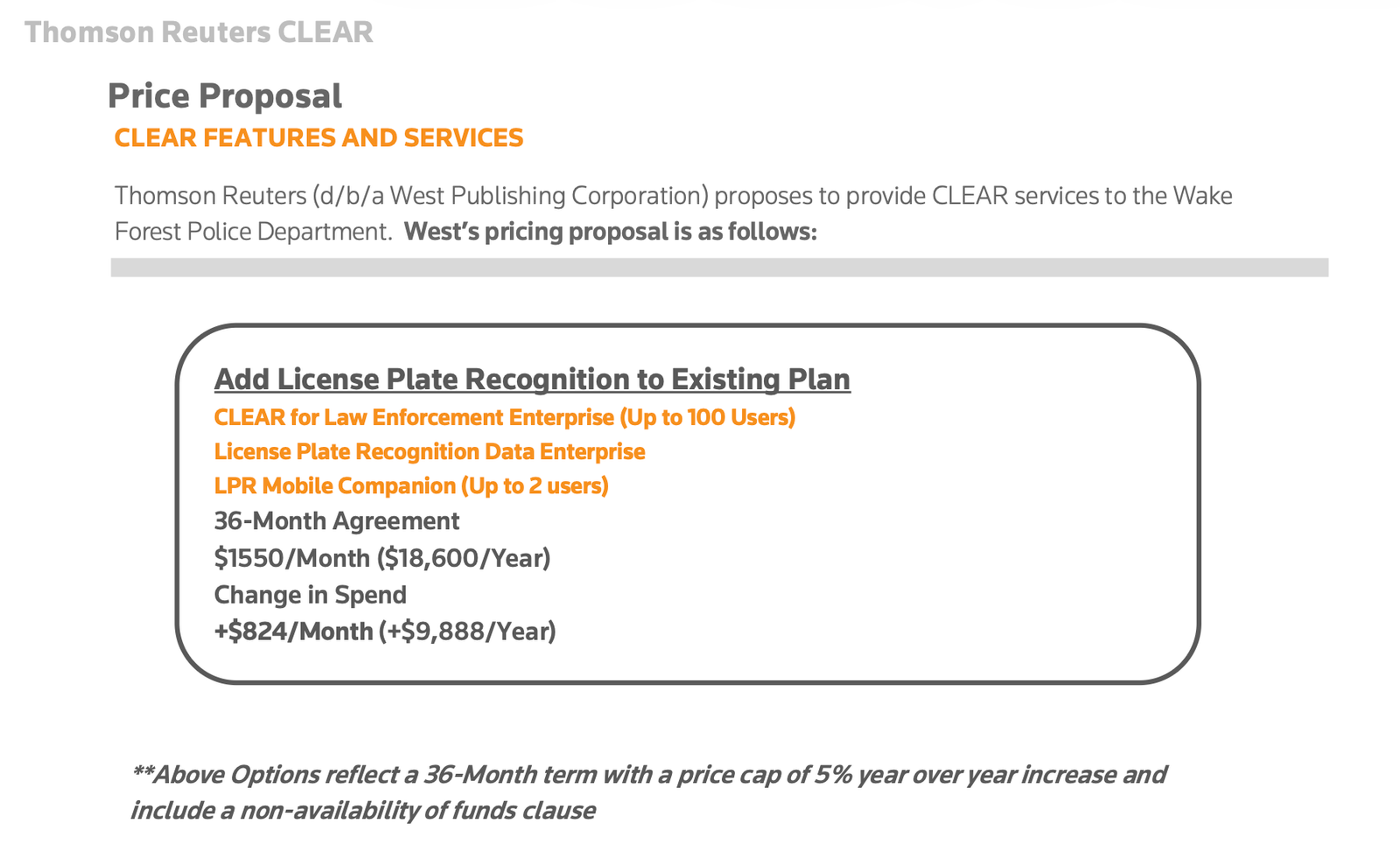
Another significant finding in the records is that the Wake Forest Police Department is actively reviewing a proposal for Thomson Reuters CLEAR, a subscription service costing $18,600 per year.
Unlike Flock, which uses police cameras, CLEAR aggregates commercial data from billions of scans collected by private tow trucks, repossession agents, and parking lot cameras. If adopted, this would effectively privatize the dragnet, allowing the government to purchase location data from private property where it cannot legally install its own cameras
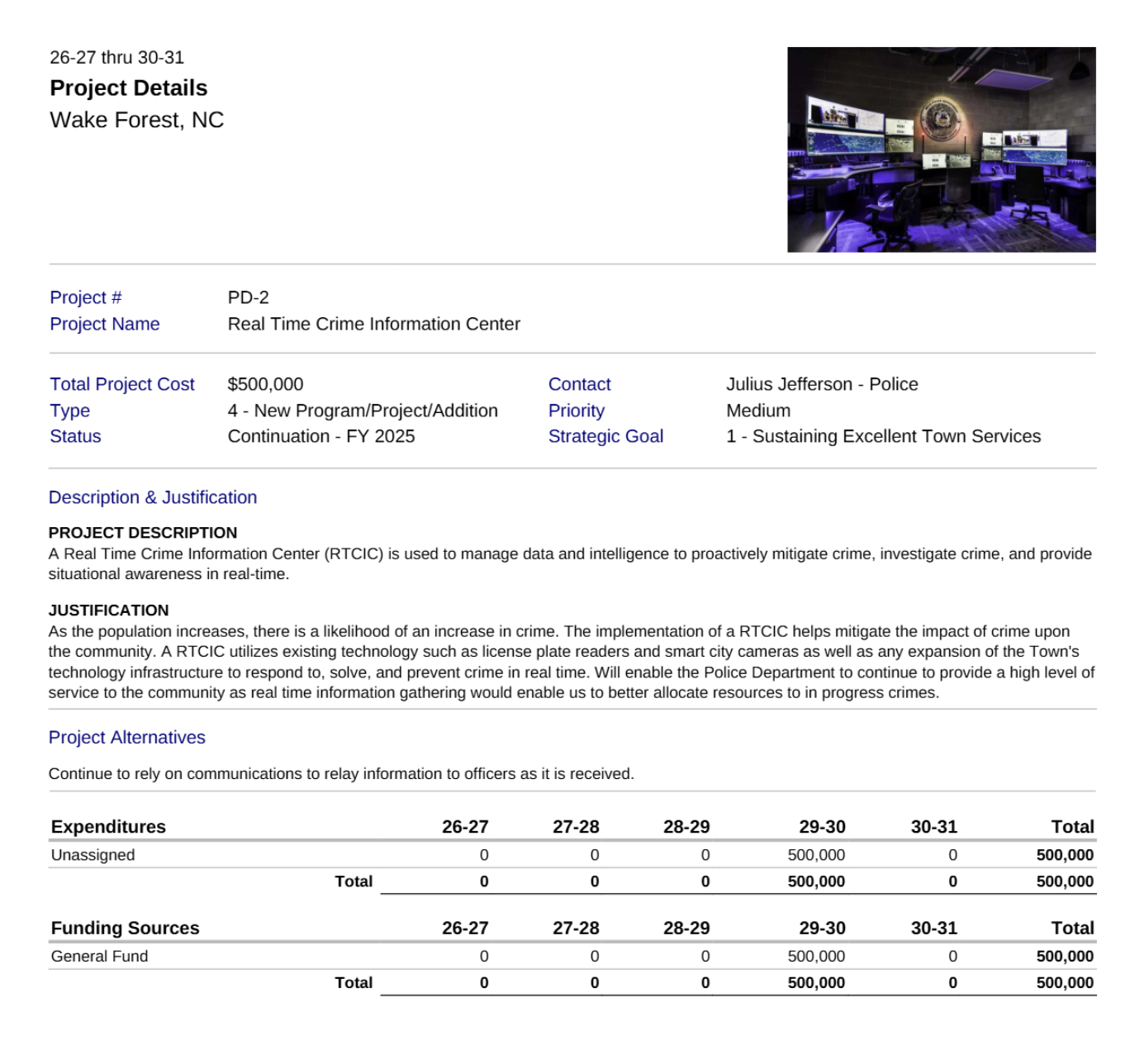
Additionally, the town’s 2026-2031 Capital Improvement Plan (CIP) includes a request for a Real-Time Crime Center (RTCC) to integrate these data streams.
The Wake Forest Police Department has used the tools available to them to solve crimes. The failure here is not on the beat; it is in the boardroom.
The Board of Commissioners has an opportunity, and arguably a duty, to review this contract. When a system is procured through a loophole, installed via a workaround, and connected to a national network without explicit public consent, it is time to pause.
Other communities, from Hillsborough, NC to Flagstaff, AZ, have reviewed similar programs and decided to remove them, determining that the costs to privacy and local control outweighed the benefits.
We should have that debate here. We should consider whether “efficiency” is a good enough reason to bypass the democratic process. We should ask whether a system owned by venture capitalists and shared with hundreds of agencies is truly the best way to keep Wake Forest safe.
The cameras are up. The data is flowing. The only question left is whether our elected leaders will retroactively apply the oversight that should have been there from day one.
So, what do you think?
Should the cameras stay up? Should they come down? Or should there simply be a more democratic and transparent process for approving them?
Tom Baker IV is the publisher of Wake Forest Matters, Wake Forest’s only independent local newsroom. A Wake Forest native, Navy veteran, and intelligence professional, Tom launched Wake Forest Matters to bring serious accountability journalism to his hometown. Tips and story ideas: publisher@wakeforestmatters.com