
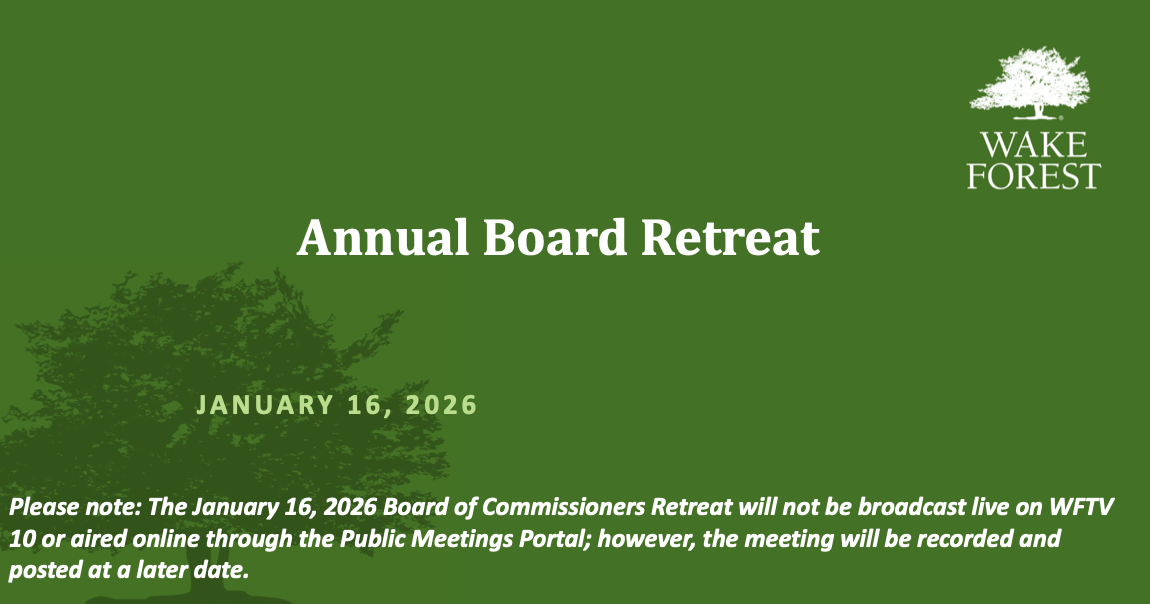
On Friday, January 16, 2026, the Wake Forest Board of Commissioners will gather for its Annual Board Retreat. Unlike regular legislative meetings, this work session is designed for high-level strategic planning rather than immediate voting.
Residents should note that the retreat will not be broadcast live on WFTV 10 or the Public Meetings Portal, though a recording will be posted at a later date.
The 126-page agenda packet outlines a schedule focused heavily on the financial mechanics of town growth, energy infrastructure, and the consequential appointment of a new Commissioner. Here is a breakdown of the key discussions scheduled for the day.
1. Land Use Economics: The Revenue-to-Expense Gap
A primary focus of the retreat is a presentation on “Demographics and Trends” by Planning Director Jennifer Currin. The data presented offers a clear look at the financial models guiding town planning decisions.
The town’s analysis breaks down the “Revenue-to-Expense Ratio” for different land uses, illustrating the fiscal impact of growth:
Residential Impact: For every $1.00 in revenue generated by residential development, the Town spends $1.20 on public services. Residential growth creates a net cost burden.
Commercial Impact: Conversely, for every $1.00 generated by commercial development, the Town spends only $0.55 on services. Commercial development effectively “subsidizes services town-wide”.
Context: This data is presented alongside population projections estimating that Wake Forest will grow from approximately 62,000 residents in 2025 to 118,912 by 2040. With 68% of land within town limits already developed, this financial data likely serves as the framework for future discussions regarding mixed-use zoning and commercial density.
2. Wake Forest Power: Rising Costs and Grid Modernization
The Board will receive updates regarding the energy landscape, signaling a period of rising costs driven by inflation, supply chain constraints, and decarbonization efforts.
Key takeaways from the utility analysis include:
Rate Increases: The town anticipates wholesale generation rate increases of approximately 2.5% to 3.5% per year.
Duke Energy Merger: Duke Energy is pursuing a combined “One Utility” system with a target effective date of January 1, 2027. While the town expects to benefit from this consolidation, the specific financial magnitude remains unclear.
Infrastructure Investment: To maintain the town’s 99.9% reliability rate, Wake Forest Power is proposing a 10-year plan that includes specific upgrades to handle “n-1” contingency scenarios (where one substation goes offline). Specific capital projects include a $347,500 improvement package for the John B. Cole Substation to prevent feeder overloads.
3. Special Event Policy: Increased Liability Coverage
As community events grow in size, the town staff is recommending updates to the Special Events Policy to mitigate financial exposure from potential lawsuits.
The proposed update introduces a tiered insurance requirement structure:
Tier 1 (Lower Risk): Events with fewer than 200 people that do not feature alcohol, food trucks, or stages would continue to require a $2 million general liability policy.
Tier 2 (Higher Risk): Events that include alcohol, stages, food trucks, or larger crowds would see the requirement increase to $5 million in general liability coverage.
4. The “Clapsaddle Seat”: Filling the Board Vacancy
The final item of the day, “Vacant Board Seat Discussion” (Item 1.9), is likely the most politically significant.
This vacancy was created when Commissioner Ben Clapsaddle was elected Mayor in November 2025, leaving his seat with two years remaining on the term (expiring December 2027).
The Process: Unlike the Mayor’s seat, this vacancy will not be filled by a public election. Instead, the current Board of Commissioners (Mayor Clapsaddle, Commissioners Shackleford, Fatmi, Cross, and Wright) will appoint a qualified resident to serve the remainder of the term.
The Timeline: Applications for the seat closed yesterday, January 14, 2026. This retreat provides the first opportunity for the Board to review the applicant pool and discuss its selection criteria.
The “Clifton Strengths” Connection: Notably, the retreat agenda begins with a “Clifton Strengths” assessment for the current Board members. The fact that the Board is analyzing its own personality dynamics immediately before discussing the new appointment suggests they may be looking for a candidate who offers a specific “culture fit” or complementary skillset to the existing team.
Why it Matters: The appointee will serve until 2027 without having to run a campaign, granting them “incumbent” status for the next cycle. They will also be a voting member on the major initiatives discussed earlier in the day, including the 2040 growth plan and the rate hikes.
What We Are Watching
Wake Forest Matters has filed a formal public records request with the Town Clerk to obtain the complete list of applicants and their application materials for the vacant Board seat.
As soon as the Town releases these documents, we will publish a full breakdown of the candidates vying for this appointment. Subscribe to get that update directly in your inbox.