Tonight, the INDY Week reported that U.S. Customs and Border Protection (CBP) agents are set to deploy to the Triangle tomorrow (November 18). This isn’t just a “Raleigh story.” It has profound, immediate implications for every resident of Wake Forest.
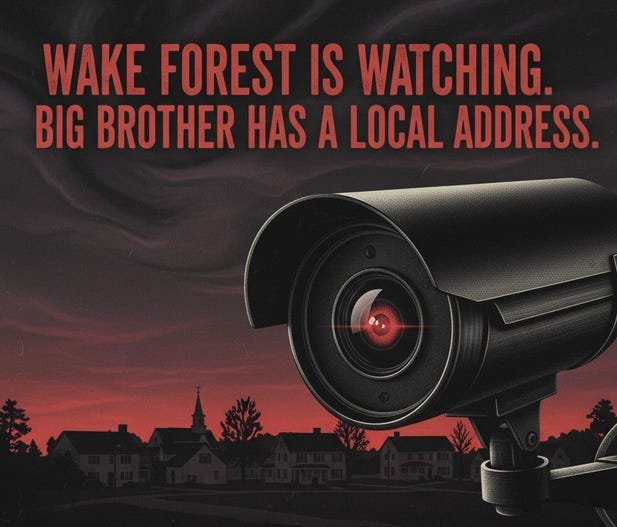
Why? Because our town has quietly installed a dense surveillance infrastructure—the Flock Safety automated license plate reader (ALPR) system—that is ideally suited for federal agencies to leverage.
These cameras capture and store data on every passing vehicle, creating a massive, searchable database of our daily movements. As federal immigration enforcement intensifies in the Triangle, we must confront a critical question: Did Wake Forest build an enforcement tool for CBP?
The Open Backdoor: How Local Data Becomes Federal Data
This is not a hypothetical risk. Federal agencies, including both CBP and Immigration and Customs Enforcement (ICE), routinely access ALPR data collected by local police.
As the ACLU has documented, this often happens through expansive data-sharing networks that require no warrant and operate with almost no public transparency. ALPR vendors like Flock even market their “Talon Network” as a tool to link hundreds of local, state, and federal agencies.
This raises serious, unanswered questions for our town:
Can federal agents access Flock data collected within Wake Forest?
What data-sharing agreements (MOUs) has our town signed?
Can feds get our data indirectly through a state or regional partner?
What legal protections—if any—stop federal agents from searching months of our historical location data?
Research shows ALPR data is used to track daily routines and identify vehicles in immigration enforcement contexts. If CBP operates in the Triangle, Wake Forest’s ALPR system could become a turnkey component of their enforcement apparatus.
The Surrender of Local Control
These systems are often sold to towns as simple tools for local police to solve local crimes, such as property theft. But the reality is a dangerous trade-off: in exchange for this tool, the town effectively gives away local control over its data and, by extension, its policing priorities.
When Wake Forest plugs into a networked system like Flock, it’s not just our police who get access. The network is designed to share.
A Predictable Failure of Governance
How did we get here? How did a town install a mass surveillance system without a robust public debate or a clear-eyed look at the consequences?
It’s a pattern seen in municipalities across the country and a perfect example of a “governance gap”:
Surveillance expands faster than oversight. Administrative decisions, including surveillance expansions, are made without formal public votes or input.
Our elected officials serve part-time and lack the dedicated staff support needed to analyze the complex implications of these technologies.
The public is left in the dark. We get little to no notice about systems that capture our data 24/7.
As the Brennan Center for Justice warns, local police surveillance routinely expands in environments with weak oversight. Towns in our own state, like Hillsborough, later voted to remove or restrict Flock cameras after the public and (belatedly) their elected officials examined the privacy implications.
This governance gap is precisely how a town’s good intentions to “catch criminals” can be exploited, leaving residents vulnerable to surveillance operations far beyond the town’s control.
This Isn’t a Drill: The Turning Point is Now
Federal enforcement agencies rarely build new surveillance systems from scratch. As Georgetown’s Center on Privacy & Technology notes, they draw on existing local infrastructures.
They use our tools.
The reported CBP deployment in Raleigh is the turning point. It moves the dangers of our ALPR system from a theoretical, “civil liberties” concern to an immediate, practical, and regional threat.
To protect our residents and restore democratic control, the Town of Wake Forest must take immediate steps to provide the transparency and oversight that should have been there from the start.
A Path to Accountability
We need to close the governance gap, and we need to do it now. We demand that the Town Board:
Publish all MOUs and data-sharing agreements associated with the Flock camera system.
Require explicit Board of Commissioners votes for any surveillance technology acquisitions or expansions.
Hold a public briefing on the ALPR system’s full capabilities, data retention policies, access logs, and any procedures for federal data requests.
Adopt warrant requirements and minimal data-retention policies, in line with best practices from groups like the EFF.
Strengthen our town’s governance capacity by giving our elected officials the staff support or structural reforms needed actually to govern the technologies they approve.
The bottom line is this: Wake Forest has constructed a powerful surveillance system capable of supporting federal enforcement operations, and it did so without our full understanding or consent.
It is time to examine and reform these practices before our local data becomes fully integrated into a federal enforcement network we cannot control.
Know-your-rights resources
Carolina Migrant Network Know Your Rights! Conoce Tus Derechos!
https://carolinamigrantnetwork.org/2025/03/31/know-your-right-conoce-tus-derechos/
To print Know Your Rights Cards:
https://docs.google.com/document/d/1lixrgTU9ve1oVItk5flkdHfxwTtjYLG1p7k64blq2-E/edit?usp=sharing
ACLU of North Carolina Know Your Rights
https://www.acluofnorthcarolina.org/know-your-rights/kyr-ir/
To locate missing people:
It can take up to 24 hours to locate people.
Immigrant Legal Resource Center Know Your Rights Solidarity Signs