
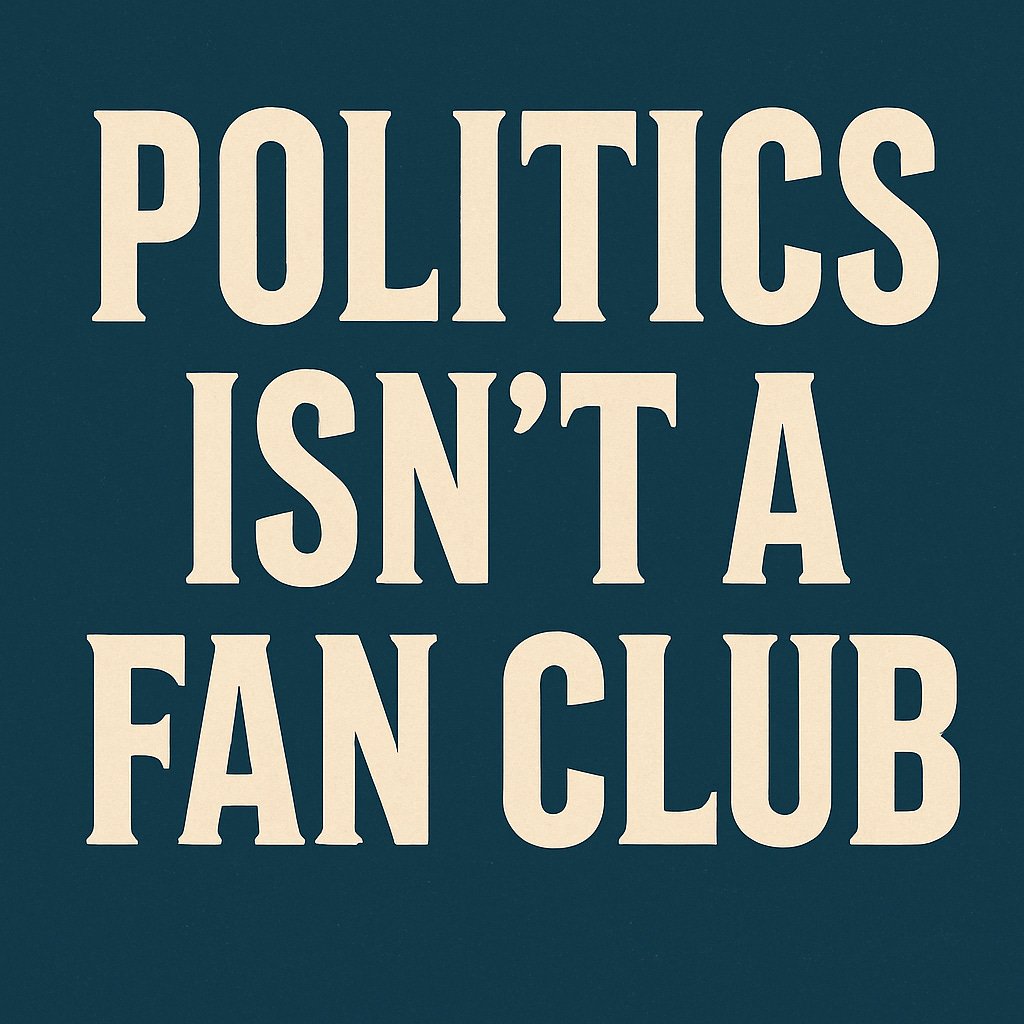
Politics fan club civic engagement accountability — these words frame a critical question in our local discourse. A recent online exchange reminded me how easily our political culture slips into the intellectual equivalent of fast food: quick, salty, filling, and absolutely devoid of substance.
Someone accused me of being “biased” — not because of anything in the argument I made, but because I’d donated to a candidate. In their worldview, politics works like sports: you pick a team, you wear the colors, and every opinion you ever voice from that moment on is reducible to which jersey you supposedly put on.
It’s a basic-as-hell understanding of politics. And honestly, it’s hurting us.
The claim wasn’t even valid in this particular case. I’ve donated to multiple candidates over many years, across races, for reasons ranging from specific issues to wanting more people involved in the civic process. Supporting a candidate doesn’t lock you into a cult of personality, as our town government coverage consistently shows. It’s an act of engagement — one of the few tools citizens actually have.
But even more importantly:
Politics should not be about allegiance to personalities.
It should be about ideas, systems, values, and truth.
The piece I wrote had nothing to do with who I supported. It was about the structure of a voting system. It was about math. It was about the process. It was about transparency in how decisions get made. Somehow, though, the response I got was:
“You’re biased because of who you donated to.”
That is the level of discourse we’re drowning in.
What Politics Is Supposed to Be About
I spent 10 years in the U.S. Navy, including tours in Iraq and elsewhere. The values drilled into us weren’t “Support your team no matter what.”
They were:
Honor. Courage. Commitment.
Those aren’t partisan. They aren’t ideological. They aren’t “left” or “right.” They’re a framework for how to move through the world — how to tell the truth, how to show your work, how to act when nobody is watching, how to stay grounded in something bigger than your ego or your tribe.
Honor means being honest about facts, processes, and systems — even when those facts don’t serve your preferred narrative.
Courage means speaking to complexity in a culture that rewards oversimplification, memes, and team-loyalty politics.
Commitment means doing the work: reading, learning, improving institutions, and engaging in civic life even when it’s tedious, slow, or unpopular.
Nothing about those values aligns with “my team good, your team bad.”
Why “Team Politics” Is So Seductive — and So Dangerous
It’s easy to understand why people fall into this mentality:
- It requires no critical thinking.
- It creates an illusion of certainty in a messy world.
- It gives people a simple villain to point at.
- And it feeds the social-media hunger for outrage.
But it’s also incredibly dangerous.
When you reduce politics to fandom, you stop being a citizen and start being a spectator. You stop evaluating arguments and start sniffing for tribal loyalty. You stop listening. You stop thinking. And worst of all: you stop being persuadable.
In a democracy, when persuasion dies, everything else dies with it.
Politics Fan Club Civic Engagement Accountability: What I Actually Care About
If someone wants to argue with the structure of the voting system, great — let’s do that. Let’s talk data, math, precedent, fairness, outcomes, and democratic integrity.
If someone wants to debate values, transparency, or governance, even better — I’m in.
But if the only move someone has in the conversation is:
“You must be biased because at some point in your life you supported X,”
Then what they’re really saying is:
“I don’t know how to engage with the argument itself.”
And that’s a shame. Because democracy is literally built on the idea that citizens can do more than tribal loyalty.
Politics Is Not a Sport. It’s a Responsibility.
I don’t care who someone votes for as much as I care why.
I don’t care who someone donates to as much as I care how deeply they understand the system they’re participating in.
I don’t care what “team” someone thinks I’m on — I care about whether they can reason beyond the level of a bumper sticker.
In the end, I’m not fighting for a person or a party.
I’m fighting for a culture that takes ideas seriously.
A culture that values truth over tribalism.
A culture that doesn’t confuse civic participation with fandom.
We can do better. And we have to — because the alternative is a politics of shallow identities, empty accusations, and zero substance.
And that’s not a country worth inheriting.
Tom Baker IV is the publisher of Wake Forest Matters, Wake Forest’s only independent local newsroom. A Wake Forest native, Navy veteran, and intelligence professional, Tom launched Wake Forest Matters to bring serious accountability journalism to his hometown. Tips and story ideas: publisher@wakeforestmatters.com