I was seventeen when the towers fell.
On the morning of September 11, 2001, I was in the weight room at Wakefield High School for first-period weight training. Coach Steve Rivers came in and turned on the TV. We stood there, silent, as the second plane hit. In that moment, everything changed. Or at least, it felt like it did. By October 2002, my senior year, I’d enlisted in the Delayed Entry Program. I believed I was doing the right thing. That’s what we were told — that it was about defending freedom, about justice, about protecting our country from something dark and unnameable. I wanted to serve. I didn’t yet understand what we were really being sent to do.
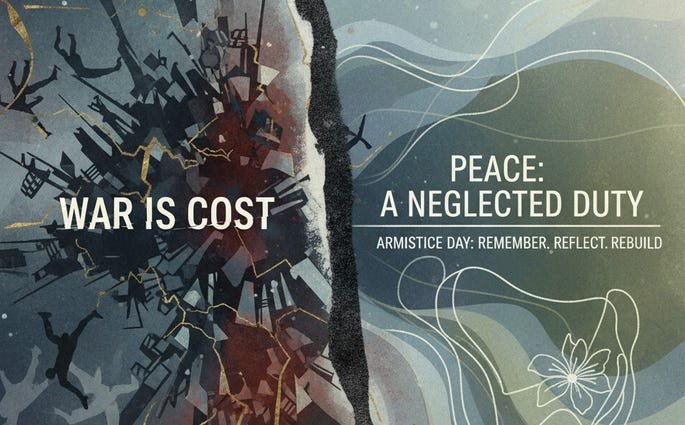
Today is Veterans Day. But before it was Veterans Day, it was Armistice Day — a day to celebrate the end of World War I. The guns fell silent at the eleventh hour of the eleventh day of the eleventh month, and the world promised: never again. That promise didn’t hold.
The wars that followed 9/11 — Iraq, Afghanistan, and the other shadow operations that spread from them, and the vaguely written war authorizations, weren’t the kind of conflicts you could come home from. They bled into everything: policy, politics, identity. They remade America in the image of fear.
I fought in those wars. I watched as they turned human beings into “targets” and hollowed out the meaning of words like “freedom” and “democracy.” We built a machine we couldn’t turn off. Guantánamo. Black sites. Drones. Renditions. We normalized surveillance, militarized our police, and let fear become a kind of religion.
Dick Cheney died last week, one of the principal architects of that era. He didn’t just wage war overseas; he helped rewire our nation to live in a permanent state of it. Now the tools we used abroad are used here, against our own citizens, immigrants, and protesters. The war came home.
I’m forty-one now, and my generation is still living in the long shadow of those choices.
The friends who didn’t make it back.
The civilians whose lives were erased.
The part of ourselves that we can’t explain to anyone who didn’t see it firsthand.
And somewhere along the way, Veterans Day stopped being a plea for peace and became another flag-wrapped ritual of forgetting.
If we genuinely want to honor veterans, we should stop making new ones for the same old reasons. We should take care of the ones still fighting battles no one can see.
And we should remember that the original spirit of Armistice Day wasn’t about glorifying war — it was about ending it.
Maybe the best way to honor that promise is to remember what war actually is — and who pays for it.
Armistice Day was never meant to glorify war. It was meant to remind us of its cost — to say “never again,” not “forever.” The founders of this country, for all their flaws, understood that liberty and perpetual war cannot coexist. They warned that the habits of war — secrecy, fear, obedience — would eat away at a republic from the inside out.
As John Adams wrote to his wife in 1797:
“Great is the guilt of an unnecessary war. But it is still greater when a nation is deluded by its rulers into war under pretence of defending its rights.”
Those words still land like a verdict. The wars that followed 9/11 were sold as acts of defense, but they reshaped what we were defending in the first place. They taught us to live in fear, to conflate dissent with disloyalty, to mistake strength for justice. The costs were human, moral, and democratic — and they’re still coming due.
So this Armistice Day, I’ll think back to that weight room in 2001, to the moment that set my life — and a generation — on its course. I’ll think about the lives lost on every side, and what it would mean to stop lying to ourselves about why, finally.
I’ll think about peace — not as an abstract hope, but as a duty we’ve neglected because democracy can’t survive without memory. And memory is what Armistice Day was meant to protect.
About the Author
Tom Baker IV is a 12th-generation American who served in the U.S. Navy and later as a civilian contractor in Iraq and Afghanistan, working alongside special operations units. His family’s line of service to the United States stretches back to the Revolutionary War.
Tom Baker IV is the publisher of Wake Forest Matters, Wake Forest’s only independent local newsroom. A Wake Forest native, Navy veteran, and intelligence professional, Tom launched Wake Forest Matters to bring serious accountability journalism to his hometown. Tips and story ideas: publisher@wakeforestmatters.com