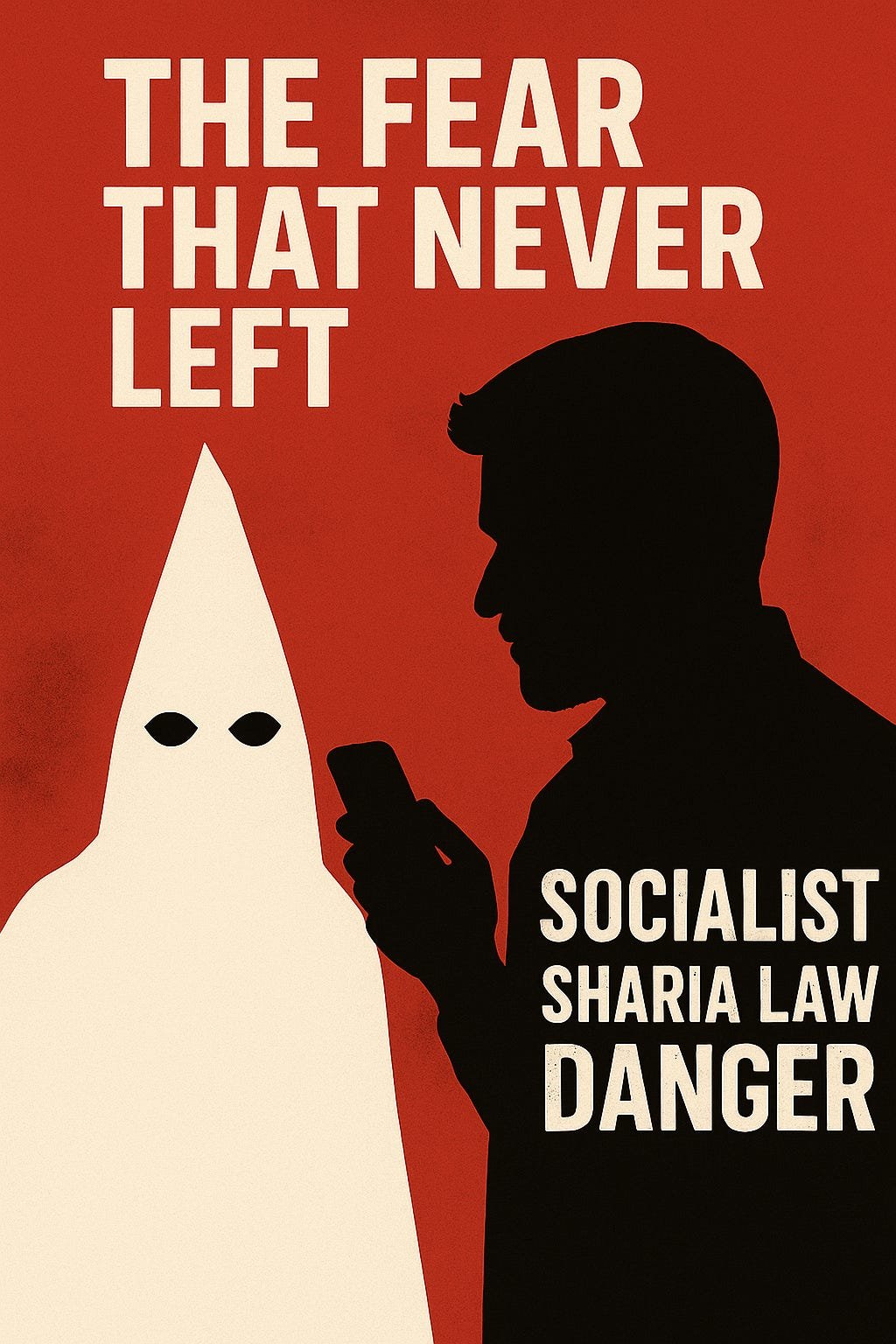
Old fear in a new form — a white hood fades into the glow of a smartphone screen. What once hid in the woods now spreads online. The message hasn’t changed; only the tools have.
In the summer of 1966, the Ku Klux Klan burned a cross in front of the Franklin County Board of Education in Louisburg—part of a wave of intimidation during desegregation fights. Stories like this happened across our state, and right here in our own backyard. A lot of this stuff never made it into the history books — but it has been passed down at kitchen tables, churches, and other places where those who are in fear seek refuge. That memory isn’t folklore. It’s a living record — proof that authoritarianism in America was never imported; it was home-grown. And today, its language has changed — but its purpose hasn’t.
The hood traded its fabric for fiber optics. The cross became a comment thread. Where mobs once gathered in the woods, they now gather in group chats. And the fear that once targeted Black families and Jewish shopkeepers now finds new masks: drag shows, trans kids, immigrants, and all those perceived as “other.”
Each panic sells the same story — that difference is danger, that safety requires control, and that control requires an enemy. It’s the same choreography with new costumes: xenophobia reborn as “patriotism,” Islamophobia disguised as “security,” transphobia dressed up as “protecting the children.” The vocabulary evolves, but the intent endures. The cross-burning, the hooded ride, the midnight engines — and now the anonymous email, the flyer on the door, the edited video clip, the call to “record minors” at a Pride event — all of this is the same anatomy of intimidation, built in the same milieu, walking the same ground.
The Old Tactics, New Costume
This month, the Wake GOP revived that tradition in digital form. Their social-media posts attacking Town Commissioner candidate Haseeb Fatmi layer three familiar tactics into one toxic bundle:
Drag Panic — recycling national “protect the children” rhetoric to cast local Pride events as indecent.
Ideological Alarmism — branding Fatmi a “socialist” who wants to “eliminate private property” or “defund police.”
Coded Fear — fueling comment sections with talk of “Sharia law” and “foreign values.”
It’s a layered strategy: moral panic, political smear, cultural xenophobia — all blended to paint one neighbor as dangerous and un-American.
As I wrote in The Anatomy of a Moral Panic, the workflow never changes: take an image, strip away context, wrap it in emotion, flood networks, and let fear do the work.
“Fear travels faster than fact — and that’s the point.”
From Red Scares to Rainbow Fears
In The Old White Hood & the Camera Phone, I traced how intimidation morphs — the hood becomes a hoodie, the cross becomes a keyboard. Today’s drag panic follows that same genealogy. Yesterday’s “communist,” “witch,” or “integrationist” has become today’s “groomer” or “socialist.” The labels rotate; the objective remains the same: to control through fear.
Post-9/11 Islamophobia provided the cultural toolkit now being repurposed. For two decades, Americans were taught to read Muslim names as threats, mosques as danger zones, difference as disloyalty. That vocabulary — Sharia, terrorist, un-American — seeped into our political reflex. Now local actors remix it: drag queens, diversity, “wokeness.” It’s the same moral panic served on fresh plates.
The Architecture of Intimidation
Across these investigations, three pillars reappear:
Shame — turning difference into danger, and outrage into currency.
That architecture once built night rides and burning crosses. Now it builds viral posts and comment threads. Authoritarianism doesn’t march with armies; it builds culture — quietly, locally, through fear disguised as virtue.
“Authoritarianism grows not from force, but from habit — from the quiet expectation that fear is normal.”
The Wake GOP’s attacks on Fatmi follow that same workflow. They fuse drag-panic emotion with post-9/11 fear coding and McCarthy-era ideological policing — all local, all intentional, all meant to discipline difference.
And as The Authoritarian Drift in Our Townwarned, this is how democratic communities begin to lose their compass: When disagreement becomes discipline, and participation starts to feel dangerous.
A Call to Conscience
This isn’t just about one candidate or one party. It’s about the moral health of Wake Forest itself.
I am calling on every candidate, every party, our Mayor, and our Town Commissioners to publicly condemn these attacks — not with hedged statements or private regret, but with the moral clarity this moment demands.
When intimidation is left unanswered, it grows. When fear becomes a campaign strategy, democracy itself becomes collateral.
Let Wake Forest say — without qualification:
HATE HAS NO HOME HERE.
The Community We Choose
Authoritarianism thrives on silence. Democracy thrives on neighbors who defend one another — even when they disagree.
Will we let fear define our future, or will we stand, visibly and vocally, for decency, truth, and shared belonging? The old hood and the new camera serve the same master: control.
Our answer must be the same as those who stood against it before us — light, courage, and community.
This is who we are. This is who we must remain.
“Wake Forest’s story isn’t finished. But the next chapter depends on whether we choose fear — or each other.”
Editor’s Note
This essay builds on prior Wake Forest Matters investigations:
The Old White Hood & the Camera Phone — the history of surveillance and intimidation in North Carolina.
The Slip, the Storm, and the Spin — how digital outrage and institutional pressure converge.
The Authoritarian Drift in Our Town — the culture of conformity threatening local democracy.
The Anatomy of a Moral Panic — how fear becomes a political workflow.
Together they form a record of how moral panic, identity politics, and intimidation have re-entered local life — and what it will take to stop them.
Tom Baker IV is the publisher of Wake Forest Matters, Wake Forest’s only independent local newsroom. A Wake Forest native, Navy veteran, and intelligence professional, Tom launched Wake Forest Matters to bring serious accountability journalism to his hometown. Tips and story ideas: publisher@wakeforestmatters.com