Wake Forest, North Carolina, is the kind of town where decisions usually happen face-to-face. I’ve lived here all my life; my family’s roots stretch back to the 1700s. In early September 2025, a single misspoken announcement at a meeting sent this small town into a week-long storm of emails, phone calls, and quiet political pressure, culminating in a public apology drafted behind closed doors.
SEBTS President Daniel Akin’s September 5, 2025, email to Mayor Vivian Jones, obtained through the North Carolina Public Records Act. Personal contact details have been removed to protect privacy.
Within a minute, Executive Vice President Ryan Hutchinson forwarded Akin’s message to Town Manager Kip Padgett with the brief note, “FYI.”
That first message from SEBTS set the stage for what came next — a statewide advocacy blast and a flood of emails that turned a single misspoken word into a week-long political storm.
Though their actions overlapped in time, the seminary and the advocacy organization operated on parallel tracks; there is no evidence that they acted in concert. Each responded independently to the same public remark.
The Email That Amplified the Mistake
At 8:02 a.m. on September 9, the NC Values Coalition, a Raleigh-based conservative advocacy organization, blasted out an email to its statewide mailing list under the subject line:
“Wake Forest is a reminder of why local elections matter.”
The message quoted the Mayor’s slip directly and claimed Wake Forest “would endure two Pride Months this year — one in June and another in October.” It encouraged supporters to “stand with Commissioner Faith Cross” and provided a click-to-contact tool that generated a prewritten email to the Mayor and commissioners.
By midmorning, Town Hall’s servers received hundreds of near-identical emails. The messages accused the town of promoting a “second Pride Month” — an issue that didn’t exist.
Pressure from All Sides
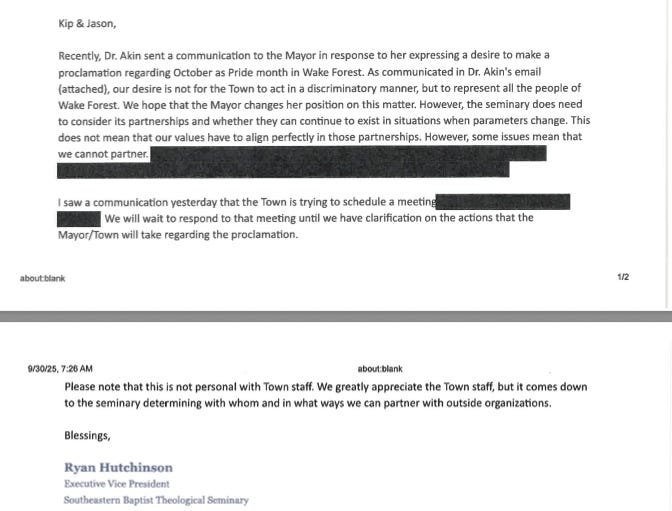
That same afternoon, at 1:58 p.m., SEBTS Executive Vice President Ryan Hutchinson emailed Town Manager Kip Padgett, writing that the seminary would “re-evaluate its partnerships with the town” if the proclamation went forward. The seminary’s influence in Wake Forest runs deep — it is one of the town’s largest property holders and a partner in development projects. By that evening, the mayor was facing pressure from two fronts: a statewide automated campaign flooding her inbox and a private warning from one of Wake Forest’s most powerful institutions.
Town-released SEBTS email (Sept. 9, 2025)
The Town’s Communications Scramble
As messages poured in, Public Information Officer Bill Crabtree began coordinating a response.
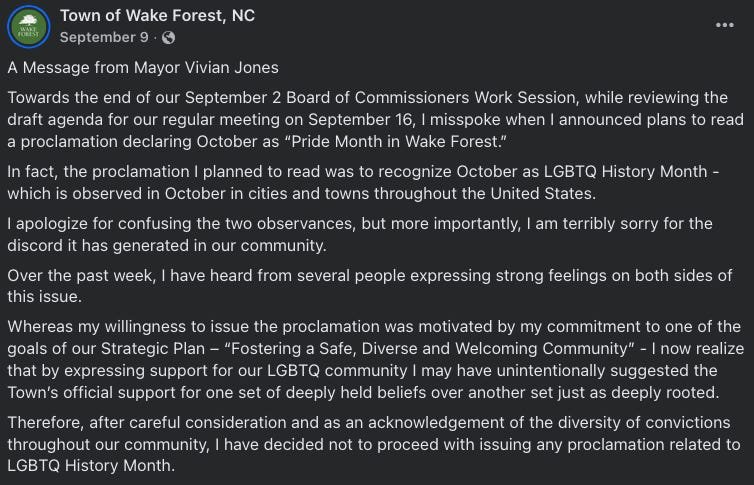
At 7:14 p.m. on Sept 9, Crabtree emailed colleagues:
“Good afternoon — I’m about to post the message at the bottom of this email on the Town’s FB page. Please let it marinate and — unless absolutely necessary — hold off on posting anything else on the Town page until tomorrow. We are aware that it will provoke a firestorm, but it must be done.”
At 8:17 p.m., he forwarded the same draft to the Mayor and Town Manager asking, “Am I ok to proceed with posting the message?”
Between Sept 9 and 12, Mayor Jones reached out by phone to Ryan Hutchinson, the seminary’s executive vice president.
By Sept 12, SEBTS President Dr. Daniel Akin followed up by email:
“Thank you for the call you placed to Ryan Hutchinson … regarding your decision to remove the proclamation from the agenda. I know this was not an easy decision, but I appreciate your willingness to listen.”
On Sept 16, the Mayor confirmed her decision to Akin by email:
“This proclamation was different; it created division and discord. It was not what was best for the Town.”
No public hearing. No public discussion. No vote
The Record and the Redactions
I began requesting public records almost immediately after the Town’s Facebook post ended the discussion.
On September 10, 2025, the day after the proclamation was effectively shelved, I filed my first records request under the North Carolina Public Records Act (N.C.G.S. § 132-1), seeking communications regarding the situation to clarify what happened.
The records released from that first request formed the foundation of this article — including the email from SEBTS Executive Vice President Ryan Hutchinson to Town Manager Kip Padgett on September 9, in which Hutchinson warned that the seminary would “re-evaluate its partnerships with the Town” if the proclamation went forward.
After receiving a redacted version of that email, I submitted a second request on October 23, asking for the complete, unredacted copy of the same correspondence, including attachments and internal Town copies.
caption…
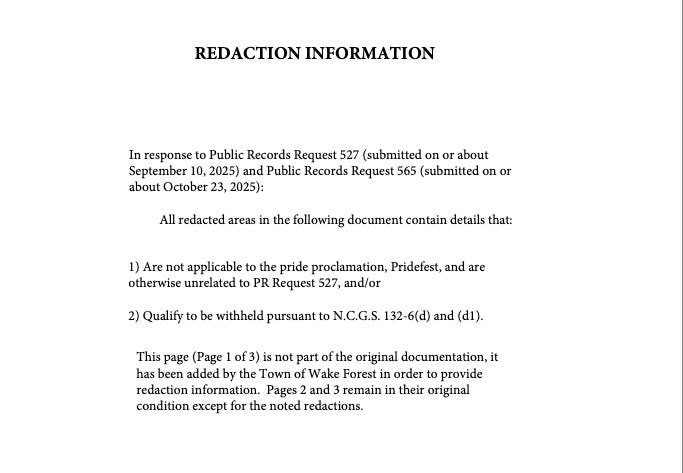
The Town’s response confirmed that portions of the message remain withheld under N.C.G.S. §132-6(d) and (d1) — provisions allowing agencies to redact information considered confidential by another law or unrelated to the subject of the request.
In a cover page attached to the release, the Town explained that redactions contained:
“Details that are not applicable to the Pride proclamation … and/or qualify to be withheld pursuant to N.C.G.S. §132-6(d) and (d1).”
The visible sections of the email show Hutchinson’s concerns about the Town’s direction, his mention of reviewing institutional partnerships, and a note that the seminary would “wait to respond” until the Town clarified its next steps.
What remains hidden — the redacted passages — is unknown. But the documents disclosed allowed for the reconstruction of the whole timeline of how public pressure and private influence converged in a single day.
Public Perception vs. Private Process
When CBS 17 covered the story with the headline
“Mayor of Wake Forest declines LGBTQ History Month proclamation amid community backlash,” it appeared to show a mayor responding to citizen input. The records tell a different story: What started as a misspoken announcement at a Commissioner’s work meeting became a statewide talking point the morning of September 9; an institutional warning arrived by 1:58 p.m.; and by that evening, the Town’s own communications team was preparing an apology they knew would be controversial.
What looked like deliberation was actually damage control.
Lessons in Modern Small-Town Power
No laws were broken. No one silenced anyone. But the timeline reveals a pattern increasingly familiar in American local politics:
A slip becomes a story before it can be clarified.
Automation turns a narrative into a deluge.
Institutional leverage translates that deluge into action or inaction.
Wake Forest didn’t turn away from inclusion; it flinched at velocity — the relentless speed with which perception can outrun fact.
Transparency Note
The records cited in this article were obtained through two formal public records requests to the Town of Wake Forest:
September 10, 2025 — Initial request filed the day after the Mayor’s Facebook post, seeking correspondence between the Town and SEBTS.
October 23, 2025 — Follow-up request for an unredacted version of SEBTS Executive Vice President Ryan Hutchinson’s September 9 email to Town Manager Kip Padgett.
The Town cited N.C.G.S. §132-6(d) and (d1) in withholding portions of that document. This report references only verified, publicly released material.
Author’s Note
My family has known Mayor Jones for most of my life. We’ve attended the same church, shared the same community spaces, and I’ve long respected her dedication and service to Wake Forest. Our recent correspondence was thoughtful and sincere, reflecting a shared commitment to the well-being of our town.
This piece is not intended as criticism of any individual or institution — not the Mayor, the Seminary, nor the advocacy organization. Each acted within their rights and convictions.
Its purpose is to document how influence moved, how perception sometimes outpaced process, and how significant decisions can take shape without public participation or visibility.
Transparency, even when it is uncomfortable, is what sustains trust and keeps a community honest, fair, and free.
Tom Baker IV is the publisher of Wake Forest Matters, Wake Forest’s only independent local newsroom. A Wake Forest native, Navy veteran, and intelligence professional, Tom launched Wake Forest Matters to bring serious accountability journalism to his hometown. Tips and story ideas: publisher@wakeforestmatters.com