The Fear That Never Left
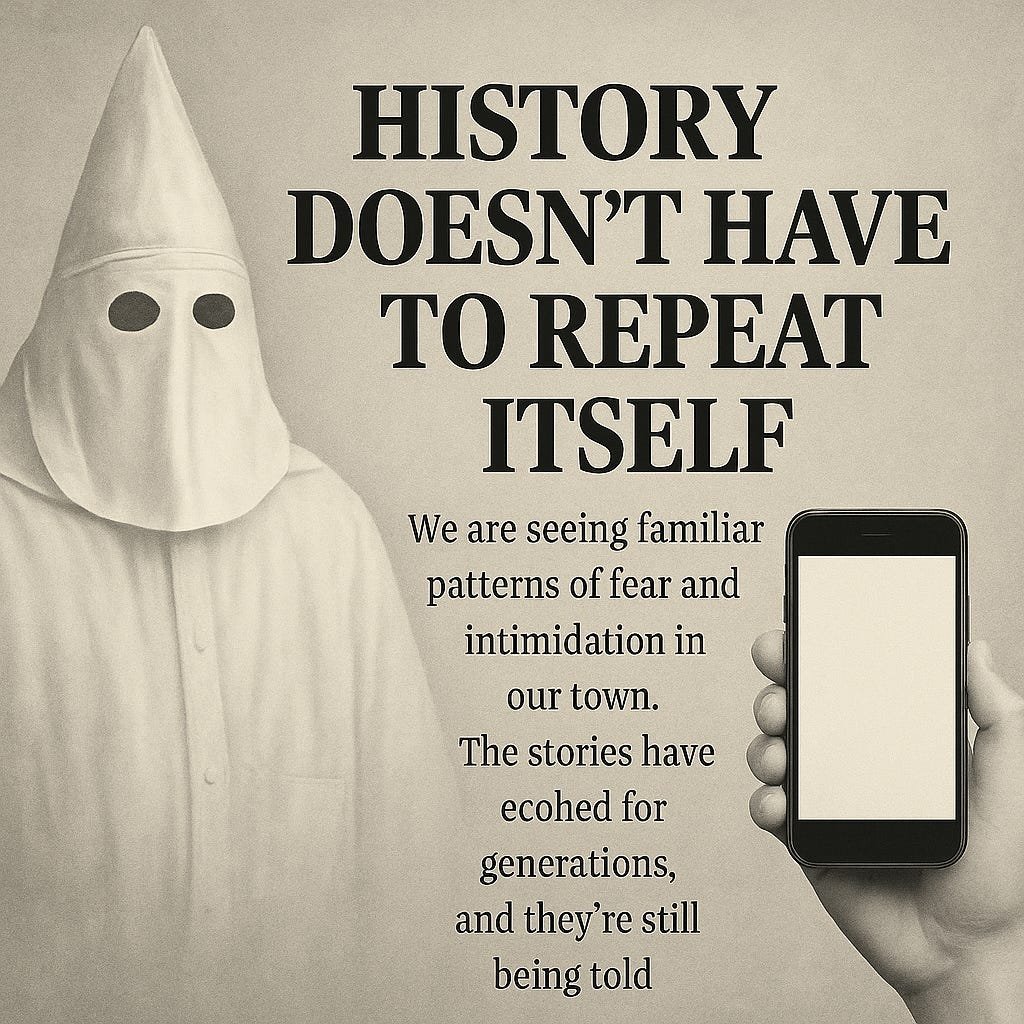
Across North Carolina, some stories never made it into the history books — stories passed quietly between generations, in kitchens and on porches.
Stories about white hoods flickering in torchlight. About meetings held after midnight in the woods. About the sound of engines idling at the edge of someone’s land.
Participants were told to film minors, log license plates, and RSVP to an encrypted ProtonMail address.
Days later, videos appeared online under titles like Children at Pride, accompanied by rhetoric describing LGBTQ residents as “indulging in a depraved lifestyle.”
The hoods are gone, but the secrecy remains.
This wasn’t journalism. It was organized intimidation — a twenty-first-century revival of the same tactics that terrorized communities a century ago.
Under North Carolina law, this conduct may be more than unethical; it may be illegal.
Chapter 14, Article 4A of the General Statutes — our “Prohibited Secret Societies and Activities” law — makes it unlawful to organize or assist any group that uses secrecy or disguise to violate or circumvent the law.
It was written to dismantle the Ku Klux Klan. It still speaks directly to this moment.
The Whisper Campaign Goes Paper and Digital
The intimidation hasn’t stopped with cameras or keyboards.
Over the past few years, small-business owners on White Street have received anonymous letters — some typed and unsigned, others written in words cut from magazines, like ransom notes.
Local publishers have found the same in their mailboxes: letters condemning them for supporting marginalized communities.
The tools may change, the hood becomes a hoodie, the burning cross becomes a keyboard, the whisper becomes a letter or webpage, but the impulse is the same: to make people afraid to be in public.
Each envelope is another act of concealment, echoing a century-old habit of hiding behind disguise and righteousness to enforce conformity. Where once intimidation came by torchlight, now it arrives by inbox and mailbox. It’s the same architecture of control — secrecy, surveillance, and shame — just written in different fonts.
The Architecture of Intimidation
Authoritarianism doesn’t announce itself with armies. It builds quietly, through culture.
Its architecture is simple:
Secrecy — coordination in the dark, justified as “protecting the community.”
Surveillance — watching neighbors, compiling names, turning the camera into a weapon.
Shame — transforming difference into danger.
That’s precisely what we just saw in Wake Forest.
A group convinced of its moral mission, organized in secrecy, using cameras, emails, and letters to police who belong in public space. Different tools. Same blueprint.
A Community Worth Defending
The laws that once dismantled the Klan were born from the same soil we stand on — laws meant to stop secret societies that used faith and fear as weapons. Yet here we are, in 2025, watching that same logic return under new names and new tools.
Authoritarianism doesn’t always arrive from above. It grows quietly, when neighbors turn on neighbors, when fear is mistaken for morality, and when harassment hides behind the language of “free speech.”
The stories our elders told — about hoods in the woods and meetings in the dark — were never just history. They were warnings. They remind us that the past isn’t gone; it waits for silence to let it grow again.
Wake Forest is a good town. But good cities aren’t immune to destructive patterns. We can shrug and say, “It’s just politics,” while secret groups film our neighbors’ children or send anonymous threats through the mail — or we can remember where secrecy and fear once led, and stop it here.
Democracy isn’t only about ballots. It’s about courage — the courage to speak, to differ, to defend each other’s right to exist without fear. The old hood and the new camera serve the same master: control.
The only antidote is community — not the kind that hides in the dark, but the type that stands together in the light.
This is who we are in Wake Forest. We stand up for each other. We protect the vulnerable. We refuse to be silenced by fear or intimidation.
When someone tries to skirt our values, we hold firm. Because belonging isn’t conditional, it’s our commitment. Let us reject the old hood, the hidden camera, the anonymous website. Let us refuse to let secrecy become strength. Let us be a town where difference is not a threat — but a truth, where kindness is not weakness — but courage, and where the only power that ever wins is the power of community, light, and shared dignity.