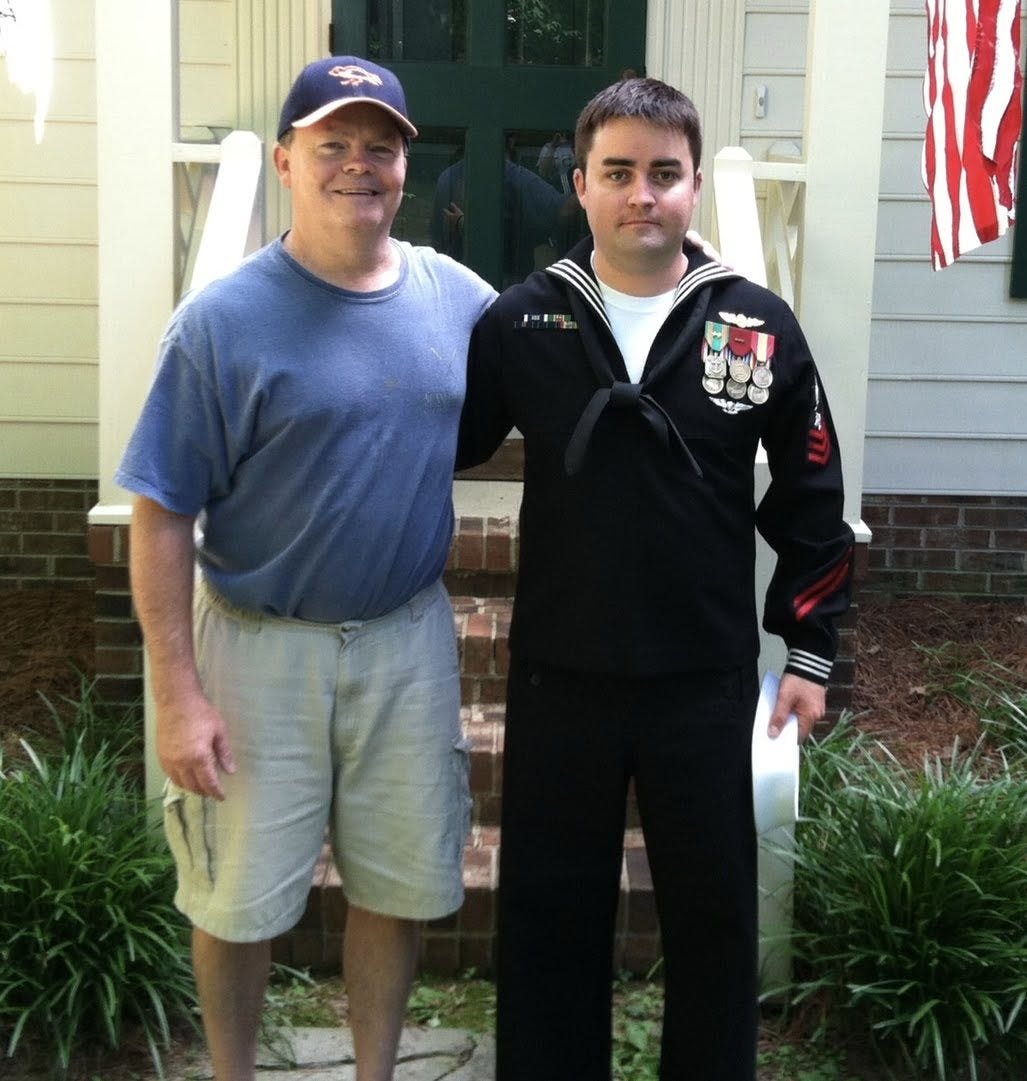
My dad (Tom Baker III) and I are in front of our family home in Wake Forest, June 2013—the last time I wore my Navy dress blues before leaving the service.
The letter from my dad was sitting on the bedside table in my childhood home, while I was on pre-deployment leave in Wake Forest, a few days before I left for Iraq in 2009. A page of plain advice in blue ink: I’m proud of you. Keep your head down. Trust your team. Come home. I was also given an envelope from a fellow Veteran who attended St. John’s. Inside was a small Episcopal Service Cross that he had carried in Vietnam, and later kept with him while working in the Pentagon on 9/11. I’m not especially religious, but I put the cross on the chain with my dog tags as a reminder that none of us truly ever walks alone.
Me with Tlyden, our Belgian Malinois working dog. Photo: Tom Baker
At the high school serving as a polling site, lines had formed early; after that morning’s attack, people still showed up. By the June 14 runoff, we were using every asset we had to escort and monitor the ballot convoys from polling sites to the central counting hubs—armed drones and other aircraft overhead, even with all of that, some convoys drew fire.
Later that year, as ISIS exploded across Iraq and Syria, the air assets we’d relied on thinned. A-10s and some F-16s were reassigned to the new fight. You could feel the difference even if you never saw the aircraft—response windows grew. I had kept the same cross in my pocket— the one sent me by a member of St. John’s.
Al Asad, Iraq, 2015 — Same fight, different map
In March 2015, I returned to Iraq, this time to Al Asad Air Base in Anbar, working against ISIS. A few weeks earlier, fighters wearing Iraqi uniforms had tried to breach the base. Iraqi forces turned them back. We felt pretty vulnerable there at that point.
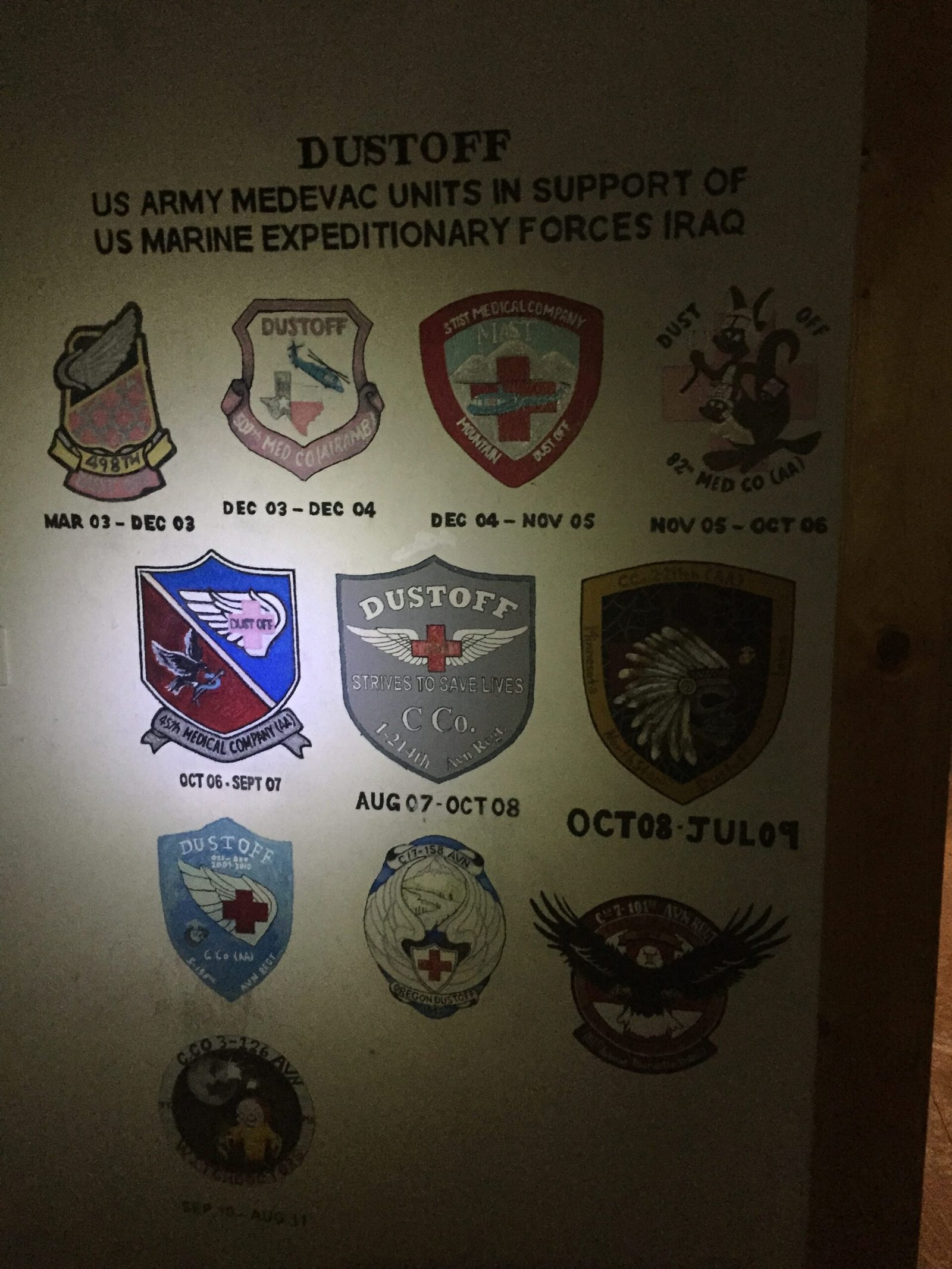
July 5, 2015: Touring the old Dustoff facilities at Al-Asad, shuttered since the 2011 withdrawal of US forces from Iraq. Photo: Tom Baker
From March through July, Al Asad became a place where Iraqi units and coalition advisors trained, coordinated ahead of a major counteroffensive to retake Fallujah, Ramadi, and then Mosul. We were there to break the back of ISIS in the Sunni Triangle in the push to eject them from the entire region. Much of my part looked like it always had—quiet, patient target development—only now the adversary had rebranded and spread. Different towns, same principle: create enough space for people to live their lives without fear.
What we fractured—and why elections matter
I don’t think we should have gone into Iraq in the first place. We broke that country, then spent years trying to stitch it back together. We did versions of the same in Afghanistan—swinging between strategies, building on shaky foundations, and too often ignoring the corruption that hollowed trust. In both places, our choices fractured institutions and identities. A key lesson: you can’t spread democracy at the tip of a bayonet.
Elections mattered in all of this—not just theirs, but ours. The people we elect decide whether we fight, how long we stay, what we fund, and who pays the price. Sometimes those choices are wise. Sometimes they’re not. And the consequences land unevenly—on civilians, on our partners, and on young Americans standing in doorways at four in the morning, hoping a light doesn’t come on. That’s why I take voting seriously: it’s the only peaceful way we have to correct course, hold power to account, and refuse to repeat the same mistakes.
What I brought home (and why I’m writing to you)
I was born and raised in Wake Forest. My family’s been here since before the United States was created. I learned how to be a neighbor from my parents, from the folks at St. John’s Episcopal, and from people all over town who didn’t have to agree with one another to show up for each other. I’ve also spent years away, in places where elections depended on whether ordinary people could make it to a school gym or a courthouse without being blown up. That changes how you look at home.
The letter from my dad and that small cross from Bob and Lynn aren’t really about religion for me. They’re about connection—family, friends, teammates, neighbors. They remind me that courage is often quiet and that the work that matters most is almost always shared.
That’s why I run this site. Wake Forest Matters is my way of bringing what I learned back to the place that raised me. I care about how we treat each other because I’ve seen what happens when communities stop believing in one another. It doesn’t usually start with violence. It starts with rumors, contempt, and the habit of turning neighbors into targets.
I’ve also seen how misinformation and the manipulation of anxiety work on people. I live with PTSD, so I know what a hijacked nervous system feels like—the jolt, the tunnel vision, the urge to react before I can think.
That’s precisely why misinformation and manufactured outrage bother me so much: they weaponize the same fight-or-flight circuitry I work hard to calm. They keep people on edge, more reactive and less reflective, and easier to steer toward extreme answers. I don’t want that for myself, and I don’t like it for this town. A healthy community helps each other de-escalate—toward patience, truth, and trust—so fear doesn’t run the show.
If you want the short version of everything I learned in Baqubah, Gardez, and Al Asad, it’s this:
Democracy is ordinary courage. It survives when people feel safe enough to show up.
Decisions matter. The leaders we elect shape lives, far away and right here at home. We owe it to each other to choose carefully and stay engaged.
Trust is protective. A town with shared facts and basic decency is harder to break than a town that lives on outrage and reaction.
Pluralism is a strength. We don’t have to share beliefs to share a future.
I still keep that little cross on my desk. It’s scratched and dull now, but the meaning holds. None of us goes alone—not in Diyala, not in Gardez, not at Al Asad, and not here in Wake Forest. If we can remember that—and act like it—then all the miles between there and here will have added up to something worth passing on.
Take the middle path. Love your neighbor. Show up.
Tom Baker IV is the publisher of Wake Forest Matters, Wake Forest’s only independent local newsroom. A Wake Forest native, Navy veteran, and intelligence professional, Tom launched Wake Forest Matters to bring serious accountability journalism to his hometown. Tips and story ideas: publisher@wakeforestmatters.com