
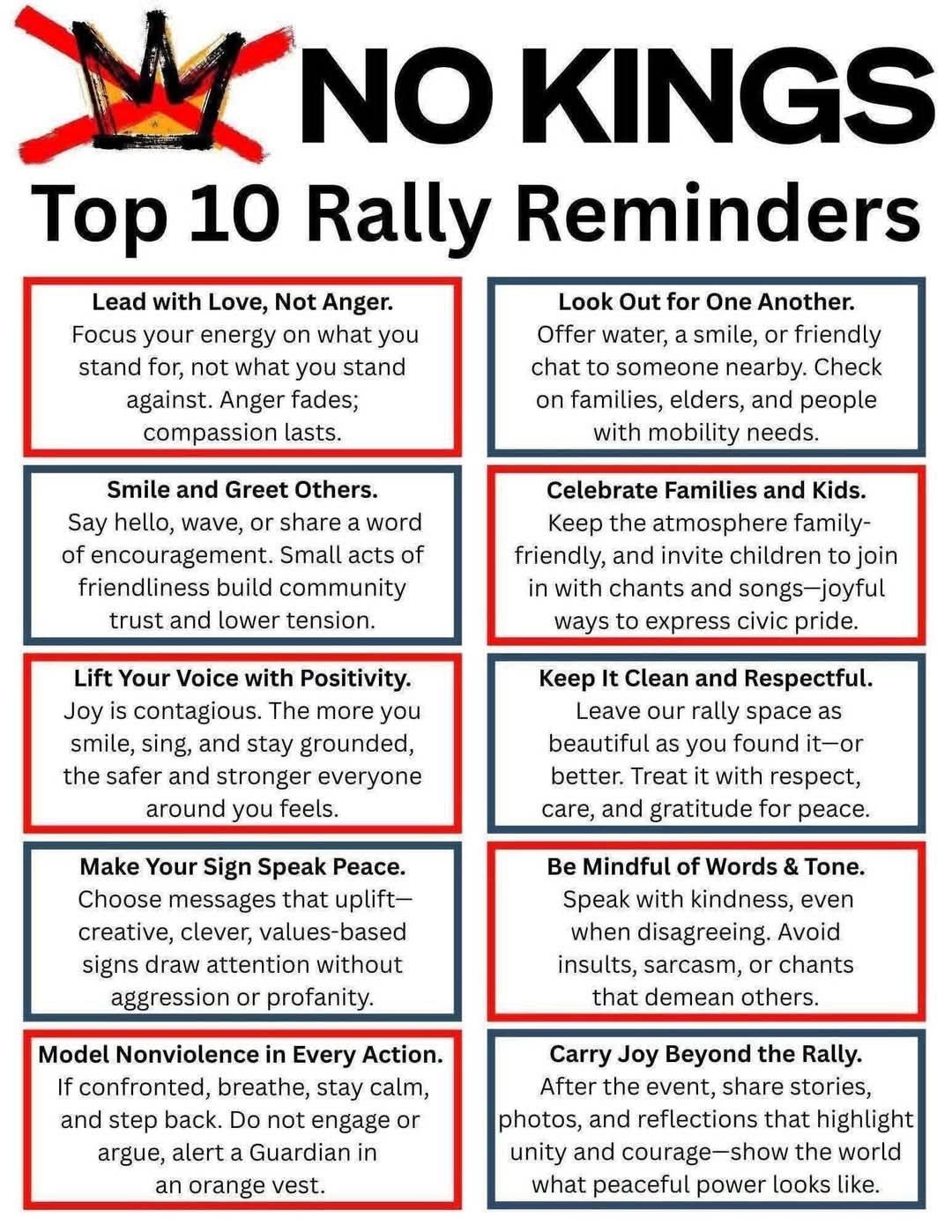
On Saturday, October 18, Wake Forest will join thousands of communities across America in the “No Kings” protest, a peaceful day of 1st amendment action to affirm that power belongs to the people, not to unchecked authority.
As a veteran and descendant of twelve generations of Wake Forest, from ancestors who fought in the Revolution and WWII to my own service in Iraq and Afghanistan, I view civic engagement as both heritage and duty. On October 18, Wake Forest will join thousands of communities nationwide in the “No Kings” protest, a peaceful affirmation that power belongs to the people, not unchecked authority. In a town growing and changing as quickly as ours, this moment is a reminder that democracy begins at the local level, in our streets, our meetings, and our shared willingness to speak with integrity and respect.
This town is changing fast: housing subdivisions are pushing outward, new schools are being built, and new residents are arriving daily. The map is remaking itself. Yet some threads endure: the college campus, downtown streets, the old trees. In moments like this, we see that change and continuity collide, and we must ask ourselves what kind of town we want to be.
What Is “No Kings”?
“No Kings” isn’t about monarchy; it’s shorthand for pushing back against centralizing power, abuses of executive authority, and erosion of constitutional norms. The movement experienced its first significant wave in June, when protests drew attention in North Carolina and beyond to federal policies perceived as authoritarian or overreaching. On October 18, organizers plan another coordinated day of peaceful protest in over 1,300 locations nationwide, including the Triangle and Wake County.
Why It Hits Home in Wake Forest
For many, Wake Forest has been a place of measured values and church influence. This town has often leaned conservative, shaped in part by the presence of Southeastern Baptist Theological Seminary. Yet growth and new voices mean more diversity in politics, faith, and priorities. While the seminary remains a powerful cultural anchor, it’s no longer the only voice in the room.
From my vantage point, rooted in this soil, hearing stories passed down through the generations, I see three interlocking reasons this protest matters here:
Guarding civic norms in a community in flux. As we wrestle with issues of development, municipal authority, and local elections, we must also protect the rules that allow a town to govern fairly, not by force or favor. A protest like “No Kings” is a reminder that residents, not distant power, deserve the last word.
Remembering our roots of resistance. My ancestors fought tyranny here during the Revolutionary War, believing that no monarch should rule over a free people. That ethos is not just ancestral lore; it is a reminder that vigilance is part of citizenship, not a hobby.
Welcoming newcomers into shared civic responsibility. If you’ve recently moved here (or plan to), let October 18 be more than a demonstration, let it be a beginning—a chance to elevate your voice, alongside longtime neighbors in unity.
Questions to Ask Ourselves
Who speaks on our behalf? In Wake Forest, voices from the seminary, local pastors, town commissioners, and business leaders all carry weight. A protest is one more voice. How will it be heard (or ignored)?
What is the role of moral witness vs. political action? A community grounded in Scripture might see protests as moral testimony. For others, it might be seen as politics. Can we hold both tensions without descending into tribalism?
How do we protect the democratic space in our everyday town? Protesting is only one expression. The deeper test is in how we engage in zoning debates, town meetings, school boards, and community events.
Will this protest change relationships? Some neighbors will disagree. Some will cheer. Some might feel uncomfortable. That’s part of citizenship. How do we respond graciously?
What is the seminary’s role in this moment? Southeastern Seminary rarely uses its institutional muscle overtly in town politics. But its moral heft and local networks give it quiet influence. Will those networks respond to or ignore this protest?
A Call to All in Wake Forest
If I may speak to my neighbors, those whose roots are deep and those who have newly arrived:
Join if you feel led. Stand with your sign, or show up. Even presence matters in a place where silence is sometimes mistaken for consent.
Be respectful. This is not about confrontation but about conscience and community.
Engage afterward. Don’t let the moment vanish. Attend town meetings where policy is debated. Vote in the upcoming municipal elections. Talk to your neighbors about what matters to you.
Remember: the power of a town is in its people, not its wealth, not its institutions, not its elites.
On October 18, in Centennial Plaza, neighbors will stand side by side. Some could consider it a small moment, but, in a fast-changing town, small moments accumulate. They sketch the boundary between what we permit and what we resist. They remind us that civic life is never passive.
We belong to this town. We will not surrender our voice.
Tom Baker IV is the publisher of Wake Forest Matters, Wake Forest’s only independent local newsroom. A Wake Forest native, Navy veteran, and intelligence professional, Tom launched Wake Forest Matters to bring serious accountability journalism to his hometown. Tips and story ideas: publisher@wakeforestmatters.com