
If you want proof of what happens when a community plans well, look at the data: in February 2026, Wake Forest was named the #1 most sought-after suburb in America. We have nearly five times as many people looking to move into our town as leave.
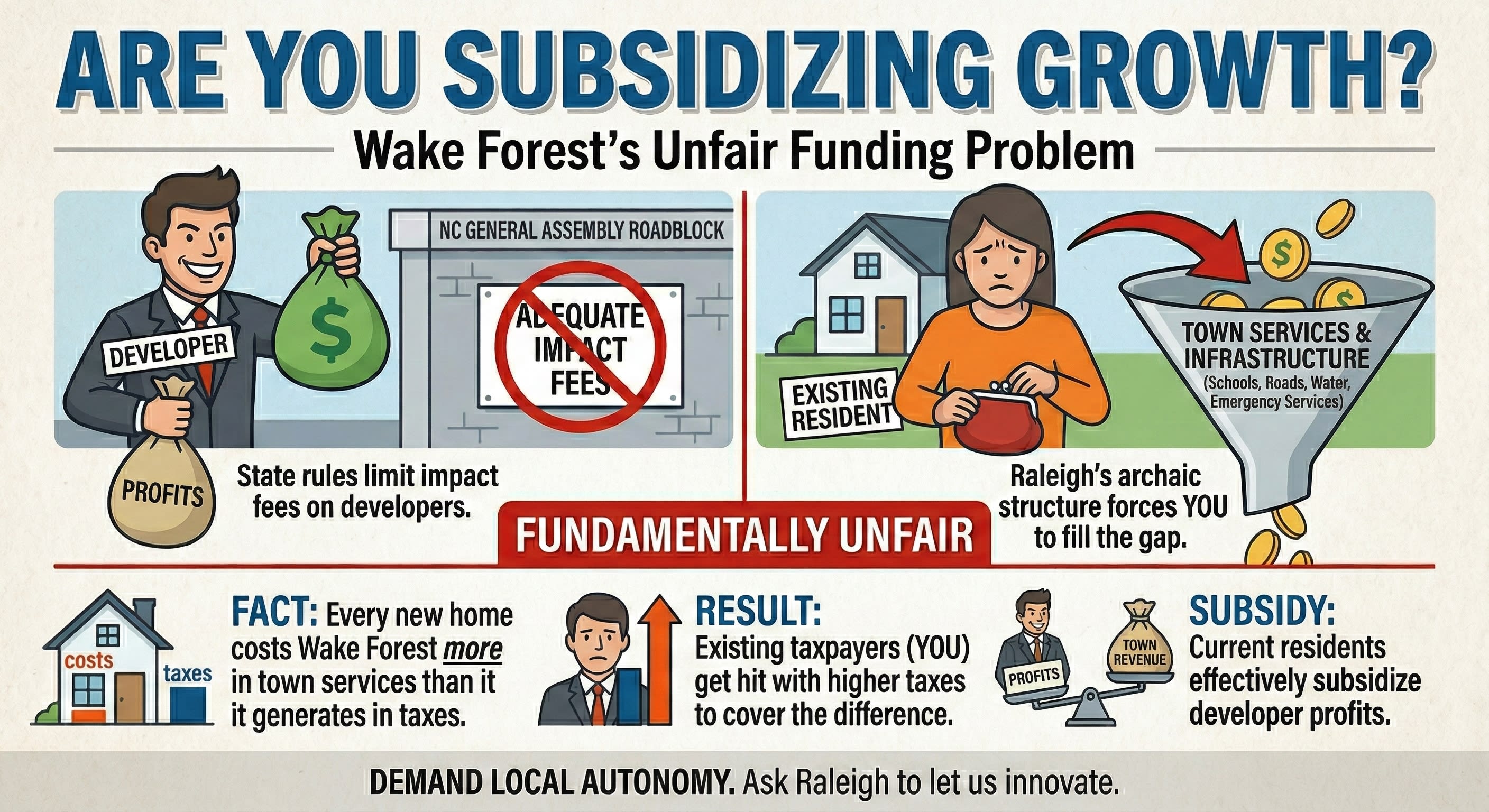
But this unprecedented success has exposed a fatal flaw in how our town is governed. State restrictions out of Raleigh make it impossible for us to plan, build, and adapt at the speed necessary to meet our explosive growth. And because the state holds all the cards, the people who already live here are being forced to foot the bill.
It is time to reform a broken system so that growth actually pays for itself. Right now, because of state roadblocks and rigid tax structures, we are effectively subsidizing our own sprawl. Here is how:
Impact Fee Deficit
Every time a new subdivision is built, it requires roads, schools, water, and emergency services. In a fair system, developers would pay impact fees that cover the true cost of this new infrastructure.
But the NC General Assembly tightly restricts the town’s ability to levy adequate impact fees. The result? Every new house costs the town more in services than it generates in traditional property taxes. To make up the difference, existing Wake Forest taxpayers are hit with higher taxes to subsidize developer profits. It is fundamentally unfair.
Planning Chokehold
To manage our growth responsibly, we need agility. But state lawmakers consistently meddle in local affairs. Look no further than the Hurricane Helene Disaster Recovery Act of 2024, which included a developer-backed provision that essentially bans local governments from “downzoning” without unanimous consent from property owners. If we want to update our Unified Development Ordinance (UDO) to require better design standards or wider sidewalks, the state has paralyzed our planners. Rapid development continues under outdated zoning rules because Raleigh won’t let us adapt.
Right now, legislative efforts are underway to fix this mess. Our local State House Representative, Mike Schietzelt, has introduced H.B. 225, a ‘local bill’ tailored specifically to restore downzoning authority for Wake Forest and Rolesville. This targeted approach is likely our fastest route to removing the state-imposed chokepoint.
Simultaneously, Rep. Schietzelt is sponsoring a broader statewide bill (H.B. 24) to repeal this disastrous provision for every municipality in North Carolina. While H.B. 24 is the ultimate goal, it faces a steeper climb through the legislature. Historically, tailored local bills gain support more easily because they address specific community needs without triggering opposition from across the state. By focusing on Wake Forest and Rolesville first, we can secure an immediate win while the broader battle continues in Raleigh.
While we should enthusiastically support these bills, we must recognize them as stop-gaps. If we have to rely on surgical, one-off legislation every time Raleigh’s mandates derail our planning, we will always be fighting from our back foot. We don’t just need a temporary legislative patch; we need the inherent autonomy to make zoning decisions locally.
Antiquated Tax Structure
We don’t just need the freedom to zone properly; we need the freedom to innovate how we collect revenue. Currently, the state forces us into a traditional property tax system that penalizes improvement. If you build a big, beautiful new business or improve your home, your taxes go up. Meanwhile, speculators can sit on vacant, prime land, paying pennies in taxes while waiting for the town’s growth to drive up their property value.
If Wake Forest had true local autonomy, we could pioneer a transition to a Land Value Tax. By taxing only the value of the land, rather than the buildings on top of it, we would instantly incentivize smart, dense, beautiful development and penalize land speculation. It is a pro-growth, pro-fairness reform. But under current state law, we aren’t allowed to try.
Tax-Exempt Footprint and the Case for a PILOT
This rigid tax system also blindsides us when it comes to our largest landholder: Southeastern Baptist Theological Seminary (SEBTS). The seminary is a vital part of Wake Forest’s identity and a valuable strategic partner. However, because of their religious and educational status, they own a massive footprint of prime, downtown real estate that generates zero property tax revenue.
While the Seminary collaborates with the town through the Wake Forest Business & Industry Partnership (WFBIP), an entity largely funded by our tax dollars, the stark reality is that regular residents are picking up the tab for the infrastructure, amenities, and services that support prime downtown land. This heavy shift in the tax burden is crushing our seniors and retirees on fixed incomes, forcing them to subsidize the very amenities that drive our town’s growth.
Other towns with massive tax-exempt footprints address this through formal Payment In Lieu Of Taxes (PILOT) programs, in which large institutions voluntarily contribute to the municipal services they consume. We need the local leverage, flexibility, and autonomy to forge a robust PILOT agreement with SEBTS, ensuring that the cost of our world-class town doesn’t fall squarely on individual homeowners.
Path Forward
Wake Forest has proven it knows how to build a community people desperately want to live in. But we cannot tackle 21st-century growth with a regulatory straitjacket tied by legislators who don’t live here.
We need the state to get out of the way. We need the power to levy fair impact fees, the authority to zone our own neighborhoods, the freedom to experiment with smarter tax structures, and the leverage to build equitable partnerships with our largest institutions. It is time for Raleigh to untie our hands, let us innovate, and allow the people of Wake Forest to build the future we are currently paying for.
What You Can Do: Our town’s future depends on us taking back the steering wheel. Contact Representative Mike Schietzelt to thank him for H.B. 225, but urge him to fight for broader, permanent local autonomy. Reach out to the Wake Forest Mayor and Board of Commissioners and tell them you support a PILOT program for tax-exempt land. Most importantly, share this with your neighbors so we can build a coalition that demands growth pays for itself.
Tom Baker IV is the publisher of Wake Forest Matters, Wake Forest’s only independent local newsroom. A Wake Forest native, Navy veteran, and intelligence professional, Tom launched Wake Forest Matters to bring serious accountability journalism to his hometown. Tips and story ideas: publisher@wakeforestmatters.com