

The Wake Forest Board of Commissioners convenes this Tuesday, February 17, at 6 pm at Town Hall (301 S. Brooks Street). A close analysis of the agenda reveals a pivotal moment of transition. The Town is moving from a phase of simple “growth accommodation” to one of “strategic control.” We are approving massive infrastructure bills to harden our capabilities, pulling new neighborhoods into the tax grid to capture the value of urbanization, and simultaneously celebrating the careers of three dedicated public servants who built the foundation for this success.
Here is your deep dive into the four critical stories behind the agenda items, framing the financial decisions against the human history of a town that has grown from a quiet village into a bustling city.
For the agenda and agenda packet, as well as other public meeting information, see the Public Meetings Portal on the official Town of Wake Forest (ToWF) website.
1. The Sticker Shock That’s Actually a Deal
The most fiscally significant item of the night is a resolution to borrow up to $18 million to fund the construction of Fire Station #6. The Board is set to approve a Guaranteed Maximum Price (GMP) of $18,553,907 with Edifice, LLC, for the station on Wait Avenue.
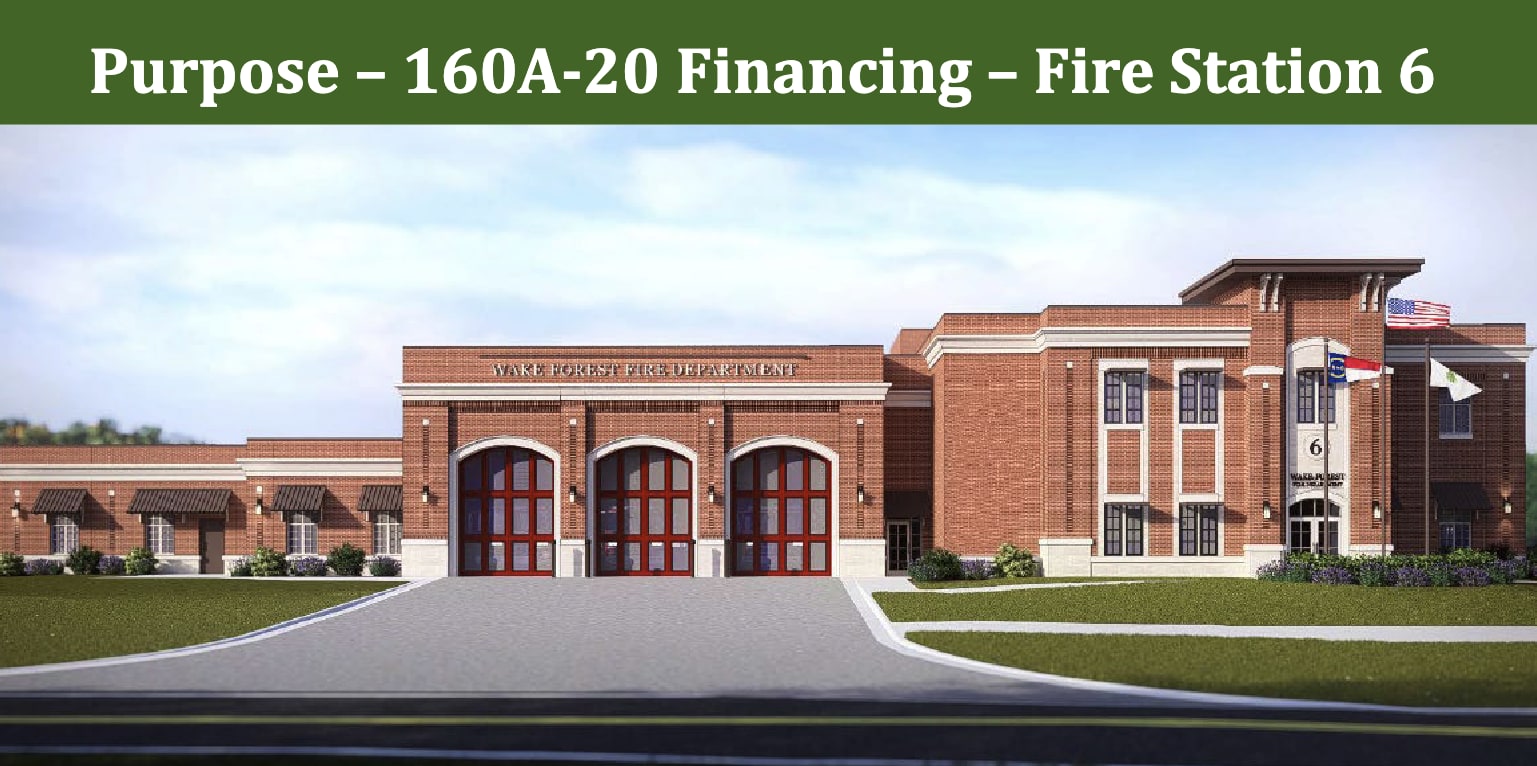
To the casual observer, $18.5 million for a single municipal building might seem inflated. However, when contextualized against regional data, Wake Forest is securing a bargain.
The Competitors: Neighboring Durham is currently navigating a fire station project with a budget swelling over $29 million due to renewable energy requirements. Zebulon recently broke ground on a joint facility with Wake County, costing approximately $17 million.
The Strategic Asset: Wake Forest’s contract includes a differentiator those stations lack: a “burn tower” for live-fire training, costing roughly $1.3 million. By building this on-site, the Fire Department internalizes training, reducing the overtime costs and logistics of sending crews to county academies. Notably, the town plans to use fire impact fees, not just general tax dollars, to fund this specific training asset.
The Hidden “Tax Cut”:
Critics of the debt should note the financial flipside. This station is mandatory to maintain the Town’s ISO Class 1 Fire Rating as we expand north. Achieving a Class 1 rating is a milestone reached by less than 1% of departments nationwide. It keeps homeowner insurance premiums significantly lower than in Class 3 or 4 districts. In effect, the tax dollars spent on this station are a defense against a potential hike in your private insurance bill.
2. The “Missing Middle” Resurrection: The Villas Annexation
Buried in the planning agenda is a public hearing on a contiguous annexation of 2.36 acres at 12751 Wake Union Church Road. Submitted by “The Villas at Wake Forest Crossing LLC,” this item tells a story of perseverance in the housing market.
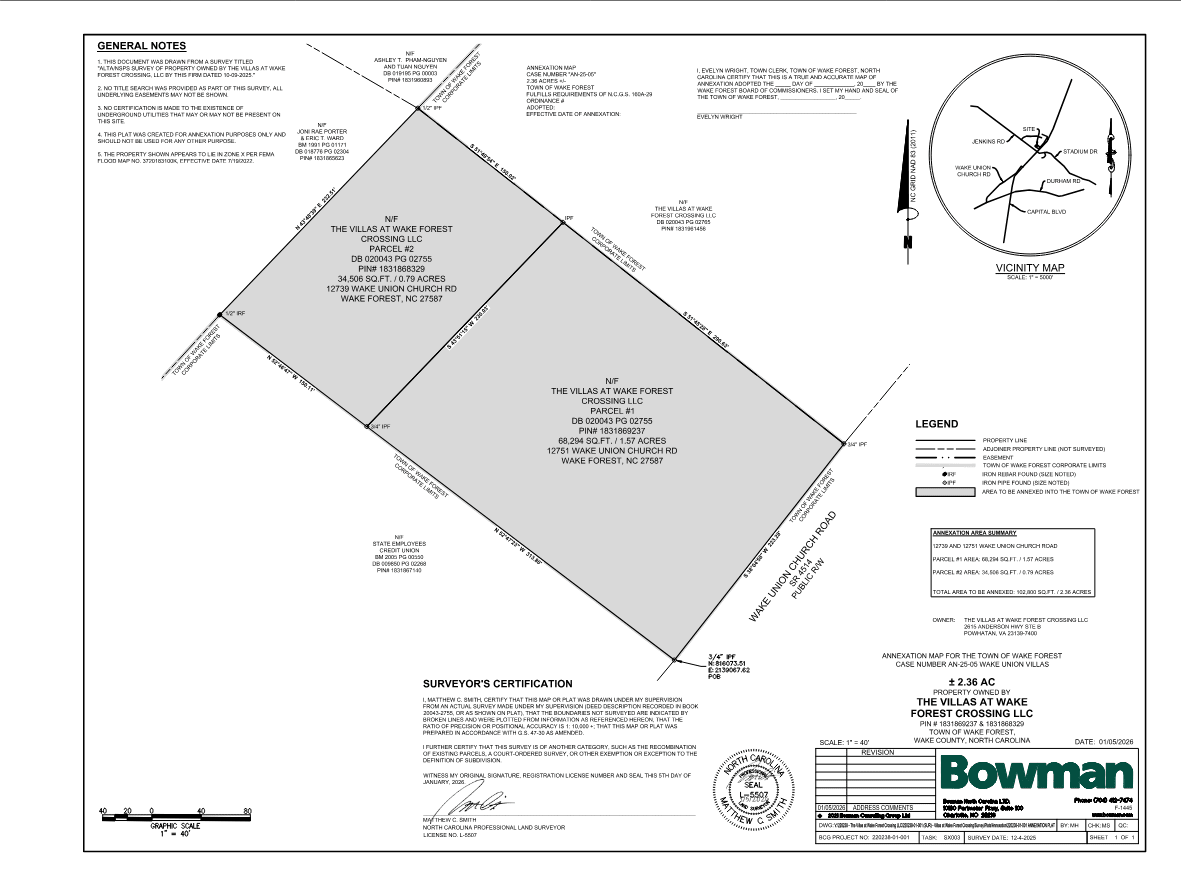
Long-time residents may recall that a project with this name, promising affordable senior housing, was proposed for this site back in 2018. It stalled as construction costs soared, entering the “Valley of Death,” where subsidies couldn’t keep pace with inflation.
The reappearance of this item suggests a resurrection fueled by intergovernmental partnership. While the County provides financial subsidies, the Town is using this annexation to provide the necessary utility infrastructure. Tuesday’s hearing is the moment to confirm that this project remains committed to the original vision of affordable senior living, a critical need in our housing ecosystem.
3. Redrawing the Downtown Map (and Tax Bill)
The most direct hit to residents’ wallets comes from the expansion of the Municipal Service District (MSD). The Board is holding a public hearing to pull 150 new properties, including the Heath Ridge neighborhood and 38 condo units, into the downtown tax zone

Property owners in this zone will pay an additional $0.14 per $100 valuation. For a typical single-family home in the expansion area, town staff estimates that this adds an extra $450 to $600 to the tax bill each year.
This move aligns with the 2024 Downtown Plan, which signaled a shift to “benefit taxation.” As Downtown Wake Forest evolves into a lifestyle center, residents, not just shoppers, are the primary users of the streetscape improvements, safety ambassadors, and decorative lighting funded by this tax. The Town argues that it is no longer equitable for commercial owners to subsidize solely the amenities that drive residential property values.
4. Bravo Zulu: A Legacy of Service
Perhaps the most significant item on the agenda isn’t a building or a tax, but a celebration of service. The Board will present resolutions of appreciation to three retiring staff members who have guided Wake Forest from a quiet village to a thriving city.
These three aren’t just retiring; they are leaving the town infinitely better than they found it. Their resolutions reveal careers defined by longevity and specific acts of dedication that held the town together during its most fragile growth spurts.
Randy Driver (Purchasing Manager): When he began his career on February 22, 1990, as an Inventory Clerk, Wake Forest’s population was just 5,769 people. Over 36 years, he rose to become the Purchasing Manager. His resolution notes that he kept a “watchful eye on spending public funds,” but his service went far beyond the ledger. Driver was a critical behind-the-scenes figure, working tirelessly during “water main breaks, power outages, ice storms, and hurricanes” to ensure crews had the materials they needed to restore the town.
Lt. Jeremy Morris (Police): Joining the force in June 1997 as a Police Officer I, Lt. Morris served a town of roughly 10,000 people. Over his 29-year career, he wore nearly every hat in the department: patrol officer, field training officer, evidence custodian, and tactical service unit member. He retires as the Criminal Investigations Division Commander, having spent nearly half his career leading the unit that solves the town’s most serious crimes. To honor his service, the Board will vote to surplus his badge and service weapon and gift them to him as a tribute to his decades of protection.
Donny Ray Carroll (Right of Way Supervisor): Even when Carroll started in 2009, the population was roughly 27,700—less than half of what it is today. Rising from Maintenance Worker to Right-of-Way Supervisor, he became a “mentor and role model” to his peers. The resolution highlights a unique contribution: he became a “familiar face” at the Wake Forest Cemetery, where he served as a repository of “historical knowledge and background for many families”. His work ensured that as the town grew, it never lost respect for those who came before.
Collectively, these three professionals take with them over 80 years of experience. They worked through the relentless pressure of growth that saw the town swell to its current estimate of over 60,000 residents. They built the systems, solved the crimes, and maintained the history that the current staff will now carry forward.
In the Navy, the signal flags for “Bravo Zulu” convey a simple, powerful message: “Well Done.” It is a fitting commendation for careers defined by such dedication. As Wake Forest navigates its new reality of $18 million fire stations and complex tax districts, we wish these three steady hands “Fair Winds and Following Seas” as they embark on their next chapter.

Meeting Details:
The Board of Commissioners meets on Tuesday, February 17, 2026, at 6:00 PM in the Town Hall Board Chambers. The meeting is open to the public and includes a public comment period.

Tom Baker IV is the publisher of Wake Forest Matters, Wake Forest’s only independent local newsroom. A Wake Forest native, Navy veteran, and intelligence professional, Tom launched Wake Forest Matters to bring serious accountability journalism to his hometown. Tips and story ideas: publisher@wakeforestmatters.com