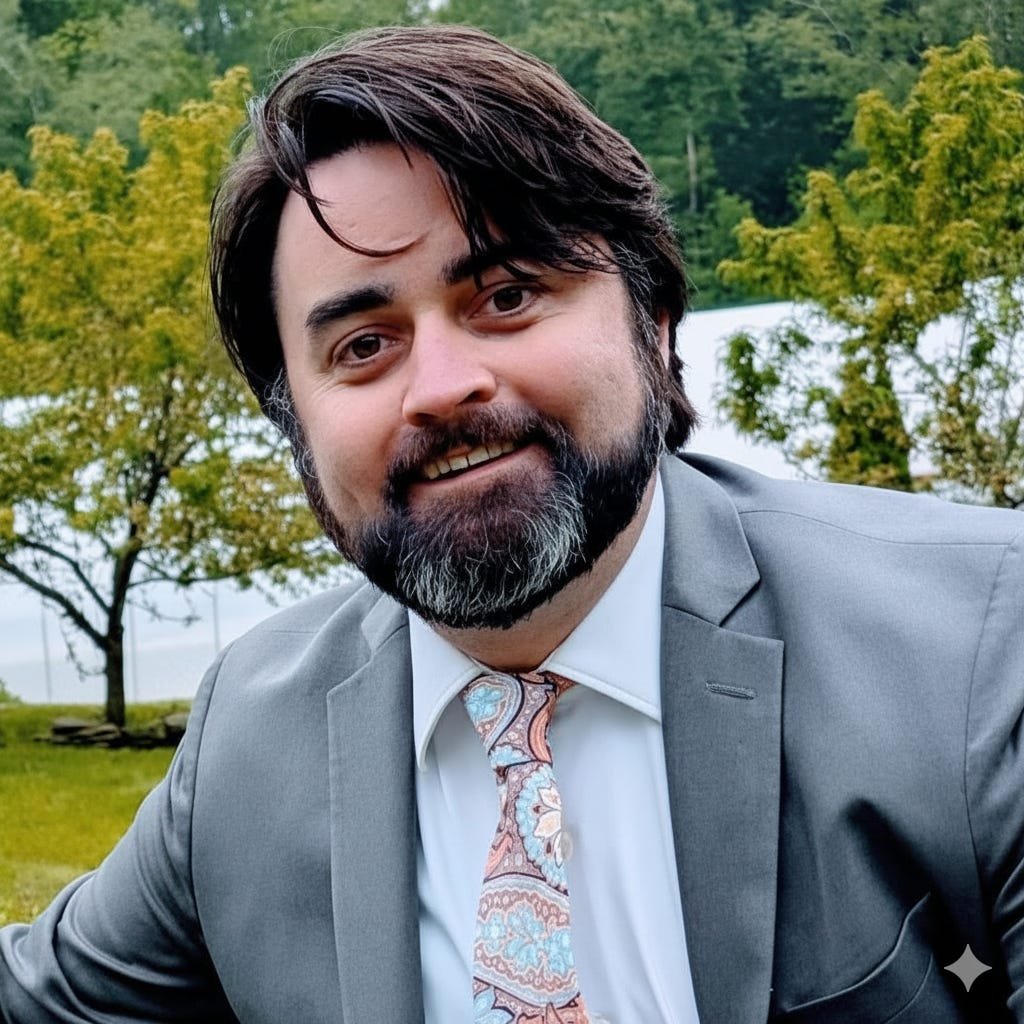
I’m Tom Baker IV, founder and editor of Wake Forest Matters.
Today I’m making something official: I’ve formed Wake Forest Matters, LLC, an independent local-news company dedicated to reporting our town’s public life with clarity, courage, and receipts.
A Family Measured in Service
My family has lived on this ground for twelve generations. The Bakers, Harrises, Cliftons, and Timberlake homesteads are still standing in Franklin County. That continuity is real, and so is the more complicated truth behind it: our family’s land and prosperity were built in part on the forced labor of enslaved Africans.
I won’t soften that; it’s a moral fact I carry into this work.
The line runs long. My ancestors fought in the Revolutionary War, defended liberty in World War I and World War II, and taught their children that service is a covenant, not a boast. I followed that line into the U.S. Navy, serving globally — in the skies, on land, and at sea.
I began as an avionics technician and later worked in intelligence collection and analysis with special operations task forces. I flew as an electronic-surveillance operator on the EP-3, supporting the national command authority.
After active duty, I deployed again as a civilian contractor — in Iraq and Afghanistan alongside SEAL, SF, Marine, and SAS elements — helping push back ISIS from Ramadi, Fallujah, and Mosul.
I’ve seen the cost of broken institutions. I don’t believe we should have gone into Iraq; we fractured more than we understood and spent years trying to stitch it back together. We repeated versions of that mistake in Afghanistan — swinging strategies, building on sand, ignoring corruption. You can’t spread democracy at the tip of a bayonet. But you can learn what keeps it alive.
In Diyala / Baqubah (2009–2010), bombs tried to silence voters, yet four days later, purple ink marked fingers.
In Gardez (2014), rockets fell near polling sites, but ballot convoys still rolled.
At Al Asad (2015), quiet, patient work helped free towns block by block.
Those years taught me that democracy is ordinary courage — a neighbor showing up despite fear.
The Way of This Place
Wake Forest isn’t just coordinates on a map — it’s continuity layered over change. Pine pitch in July, clay under your nails, the drawl of a porch story that’s lasted a hundred summers. Hammers now echo where tobacco once hung in barns, and the quiet hills keep watch over us still.
This land remembers. Creeks, ridges, mailboxes, corner stores — they hold a ledger of how we treat one another. Around here, reputation travels faster than rumor, and grace lasts longer than outrage. My elders taught me that before you judge a person, you’d better know their people, their work, and their heart. That rhythm of slow judgment, plain speech, and earned respect is worth keeping.
Those who’ve just arrived are part of this story now. Bring your hopes and your histories — we need both. But there’s a way of this place that matters: don’t take more than you give. Learn the backroads before you redraw the map. Honor the ones who came before; invest in the ones who’ll come after.
We’ve always been a town of thresholds — from farm to college, from mill village to tech corridor. The soul of Wake Forest isn’t measured in property values or traffic counts; it’s measured in whether we can still look each other in the eye, agree to disagree, treat each other with respect, and adhere to the norms and the democratic process.
I do this work in the entrepreneurial spirit of my namesake, James Thomas Baker Sr., who once ran the general store on Main Street in downtown Youngsville. He served neighbors not just with goods but with trust — knowing a store was more than commerce; it was a connection. What he built with a counter and a handshake, I’m building now with reporting, daylight, and a public record.
The Long Quiet Ground
Out near Louisburg, down a pine-lined road once hushed and open, my father and I maintain a family cemetery whose oldest stones date to 1730. The pines are thinner now — development edging closer — but the ground still holds steady.
The cemetery sits near Harris Chapel Baptist Church. The land for that church was donated by A. J. P. Harris, whose family cemetery I now help tend — the same ground where my grandparents and great-grandparents are buried.
I go there to cut grass, clear limbs, and place wreaths at Christmas.
It’s where the earliest Bakers and Harrises rest, and we’ll keep caring for it in perpetuity.
Near the plot are hand-cut granite line markers, almost swallowed by roots — reminders of when land was measured not by speculation or survey drones but by sweat and witness.
That ground teaches humility and proportion. It reminds me that our duty isn’t just to preserve the past, but to hand the place forward in a condition worthy of those yet to come.
That same duty guides Wake Forest Matters — not nostalgia, but stewardship.
The Church That Raised Me
I grew up in St. John’s Episcopal Church, a brick sanctuary filled with sunlight and the sound of hymnals and creaking pews. Those people taught me what it means to love your neighbor — not as a slogan but as a daily practice. They were the ones who showed up when the Athey plant closed days before Christmas, when a family struggled, when the world felt mean.
They welcomed everyone — farmers, professors, single parents, newcomers still finding their footing. I’m proud of that tradition and the church that continues to show up and welcome all. Because around here, “y’all” means all.
That spirit carries into Wake Forest Matters. To report fairly is to love the neighbor — to tell the truth even when it’s hard, to hold power accountable without malice, and to keep the circle wide enough for everyone who calls this place home.
Lessons Brought Home
Democracy is ordinary courage.
In Baqubah, it was a voter stepping through a checkpoint; here it’s an election worker opening the gym at 5 a.m., a neighbor refusing to share a lie, a parent choosing facts over fury.
Decisions matter.
One order ripples through a village; one town commission board vote reshapes a town’s map.
Trust protects.
Shared facts are civic armor.
Pluralism is a strength.
Marines, SAS, Iraqis, Afghans — different creeds, one mission.
Wake Forest doesn’t need uniform beliefs; it needs rules, institutions, and truth sturdy enough to hold disagreement.
I live with PTSD, so I know what a hijacked nervous system feels like — the jolt, the tunnel vision, the urge to react before thought. That’s why misinformation and manufactured outrage bother me: they weaponize the same circuitry. A healthy town helps each other de-escalate — toward patience, truth, and trust — so fear doesn’t run the show, we stand up to bullies and those who threaten any of us, because an injury to one is an injury to every person in this town.
Why Incorporate Now
Because form follows function, if the mission is public-interest reporting, the vehicle must support it — clean finances, accountability, durability, and a firewall between journalism and everything else. An LLC lets me put that promise in writing and keep it.
“Sunlight, stories, and community strength are how a town stays free.”
We keep that right here — with documents, daylight, and neighbors who still believe truth is worth the work.
Join Me
Subscribe for free
If you can, make a monetary pledge of support — you’ll help me expand my tech stack, underwrite records requests, transcriptions, and time on the ground.
Send tips, documents, or corrections to wfm@wakeforestmatters.com
The mission now is civic, not kinetic: keep the facts straight, keep the doors open, keep faith, stand for all in Wake Forest.
This is Wake Forest Matters.
Let’s get to work.
— Tom Baker IV
Founder & Editor, Wake Forest Matters, LLC
Tom Baker IV is the publisher of Wake Forest Matters, Wake Forest’s only independent local newsroom. A Wake Forest native, Navy veteran, and intelligence professional, Tom launched Wake Forest Matters to bring serious accountability journalism to his hometown. Tips and story ideas: publisher@wakeforestmatters.com