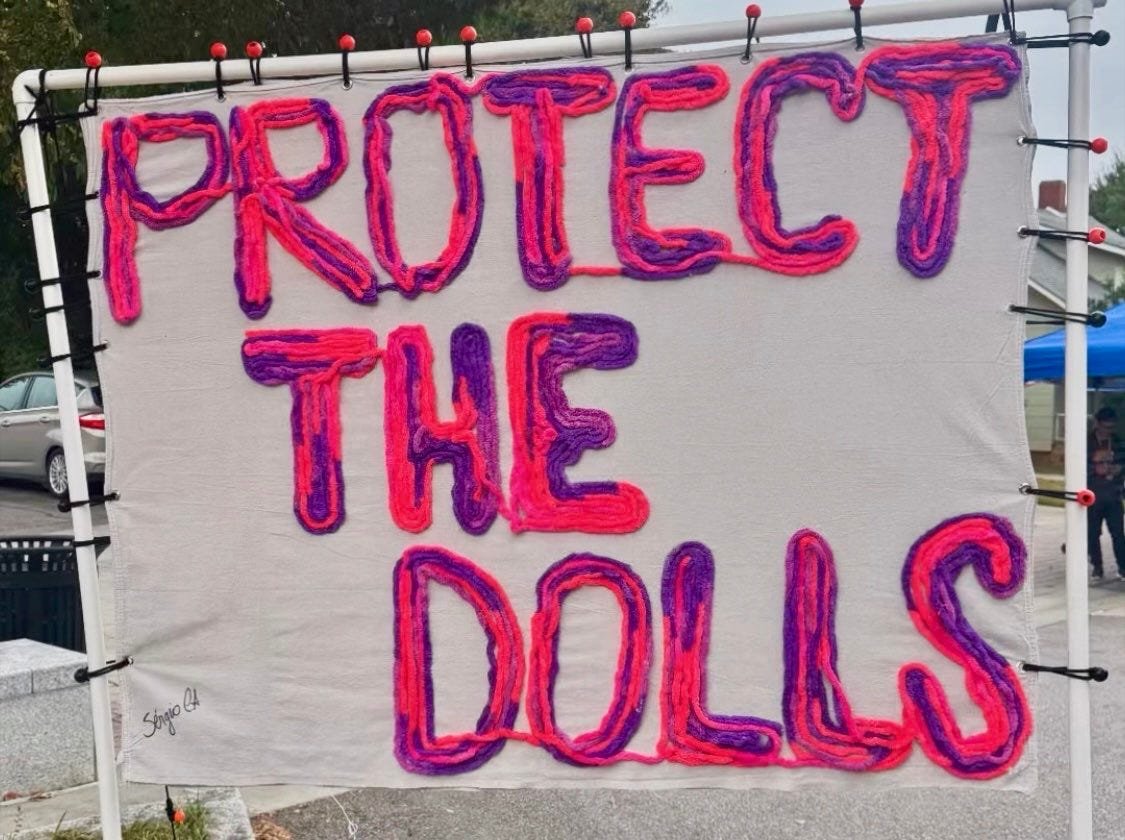
More than 4,000 people filled downtown Wake Forest for the town’s second annual Pride Festival — a day that radiated color, joy, and defiance. Families, students, clergy, and local businesses gathered to celebrate love and community. For a town often defined by its proximity to the Southeastern Baptist Theological Seminary, the event marked something larger than a parade: it was a declaration that Wake Forest belongs to everyone.
A Community That Showed Up
Organized by Wake Forest PRIDE and supported by dozens of small-business sponsors, the festival featured live music, local art, advocacy booths, and hundreds of trained volunteers. The turnout — nearly double that of the first year — sent a clear message: Wake Forest residents reject fear and exclusion and embrace their neighbors with open arms.
Street preachers and anti-LGBTQ agitators assembled at Brooks Street and Elm Avenue before entering the permitted footprint of Wake Forest Pride. Photo: Wake Forest Matters, October 11.
Several attendees and local observers reported that some participants were students from the Center for Great Commission Studies at Southeastern Baptist Theological Seminary, a missionary-training division of the seminary. While the institution itself did not issue any public statement about the protest, witnesses said the students were present among those confronting festivalgoers.
The Center describes its mission as training Christians “to make disciples of all nations,” and it maintains active outreach programs across the region. That outreach, on this day, took the form of open-air proselytizing that many residents and business owners experienced as harassment.
A man from Morrisville — who has appeared at other Pride events in the Triangle with concrete “millstones” painted with rainbow flags and Bible verses — boasted of having one with him. This individual and their company may be linked to the March 2023 Beaufort harassment case, where a millstone was placed in front of an LGBTQ+ business overnight by three unidentified individuals. The symbolism, drawn from a biblical passage about punishment, has been widely condemned by faith leaders as a threat.
A Town of Symbolism
Wake Forest’s significance runs deeper than geography. It is home to the Southeastern Baptist Theological Seminary, an institution influential in the evangelical movement that has shaped much of America’s religious and political life.
Many SBC leaders and affiliated organizations have been vocal on political issues ranging from education to reproductive rights to LGBTQ+ policy. The movement’s influence reaches deep into Washington: Speaker of the House Mike Johnson, for example, is a longtime Southern Baptist who has publicly described his faith as central to his policymaking. He has participated in events with SBC leaders and has advocated for policies reflecting their priorities.
As Congress remains gridlocked and the federal government faces shutdowns and funding crises, the ripple effects are felt here in Wake Forest. Residents, small businesses, and public-sector employees all experience the economic uncertainty those national decisions create.
That connection — from the seminary’s classrooms to the nation’s Capitol — underscores why Wake Forest’s Pride celebration resonated far beyond a single day in October. It became a moment when a small town symbolically pushed back against a powerful political and cultural current that often seeks to marginalize the very people who make the community thrive.
Standing Up to Hate
What mattered most about this year’s Pride wasn’t who tried to disrupt it — but how the community responded.
Volunteers calmly redirected agitators away from family areas. Local police maintained a steady presence, allowing peaceful expression while ensuring safety.
The image was striking: a small cluster of angry voices at the edge of a vibrant street, dwarfed by thousands of residents laughing, dancing, and waving rainbow flags.
Wake Forest Pride stood firm. The message was unmistakable — intolerance has no home here.
Context and Courage
Wake Forest’s show of solidarity carries weight far beyond its borders. Across the country, anti-LBGTQ+ legislation and rhetoric have intensified, and Pride events have increasingly become flashpoints for hate.
In that climate, a local celebration like Wake Forest Pride becomes more than a festival — it becomes an act of civic courage.
That courage stands in contrast to the cynicism of those who exploit fear for influence. While Mayor Jones may hesitate over symbolic gestures, ordinary citizens have already declared their values — not through proclamations, but through action.
A Celebration of Love, Not Politics
By day’s end, rainbow flags waved all along a downtown square filled with children blowing bubbles, couples holding hands, and seniors applauding drag performers who drew cheers from the crowd.
For one afternoon, Wake Forest looked exactly like the place its residents know it can be: diverse, compassionate, and unafraid.
Wake Forest Pride’s success wasn’t just about attendance — it was about transformation.
In the face of outside agitation and national polarization, the people of Wake Forest chose unity, and in doing so, they proved that pride in oneself, in one’s neighbors, and in one’s town will always outshine hate.