
A note on sourcing: This article is based on publicly available news coverage, Wake Forest Police Department communications, Town of Wake Forest municipal code, North Carolina General Statutes, UNC School of Government legal analysis, manufacturer specifications, and local social media discussion. We have not interviewed any participants in the Heritage incident or their families, and the Town of Wake Forest did not respond to our request for comment.
Understanding Wake Forest e-bike laws is critical for every parent in town. On January 20, the Wake Forest Board of Commissioners voted to update the town’s Code of Ordinances governing motorized scooters, electric bicycles, and electric assisted bicycles. The amendment, which lifted a previous ban on motorized scooters, established clear rules for where these devices can operate: shared streets, greenways, parks, multi-use paths, and bike lanes, but not sidewalks. It capped speeds at 10 mph on greenways and in parks, required helmets for riders under 16, and gave pedestrians an explicit right of way. Captain David Zick told the Wake Weekly that enforcement would initially focus on education.
Less than two months later, that approach was put to the test. A coordinated street takeover in the Heritage subdivision saw a group of juveniles on e-bikes block intersections, blow through traffic signals, ride against the flow of traffic, and flee from officers. The Wake Forest Police Department responded with a public warning and media coverage on WRAL followed quickly.
The physics underscore what Wake Forest e-bike laws are designed to prevent. A standard bicycle weighs about 30 pounds. A commuter e-bike, around 50. The e-moto class, Sur-Rons, Talarias, Rawrr Mantises—tips the scales at 110 to 167 pounds. When a machine that heavy, carrying a teenager, is moving at 45 or 50 mph and hits a pedestrian or a car, the result is a catastrophic, high-kinetic-energy event. Standard bicycle helmets are engineered for impacts at 15 mph. They are useless at those speeds. Pam Jones’s $4,000 car repair bill is what a low-speed collision looks like. The next one could be a funeral.
Wake Forest E-Bike Laws: Street Takeovers Are a Crime
North Carolina didn’t leave this to interpretation. G.S. 20-141.10 explicitly defines a street takeover as the unauthorized taking over of a highway, street, or public vehicular area by blocking traffic to perform stunts, contests, or exhibitions. The statute specifically lists burnouts, doughnuts, drifting, and wheelies. The UNC School of Government has published a detailed explainer on how the law works in practice.
The statute goes further. It’s a criminal offense to coordinate a takeover through social media, participate in one, commit an overt act in furtherance of one, or facilitate one. The kids texting out the meetup location and those actively filming to promote the event could face the same charges as the riders themselves. The statute does draw one line: mere presence alone, without an intentional act, is not sufficient for conviction. But coordinating, filming for distribution, or any overt act in furtherance of a takeover crosses that line.
E-Bike Law Enforcement: What Impoundment Looks Like
Chief Jefferson has publicly warned that participants face arrest, citations, and vehicle impoundment. Some residents have reasonably asked whether that’s realistic for a device that looks like a bicycle.
Here’s where the law gets unusual. The street takeover seizure statute incorporates by reference the older drag racing forfeiture rules under G.S. 20-141.3(g). Upon seizure, a magistrate reviews the officer’s affidavit and orders the vehicle held — typically by the local sheriff or a state contractor. But if the juvenile is ultimately convicted and a judge orders permanent forfeiture, the vehicle doesn’t stay with the police department. Under G.S. 20-28.5, it’s either auctioned at public sale with net proceeds paid to the county school fund, or the county board of education can choose to keep the vehicle for its own institutional use. That’s not a typo. The legislature wrote the forfeiture law so that the proceeds — and in some cases the vehicles themselves — benefit the public school system. And if the case drags on and storage costs keep mounting, the county board of education or the State Surplus Property Agency can execute an expedited sale after 90 days, liquidating the bike before the case is even resolved. Your kid’s $4,500 electric dirt bike could end up as property of the Wake County Public School System.
The financial hit adds up fast. Standard North Carolina municipal towing fees start around $175 for a base tow. Recovery charges run $45 per 15 minutes. Daily storage fees range from $25 to $35. Add a $25 municipal processing fee. If a $4,500 electric dirt bike gets impounded on a Friday night and the parents can’t get a court order for 30 days, they’re looking at over $1,000 in storage alone, to retrieve a machine their child can’t legally ride on public streets.
Wake Forest E-Bike Laws on Greenways
The danger doesn’t stop at the subdivision line. Wake Forest’s greenways were designed for walkers, joggers, families with strollers, and pedal cyclists. The Town recently posted a reminder about the 10 mph speed limit on parks, greenways, and multi-use paths. Mark Morrow’s description of nearly being hit at 40 to 50 mph on a greenway illustrates just how far the reality has drifted from the rules.
The Town’s amended ordinance bans motorized scooters, e-bikes, and motorized recreational devices from all sidewalks. On greenways, the 10 mph speed limit applies. Pedestrians always have the right of way. Any trail user under 16 must wear a helmet. And any device capable of exceeding 20 mph is subject to moped or motorcycle requirements that effectively ban it from trails.
A teenager in dark clothing on a silent, matte-black electric motorcycle at dusk is functionally invisible until impact.
Vandalism and the Culture of Impunity
This attitude of impunity appears to be bleeding into other forms of damage to shared public space. In March 2026, unknown vandals defaced the soon-to-open Phase 3 of the Dunn Creek Greenway, spray-painting freshly paved trails, fencing, signage, and a pedestrian tunnel. Cleanup and replacement costs easily exceed $1,000. The WFPD has asked for the public’s help identifying those responsible.
We can’t connect these incidents to the street takeover participants. But the pattern of contempt for public infrastructure is hard to ignore, and local frustration over both issues is feeding into the same conversation.
WFPD Is Doing Its Part
Credit where it’s due: the Wake Forest Police Department is being proactive. Officers are deploying on greenways and at parks. A recent WFPD Facebook post announced that the department is ramping patrols up as the weather warms.
The department has two specialized units suited to this problem. The Bike Patrol Unit is trained through a rigorous 40-hour program certified by the International Police Mountain Bike Association, specializing in rolling apprehensions and trail enforcement. The Motor Unit, established with an $85,000 grant from the N.C. Governor’s Highway Safety Program, uses BMW motorcycles for traffic enforcement in subdivisions and secondary roads, exactly the terrain where takeovers happen.
Chief Jefferson has drawn a clear line. The community stands behind it. But enforcement alone can’t solve this if the machines keep rolling out of family garages every afternoon.
What Other Communities Are Doing—and Where Wake Forest Stands
Wake Forest is not alone. Communities across the country are grappling with the same problem: a consumer market that sells high-powered electric vehicles as “bicycles,” a patchwork of state laws that weren’t written for these machines, and a wave of youth riders operating them with no training, no licensing, and no supervision. Here’s how some of them are responding.
Newport Beach, California
- Newport Beach unanimously approved a new municipal code in late 2025 that specifically addresses e-bike enforcement for minors. The ordinance requires helmets for all riders under 18, delineates unsafe riding behaviors, and gives officers discretion to impound any bicycle or e-bike on the spot, with release only to a responsible adult. First-time juvenile offenders can be diverted into a mandatory safety education program. The city’s police department has explicitly stated that Sur-Ron and Segway-type vehicles are classified as motorcycles and are subject to 30-day impoundment if operated without proper licensing.
Naperville, Illinois
- Naperville approved an ordinance in December 2025 imposing a minimum age of 16 for all e-bike riders, effective January 2026. Class 1 and 2 e-bikes are permitted on city trails with a 15 mph speed limit. Class 3 e-bikes are restricted to streets and designated bike lanes. No e-bikes are allowed on sidewalks or the city’s popular Riverwalk. The police chief cited the safety risks created by young, inexperienced riders who don’t understand traffic laws.
Hoboken, New Jersey
- Hoboken took a different approach, focusing heavily on battery safety and registration. The city’s 2025 ordinance bans the use, sale, and repair of secondhand lithium-ion batteries for e-bikes and prohibits charging or storing devices in common areas of multi-unit buildings. Any unregistered Class 3 e-bike can be impounded at the owner’s expense. Police impounded 14 mopeds, motorcycles, and e-bikes in a two-week enforcement surge. New Jersey’s statewide law, taking full effect in 2026, will require licensing, registration, and insurance for all e-bikes, with a minimum rider age of 15.
Durham, North Carolina
- Closer to home, Durham passed an ordinance in late 2024 prohibiting all e-bikes from its greenway trail system, a blanket ban that advocates have criticized as overly broad, since it also affects legal, low-speed pedal-assist riders. The American Tobacco Trail, part of the East Coast Greenway, runs through Durham. The ban illustrates the risk of reactive policy: without clear distinctions between compliant e-bikes and high-powered e-motos, well-intentioned regulation can punish responsible riders alongside bad actors.
The Illinois Model: Regional Coordination
- In the Chicago suburbs, 43 municipalities organized through the Northwest Municipal Conference held a summit in September 2025 specifically to coordinate e-bike regulation. The consensus: the biggest problem is classification confusion. Ride Illinois, a statewide nonprofit, is pushing for legislation in 2026 to formally define “e-motos” in the Illinois Vehicle Code, giving municipalities a clear legal basis for targeted enforcement without restricting compliant e-bikes.
Where Wake Forest E-Bike Laws Fit
- Wake Forest e-bike laws already offer several advantages. North Carolina’s street takeover statute, G.S. 20-141.10, gives police clear authority to act—including seizure and forfeiture—that many other states lack. The January ordinance update established greenway speed limits, a sidewalk ban, and helmet requirements. The WFPD is actively deploying specialized units.
- But Wake Forest still lacks some tools other communities are building. There is no minimum age for e-bike operation beyond the state helmet requirement for riders under 16. There is no juvenile diversion program tied to e-bike violations, like Newport Beach’s. There is no formal, public education campaign aimed specifically at parents explaining classification thresholds and liability exposure. And North Carolina, unlike New Jersey or California, has not yet passed statewide legislation to tighten e-bike definitions or mandate registration for high-powered devices—though Senate Bill 576 introduced in 2025 by Sen. Lee sought to begin that process.
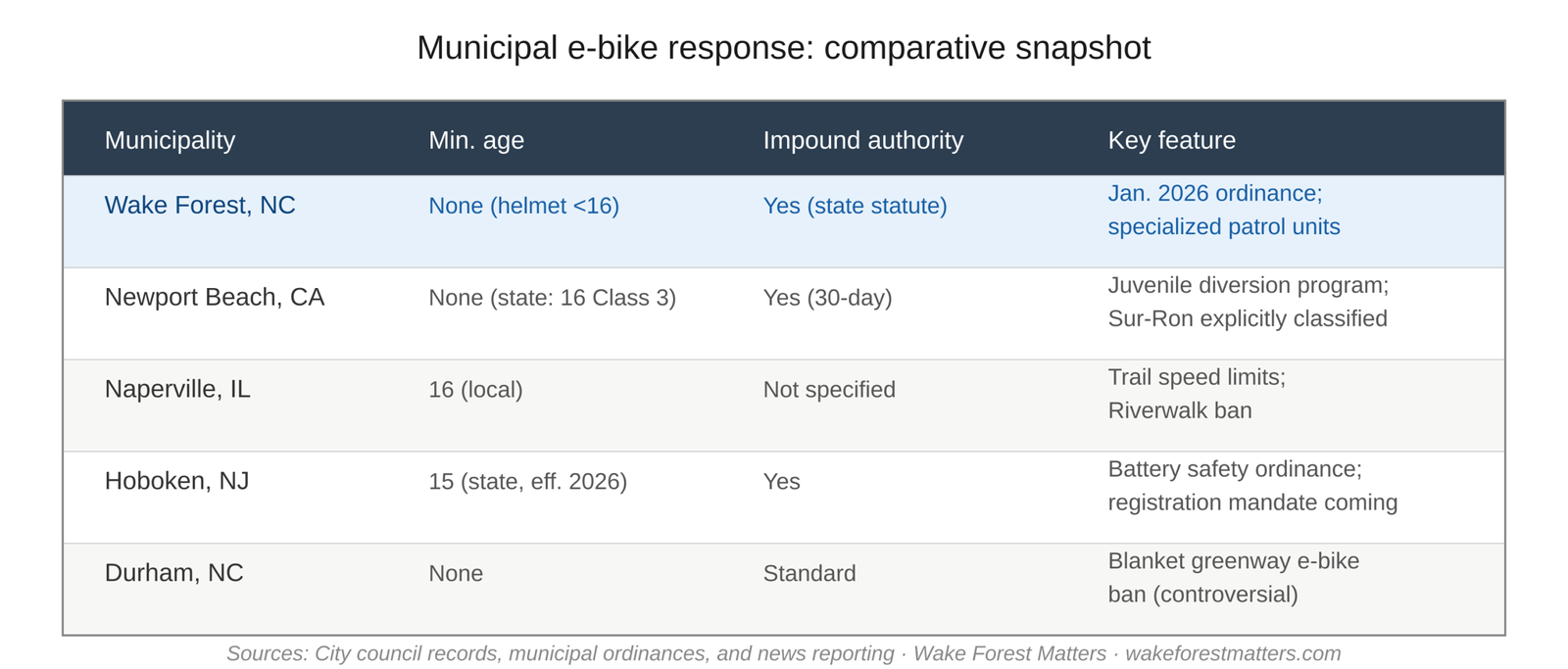
The lesson from these communities is consistent: targeted enforcement works better than blanket bans, classification clarity is essential, and education without consequences doesn’t change behavior. Wake Forest has the enforcement backbone. What it may need next is a local ordinance that fills the gaps state law leaves open.
Wake Forest E-Bike Laws Start in the Driveway
Here’s the part nobody wants to hear: the most critical failure point under Wake Forest e-bike laws is parental accountability.
As detailed above, the e-moto class of machines costs between $3,500 and $5,000, and lower-end models are available at big-box retail for a fraction of that. Parents are buying these devices as gifts and handing them to unlicensed minors. The point-of-sale education is nonexistent or deliberately vague. And the kids are bypassing the limiters before the receipt hits the trash.
To be clear: many kids riding compliant, low-speed e-bikes are doing nothing wrong. They’re using a legitimate tool for mobility and independence, and the Town’s January ordinance was designed to accommodate exactly that kind of responsible use. This is about the parents of the bad actors, the ones who bought a machine capable of 50 mph and didn’t check the law, didn’t check the specs, and aren’t checking on where their kid takes it every afternoon.
North Carolina law provides multiple avenues to hold those parents financially and legally responsible.
Strict Liability for Property Damage
Under G.S. 1-538.1, if a minor willfully or maliciously injures a person or destroys property, the parent is liable for up to $2,000 in actual damages under strict liability. The plaintiff doesn’t need to prove negligent supervision, the parent-child relationship alone is sufficient.
Negligent Entrustment: Unlimited Liability
Beyond the statutory cap, parents face potentially catastrophic civil exposure under the common law doctrine of negligent entrustment. A parent can be held personally liable when they knew, or should have known, that their child was a danger to others. Buying an unlicensed 14-year-old a machine capable of highway speeds and letting them roam public streets unsupervised is the textbook definition.
When that kid hits a pedestrian on the Dunn Creek Greenway, the victim’s attorney will bypass the minor and sue the parents directly, for medical bills, pain and suffering, and punitive damages. There is no cap.
The Family Purpose Doctrine
North Carolina also enforces the Family Purpose Doctrine: the owner of a motor vehicle is liable for the negligent acts of a family member if the vehicle was provided for household use. Because these machines are bought by parents, housed in the family garage, and provided for the teen’s recreation, the doctrine applies cleanly.
And here’s the final kicker: standard homeowner’s and auto insurance policies will almost certainly deny coverage for injuries caused by an unregistered, illegal motor vehicle operated by an unlicensed minor. The full financial weight of a civil judgment falls on the parents’ personal assets.
What Comes Next for Wake Forest E-Bike Laws
The youth e-bike street takeover phenomenon isn’t a passing fad. It’s happening in Wake Forest, and it’s happening in suburbs and cities across the country. The machines involved exist on a spectrum, from perfectly legal to wildly illegal, and the line between them is poorly understood by most parents who buy them.
The WFPD has the statutory tools and the tactical capability to enforce the law. The community backs them. But other municipalities are going further: setting minimum age requirements, building juvenile diversion programs, coordinating regionally, and pushing for state-level classification reform. Wake Forest should be studying those models now.
For residents who want to understand the regulatory landscape better, BikeWalk NC is hosting a free webinar on April 9 covering North Carolina e-bike regulations, featuring Steven Goodridge. The session will provide an overview of existing laws, clarify distinctions among electric motorized cycles, and explore how these regulations may shape transportation policy going forward.
In the meantime, the warning period is over. Every takeover participant should be cited under G.S. 20-141.10. Every illegal vehicle should be impounded. And the parents who made it all possible need to understand that their exposure, legal, civil, and financial, is enormous and growing.
The safety of Wake Forest’s streets and greenways doesn’t start with a police cruiser. It starts in the driveway.
Editor’s Note
Wake Forest Matters requested comment from the Town of Wake Forest for this story. The Town did not respond. We have not been able to identify or reach the families involved in the Heritage subdivision incident. We did not witness the Heritage event firsthand and cannot confirm the specific types of vehicles involved. This article is based on publicly available North Carolina statutes, UNC School of Government legal analysis, Town of Wake Forest municipal code, Board of Commissioners meeting records, Wake Forest Police Department communications and social media posts, manufacturer specifications, local news coverage from WRAL and the Wake Weekly, and community discussion on social media. Comparative municipal data was gathered from publicly available city council records, ordinances, and news reporting. If you have information about e-bike street takeover activity in Wake Forest or the Dunn Creek Greenway vandalism, contact the Wake Forest Police Department and kindly drop us a tip at tips@wakeforestmatters.com

Tom Baker IV is the publisher of Wake Forest Matters, Wake Forest’s only independent local newsroom. A Wake Forest native, Navy veteran, and intelligence professional, Tom launched Wake Forest Matters to bring serious accountability journalism to his hometown. Tips and story ideas: publisher@wakeforestmatters.com