The snow had largely retreated by Tuesday evening, leaving behind the grey, slushy evidence of a winter storm that had paused the pulse of Wake Forest for the better part of a week. The roads were clear, the power was on, and the town was slowly waking up from its icy hibernation. But as the Wake Forest Gazette recently reported, the quiet outside was a sharp contrast to the atmosphere inside Town Hall on Brooks Street.
There, the air was charged with a kinetic energy that had nothing to do with the weather.
At precisely 6:00 PM, Mayor Ben Clapsaddle struck the gavel to open the February 3, 2026, work session of the Board of Commissioners. To the casual observer tuning in via the live stream, nursing a hot chocolate in the comfort of their living room, it might have looked like standard municipal theatre, a procedural trudge through the unglamorous machinery of local government.
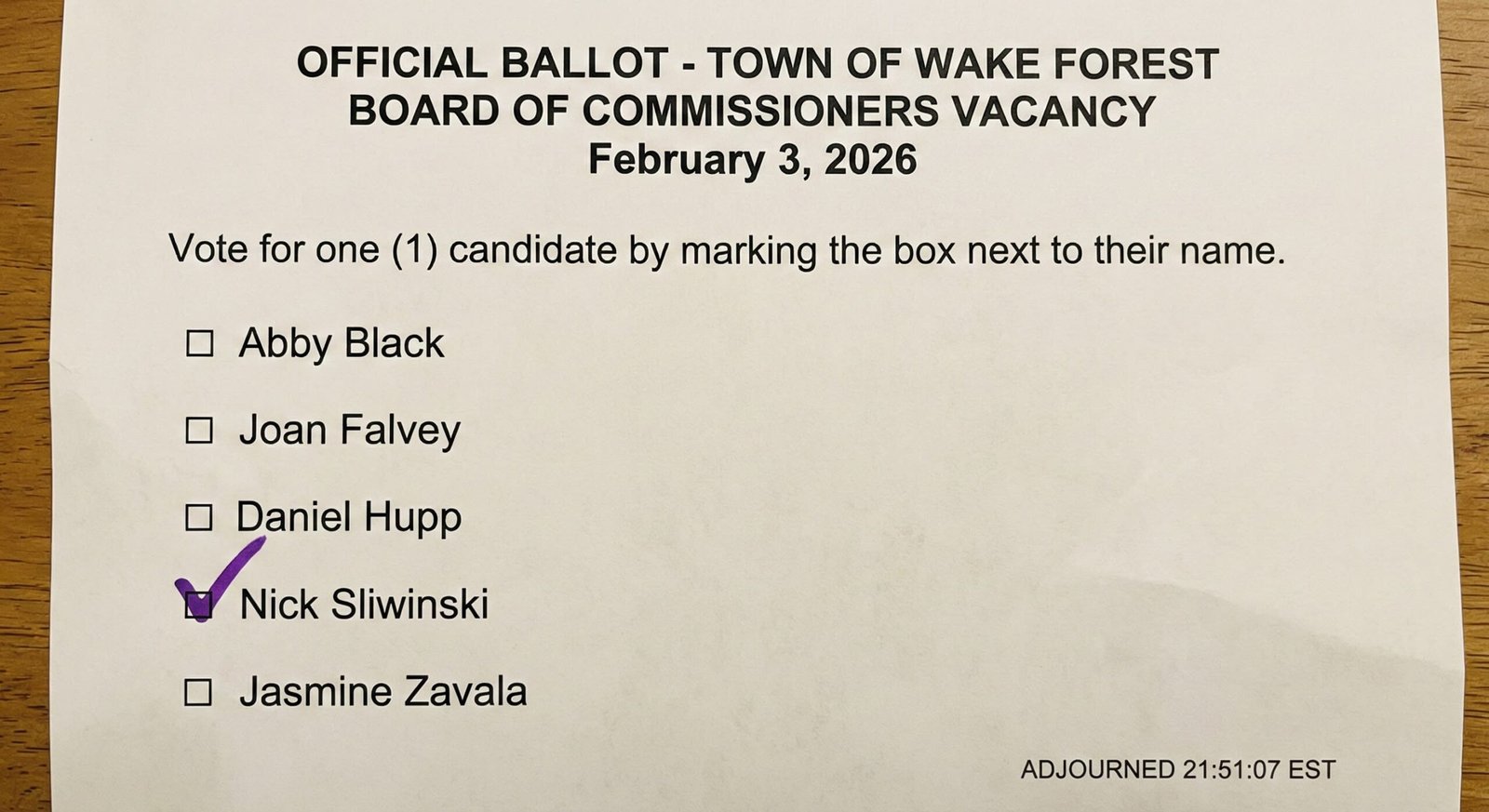
But by the time the gavel fell again to adjourn, exactly 3 hours, 51 minutes, and 7 seconds later, the Board had navigated a grueling democratic stress test. While the headlines tell us who was chosen, they cannot fully capture the grueling 231-minute marathon that exposed the fault lines, the mechanics, and the human cost of how we choose our leaders.
This is the deep dive, the full story of that night.
Part I: The Crucible of Competence
To understand why the night ended the way it did, with the return of a veteran rather than the elevation of a newcomer, one must look closely at the first hour of the meeting. This preamble, often dismissed as housekeeping, was in fact the crucible that defined the criteria for the new appointee.
The Board was down one member. The vacancy was created by Ben Clapsaddle’s own ascent to the mayoralty in the previous election, leaving a two-year hole in the legislative body. The four sitting Commissioners, Keith Shackleford, Faith Cross, Adam Wright, and Haseeb Fatmi, were not just looking for a colleague; they were looking for help.
As the meeting began, that need for help became tangible. The agenda was a gauntlet of technical complexity.
The Fire Station Dilemma
First up was Mickey Rochelle, the Facilities Director, presenting the construction contract for Fire Station #6. This wasn’t a simple rubber stamp. The project carried a “Guaranteed Maximum Price” (GMP) of over $20 million. Rochelle walked the Board through the site challenges on Wait Avenue, explaining the topography’s intricacies and the need for underground stormwater detention.
The discussion quickly became technical. Commissioner Faith Cross, demonstrating the level of detail required of the role, pressed on the design specifics.
“Is the video we saw specific to the topography there? Will the tower be lower?” she asked, referencing a 3D rendering shown earlier.
Fire Chief Ron Early had to step in to explain the civil engineering constraints: “Because of the topography, we couldn’t do a true basement… we designed a way of changing using the front and rear. It is not ‘dug in.’”
For 20 minutes, the discussion revolved around grade changes, civil drawings, square-footage costs ($836 per square foot), and the liabilities of a “Guaranteed Maximum Price” contract. The subtext was clear: This job requires the ability to visualize complex architectural constraints and steward eight-figure budgets. It is not a role for passivity.
The S-Line Complexity
Hardly had the fire station contract been finished when the Board pivoted to an even more complex beast: the S-Line Rail Corridor. Brad West, the Long Range Planning Manager, and NCDOT officials presented a grant opportunity that sounded like it was written in a different language.
They spoke of “RAISE grants” versus “BUILD grants.” They discussed “mobility hubs,” “NEPA compliance,” and the distinction between funding for “rail infrastructure” and “station elements.” They navigated the federal requirements for a $25 million grant application due in mere weeks.
Jason Orthner, the Rail Director for NCDOT, laid out a vision that connected Wake Forest to a seven-state network stretching to D.C. But the immediate question for the Board was financial: approving the local match meant committing the town’s future finances to a federal partnership that would span years.
Sitting on the dais, the four Commissioners had to process this influx of high-level data in real-time. They had to understand the difference between the “preliminary design” and the “final construction” funding.
For the five candidates sequestered downstairs, Abby Black, Joan Falvey, Daniel Hupp, Nick Sliwinski, and Jasmine Zavala, this first hour was a silent barrier. They sat in a holding room, likely reviewing their notes on community engagement and transparency. Meanwhile, upstairs, the Board was implicitly sketching the profile of the colleague they needed. They were looking for a technician who could read a 50-page civil engineering report at 8:00 PM on a Tuesday without blinking.
By the time the regular business concluded, the meeting was already heavy. The air in the chamber had shifted from administrative politeness to a palpable tension. The technical manuals were put away. The interview scorecards came out. The real test was about to begin.
Part II: The Architecture of Fairness
In the history of small-town politics, appointments like this have often been the subject of cynicism. The “Old Boy Network” is a trope for a reason; in many places, vacancies are filled via hushed phone calls or closed-door executive sessions long before the public meeting begins. The appointee is often a friend, a donor, or a political ally, parachuted in with little scrutiny.
Adding to this atmosphere of skepticism are the persistent rumors that surface both online and offline. As an operator trained to monitor these spaces, I heard whisper networks discussing party influencers and bosses trying to impose their choices on board members. While such attempts at influence are not unheard of in political processes, without direct evidence, meaning recordings, phone and text logs, metadata, public records, or formal statements, these claims cannot be confirmed. At that point, the information remains largely hearsay.
Tuesday night in Wake Forest was a radical rejection of that history. It was an attempt to operationalize fairness through a process that was not only legal and properly adjudicated but was meticulously designed to withstand the highest levels of scrutiny.
Much credit is due to Town Attorney Nathan McKinney, Town Manager Kip Padgett, and the Board of Commissioners for constructing a process that served as a fortress against bias. This was a procedural cage match, strictly regulated to ensure that no candidate, whether a former colleague or a total stranger, had an unfair advantage.
Before the interviews even began, the Board debated the rules themselves, proving that the architecture of the evening was a deliberate, transparent choice. Attorney McKinney presented a procedure with strict time limits, sparking friction between the desire for control and the desire for depth.
The debate that followed was revealing; the Board wrestled with the “micromanaging” of the process versus the need for consistency. If one candidate got ten minutes and another got two, the fairness of the process would collapse. Ultimately, they settled on a compromise: a loose cap, but with strict adherence to the question list.
The rules were laid out with legal precision:
Total Sequestering: The five finalists—Abby Black, Joan Falvey, Daniel Hupp, Nick Sliwinski, and Jasmine Zavala—were physically kept out of the chamber. They could not watch the livestream or hear one another’s answers, preventing any “last speaker advantage”.
Standardized Core Questions: None were personalized. No one got a softball about a hobby or a curveball about a past controversy. Town Manager Kip Padgett acted as the neutral questioner, reading the same seven “Core Questions” to every single applicant to ensure a level playing field.
Strict Time Limits: Candidates were held to three minutes for an opening statement, two minutes per core question, and five minutes for a closing statement. A visible timer on the dais kept the rhythm, adding a layer of professional pressure to the performance.
The Seven Core Questions: The Standardized Script
To ensure absolute consistency and eliminate any “last speaker advantage,” Town Manager Kip Padgett read this exact script to every candidate. This was the yardstick against which every vision for Wake Forest was measured:
It was clinical. It was dry. And it was exactly what a fair, transparent, and properly adjudicated democratic process looks like. It stripped the handshake of its charisma and replaced it with the rigor of a formal deposition.
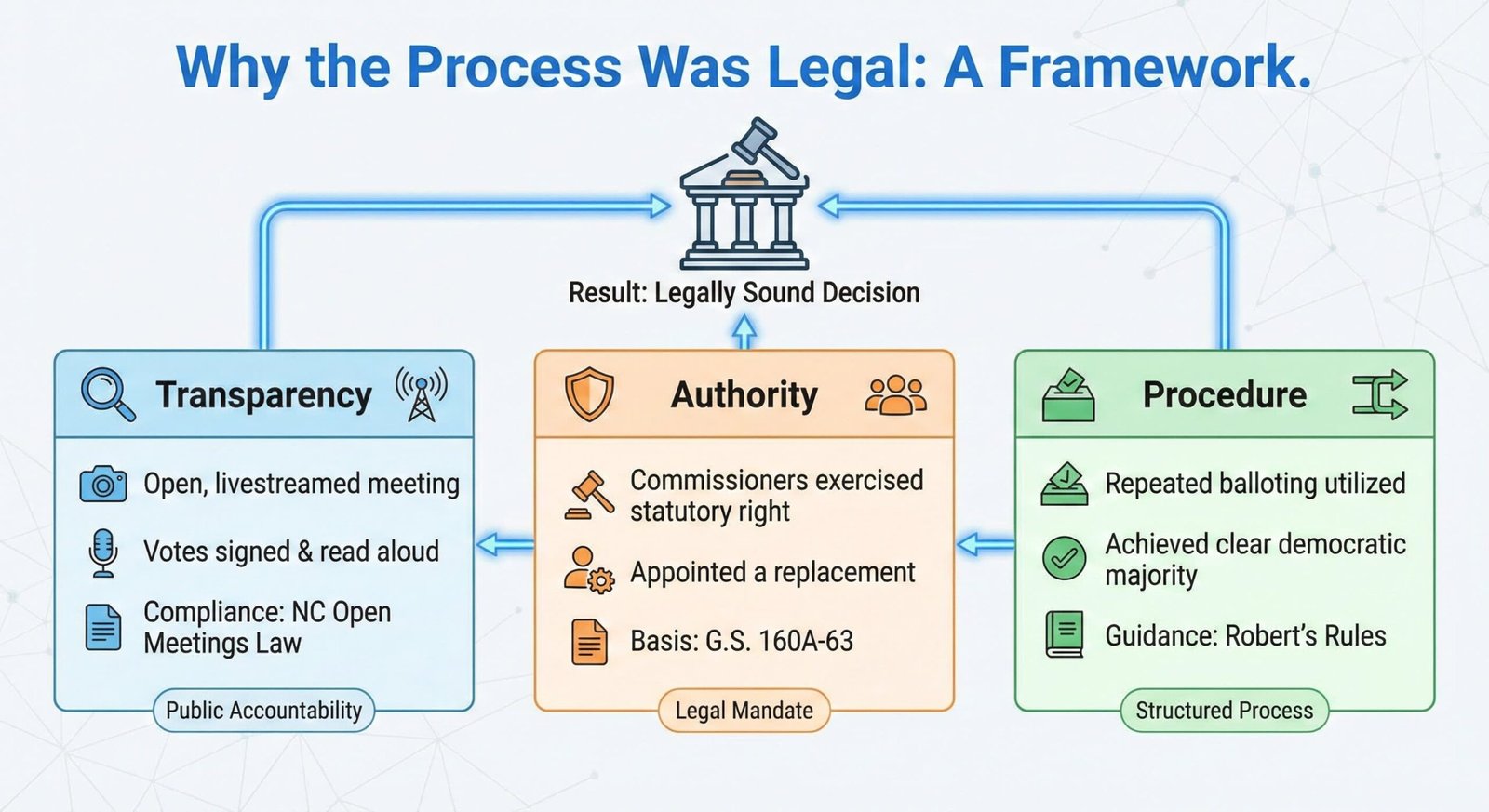
This rigor was not merely a stylistic choice by the Board; it was a shield against legal vulnerability. To understand why the night’s eventual deadlock became so tense, one must understand the statutory machinery operating in the background.
First, the process adhered strictly to NC General Statute § 160A-63. This law mandates that a mid-term vacancy must be filled by a majority of the remaining members. With four sitting commissioners, the magic number was three. A simple plurality—where a candidate might “win” with just two votes against a split field—would not suffice. This statutory math is what eventually forced the Board into its grueling stalemate; without that third vote, the seat legally remains empty.
Second, the voting method itself was designed to satisfy North Carolina’s rigid transparency laws. While the use of paper ballots might have looked like a dramatic flourish, it was a compliance necessity. Elected officials cannot vote by secret ballot. By requiring each Commissioner to sign their name and having the Town Clerk read the votes aloud, the Town Attorney ensured the process satisfied the “open vote” mandates of public records law.
Finally, the shadow of Robert’s Rules of Order loomed over the proceedings. Standard parliamentary procedure dictates that when a body is deadlocked, it cannot simply change the rules to accept a lower threshold; it must continue balloting. This adherence to procedure protected Mayor Clapsaddle from the uncomfortable position of being the kingmaker too early, forcing the legislative body to resolve its own standoff.
The result was a process that wasn’t just fair in spirit—it was legally bulletproof.
As the Board took a short recess to bring up the first candidate, the Mayor went off-script to thank the staff for their work during the storm, a brief moment of humanity before the procedural machinery ground back into gear. Then, the doors opened.
Part III: The Five Auditions
One by one, the candidates were ushered to the podium. And one by one, they offered five distinct visions of what Wake Forest is, and what it should be. The transcript of their answers reveals the stark contrast in how each viewed the role of a Commissioner.
1. Abby Black: The Engaged Citizen
First to the microphone was Abby Black, a lifelong resident and private cloud administrator. Black represented the archetype of the “Homegrown Steward.”
Her opening statement was a love letter to the town: “I have lived in Wake Forest all my life… I am the daughter of hardworking parents who have been residents and local business owners for 30 years.”
But Black didn’t rely solely on nostalgia. She demonstrated a clear understanding of the “engaged citizen” pathway. She cited her attendance at the “Citizens Academy” and “Planning 101.” She spoke of her time as Co-Chair of the Urban Forestry Board. She was the candidate who had done the reading.
The Key Exchange
When Town Manager Padgett asked Question 1—regarding the balance between constituent input and board authority—Black offered a response grounded in the hard limits of local power.
Manager Padgett: “How do you view the role of a commissioner in balancing personal integrity, values… and input from constituents when they are in tension?”
“There is always a balance between what the residents want and what the commissioners can supply within the jurisdiction of the board. For example, while there are a lot of people frustrated about traffic problems, the federal and state DOTs manage most of the town roads, so the Board of Commissioners has to cooperate with those entities to make progress.”
It was a solid answer, correctly identifying one of the biggest misconceptions in local government (that the Town controls all the roads). But when pressed for a specific example by Commissioner Cross, Black pivoted to trees.
“While I was on the Urban Forestry Board, there was a lot of discussion about how to keep our tree canopy and maintain Wake Forest’s identity. We found that the Urban Forestry Board mostly manages town-owned trees in the rights-of-way, but maintaining the canopy also falls on residents. So the board did public outreach at events like Forest Fest, where we did the sapling tree giveaway.”
The Takeaway: Black showed she had done the homework. She represented the town’s environmental conscience, focusing heavily on the tree canopy and “smart growth.” But her answers remained largely within the realm of advisory boards rather than legislative governance.
2. Joan “Joanie” Falvey: The Community Connector
Next was Joan Falvey, who immediately established a rapport by correcting the Mayor: “I prefer Joanie.”
Falvey, a downtown business owner and Vice Chair of the Historic Preservation Commission, brought a different energy. If Black was the preservationist, Falvey was the humanist. She spoke of her business not as a commercial entity, but as “Wake Forest’s Living Room”—a safe space where politics and religion are checked at the door in favor of human connection.
The Key Exchange
Falvey’s strongest moments came when she applied her business philosophy to town governance. On Question 1, regarding integrity and conflicting views, she rejected the polarization of modern politics.
“To continue following the path Wake Forest is on, it is important to hear all sides. You can’t work in a vacuum. Sometimes things feel politically or religiously focused… In my business, we have a policy: we don’t discuss religion or politics; we discuss people’s needs, desires, and dreams. I think the role of commissioner requires the same thing—it is a non-partisan role. Focusing on the community at large and what will keep the community safe is what is most important.”
When asked Question 7 about the town’s future, Falvey pivoted to a deeply personal issue that resonates with many long-time residents: gentrification and affordability.
“Infrastructure is a major complaint… [But] affordable housing is also important; the market has skyrocketed, and I want my young adult children to be able to afford a home here.”
The Takeaway: Falvey represented the “Downtown Energy”—the entrepreneurial spirit that has revitalized White Street. She wasn’t citing statutes; she was citing the community’s vibe. She offered a vision of the Board as a facilitator of connection, a place where the town’s history meets its future.
3. Daniel “Danny” Hupp: The Advocate
Danny Hupp, Chair of the Parks & Rec Advisory Board, walked to the podium with a quiet, determined intensity. Before answering a single question, he made a request that silenced the room and reframed the interaction.
It was a powerful moment of self-advocacy. Hupp didn’t just talk about inclusivity; he lived it. He spoke of his Panamanian heritage, his “abuelo” (grandfather) Mario Fonseca, who was involved in politics, and his deep commitment to the town’s specialized programs for individuals with disabilities.
The Key Exchange
Hupp’s most effective answer came on Question 2, regarding staying informed about diverse needs. Commissioner Cross pressed him on his work with Parks & Rec.
Commissioner Cross: “Do you feel you are doing this as Chair of Parks and Rec?
“Yes. We had a resident, Amara Hazlett, come to a meeting in 2022 to talk about a skate park. He gave a perspective I hadn’t thought of—that a skate park isn’t just for teenagers but for older individuals too. His passion helped us see that we should look at a skate park for Wake Forest.”
And on Question 7 (Future Issues), Hupp didn’t talk about roads; he talked about people.
“I would prioritize expanding the Wake Forest Center for Active Aging… and increasing specialized programs for individuals with disabilities.”
The Takeaway: Hupp represented the “Service Heart” of the town—the volunteer who coaches soccer, chairs the advisory board, and wants to ensure the government works for the marginalized. He ended with a memorable tag line that seemed to echo in the room: “The best way to find out if you can trust somebody is to trust them. You can trust in Hupp.”
4. Nick Sliwinski: The Technician
Then came Nick Sliwinski.
From the moment he stepped to the microphone, the dynamic in the room shifted. Sliwinski wasn’t a hopeful applicant; he was a colleague returning from a brief sabbatical. Having served as a Commissioner from 2021 to 2025, he didn’t need to introduce himself. He knew where the cameras were. He knew the meeting’s cadence.
Sliwinski’s opening statement was a resume of the Board’s recent greatest hits: the Mental Wellness Fair he helped organize, the UDO update, and the Fire Station #6 planning. He positioned himself not as a new voice, but as the “consistency” required to finish the job. “I am in the unique position to step into this role and make significant contributions on Day One,” he said.
The Key Exchange
The defining moment of Sliwinski’s interview, and arguably the entire night, came on Question 3. The question asked how a commissioner should handle complaints about town staff. The previous candidates had offered variations of “I would listen to both sides” or “I would mediate.” They answered as humans trying to solve a conflict.
Sliwinski answered as a bureaucrat protecting a system.
“I am not certain that is the role of a commissioner to decide if it’s accurate. In the Council-Manager form of government, staff falls under the purview of the Town Manager. If a complaint comes in, that information should be passed along to the Town Manager to follow up appropriately.”
It was a technically perfect answer. It demonstrated a precise understanding of the legal firewall between the legislative body (the Board) and the administrative body (the Staff). It showed he understood that a Commissioner meddling in personnel issues is a liability.
On Question 7 (Future Issues), he didn’t just mention traffic; he named the specific legislative hurdles.
“First is Capital Boulevard—a project pressing for a quarter-century. I would continue advocating for funding with state/federal officials. Second is growth and the UDO update. Being able to jump back into that process with historical context allows me to advance that plan while listening to current citizen input.”
The Takeaway: Sliwinski represented the “Technocratic Ideal”—competence, experience, and stability. He wasn’t auditioning for a role; he was proving he already knew the lines.
5. Jasmine Zavala: The Policy Wonk
Finally, Jasmine Zavala took the podium. A lifelong resident whose family owns a prominent local restaurant, Zavala brought a resume that blended deep local roots with high-level policy training.
She spoke of her Master’s in Public Administration and her work as a nonprofit consultant. Her answers were peppered with terms like “decision matrix,” “economic impact analysis,” and “political feasibility.”
The Key Exchange
Zavala’s standout moment came on Question 4, regarding job experience. She didn’t rely on generalities; she walked the Board through a policy analysis framework.
“My nonprofit consulting experience trained me to look at data and trade-offs. For my Master’s capstone, I conducted a policy analysis on tax codes… I evaluated alternatives using a decision matrix to compare economic impact, equity, and political feasibility. I would use that same framework as a commissioner: listen, gather information, and make decisions that impact cost and practicality.”
On Question 7 (Future Issues), she tackled the tension between development and conservation with a personal anecdote that resonated with the “New Wake Forest” demographic.
“Conservation. When the land near my parents’ restaurant was clear-cut, I was devastated… though my dad saw ‘new customers.’ Perspectives differ. I want to focus on conservation and the UDO. I also want to focus on education partnerships and supporting small businesses.”
The Takeaway: Zavala represented the “New Generation”—young, diverse, highly educated, and looking at the town through the lens of systemic data rather than just anecdote. She was impressive, polished, and ready.
Part IV: The Deadlock
By the time the interviews concluded, it was late. The Board took a five-minute recess— “smoke ‘em if you got ‘em,” the Mayor joked—, but when they returned, the mood was somber. The candidates were brought back into the room. The audience settled in. The marathon was entering its final, most grueling phase.
The Town Attorney distributed the ballots. These were not secret votes. Under the session rules, each Commissioner had to sign their name to their choice, fold the paper, and pass it down the line for the Mayor Pro Tem to read aloud. It was democracy in its rawest, most vulnerable form.
Round 1: The Fracture
The clerk tallied the votes. The room went quiet.
Nick Sliwinski: 2 Votes (Shackleford, Wright)
Daniel Hupp: 1 Vote (Likely Cross or Fatmi)
Joan Falvey: 1 Vote (Likely Cross or Fatmi)
Three votes were needed for an appointment. They had a stalemate.
The fissure that opened up was not personal; it was deeply philosophical. It was a debate about the nature of the vacancy itself.
Commissioner Keith Shackleford, the Mayor Pro Tem, spoke first to explain his vote. He was unapologetic about his support for Sliwinski. His argument was purely pragmatic: with only two years left in the term, the town couldn’t afford a six-month learning curve. He cited Question #3—the question about staff complaints—as the litmus test. Sliwinski knew the boundaries of the job; the others, while well-intentioned, did not.
“Day One readiness,” Shackleford emphasized. He was voting for the technician who could handle the S-Line grant and the Fire Station contract they had discussed hours earlier.
Commissioner Adam Wright concurred. He pointed to the complexity of the job, the S-Line grants, and the UDO rewrite. He wanted the known quantity.
But Commissioners Faith Cross and Haseeb Fatmi held the line. Their argument was rooted in the democratic mandate. As Commissioner Cross eloquently argued, the recent election (which had elevated Clapsaddle to Mayor and created this very vacancy) was a signal from the voters. The public had voted for change. To appoint a former Commissioner, someone the voters hadn’t just returned to office, felt to them like a betrayal of that fresh mandate.
“I wanted to give a chance to someone new… to find a compromise,” Cross said. She acknowledged Sliwinski’s qualifications but argued that the Board needed to honor the “vibe” of the electorate. She wanted to expand the franchise, not contract it.
Round 2: The Entrenchment
The ballots went out again. Green paper this time. The clock ticked past the three-hour mark. The fatigue was setting in.
Nick Sliwinski: 2 Votes
Daniel Hupp: 1 Vote
Joan Falvey: 1 Vote
Still deadlocked.
This is where the process began to exert its pressure. The Town Attorney, Nathan McKinney, quietly outlined the “Doomsday Scenario.” If the ballot method failed after three rounds, the Board would have to move to a motion-and-vote system. In that scenario, if the 2-2 tie persisted, Mayor Clapsaddle would be forced to break the tie.
The irony was palpable. The seat was empty because Clapsaddle had vacated it. For him to cast the deciding vote on his own successor would have felt, to many, like a failure of the Board’s independence. It was a scenario everyone, especially the Mayor, wanted to avoid.
“I do not have a comment at this stage,” Clapsaddle said, signaling his desire to let the Board resolve it themselves. But his presence loomed over the deadlock.
Part V: The Resolution
The “Shadow of the Tiebreaker” loomed large over Round 3. The hour was late. The arguments had been made. The bloc of Cross and Fatmi realized that they could not coalesce around a single challenger strong enough to flip Shackleford or Wright.
Hupp and Falvey had split the opposition vote, diluting the alternative path. Without a Ranked Choice system to consolidate the “change” vote, the math favored the plurality leader.
To persist in the deadlock would be to force a political crisis. To yield would be to choose stability.
Round 3: The Breakthrough
The ballots were collected. The Clerk tallied them.
The resistance had broken. Sliwinski had the three votes (likely four, in a show of unity) needed to secure the seat, though the final ballot breakdown was not read in full; the result was decisive.
In the end, administrative gravity won out. The need for a fully functioning board, the desire to avoid a messy tie-breaker involving the Mayor, and the undeniable qualification of Sliwinski’s experience tipped the scales.
Nicholas Sliwinski walked to the front of the room. He placed his hand on the Bible that Carissa, his wife, held. With the late-night quiet of the Town Hall pressing in around them, he took the oath of office. He swore to uphold the Constitution and the laws of North Carolina.
Part VI: Closing the Holes in Our Democracy
As we analyze the outcome of Tuesday night, it is important to start with a baseline of respect: The Board of Commissioners did exactly what they were elected to do. Faced with the difficult, necessary task of filling a mid-term vacancy, they followed the law, resisted political pressure, and navigated a high-stakes appointment with dignity and transparency. They did the best they could with the system they have.
But the friction of the evening also offered us a gift. It illuminated a structural gap in our local democracy, a “hole” in the process that, if left unaddressed, risks narrowing the path to leadership rather than widening it.
We must look honestly at the dynamic we witnessed. The process was fair on paper, but in practice, it revealed a system heavily weighted toward technical continuity.
When the metric for a “good answer” hinges on an intimate grasp of the town’s mechanics, an incumbent like Nick Sliwinski isn’t just taking a test; he’s the one who helped write the study guide. His victory wasn’t necessarily a win for “new ideas,” but a demonstration of operational literacy.
By flawlessly citing the Council-Manager form of government, he did more than answer a question; he signaled that he already understands the boundaries of power. While others might suggest direct intervention in town staffing, Sliwinski knew that staff fall under the Manager’s purview. He didn’t have to guess where the levers of power were located because he had spent four years pulling them. He knew the acronyms, the liability limits, and the charter, effectively turning his prior service into a shield against the “learning curve” argument.
This isn’t a failure of the candidate or the Board; it is a feature of a system designed to prize “Day One Readiness.” But by prioritizing immediate technical competence, we inadvertently create a closed loop in which only those who have already led are qualified to lead.
This raises a vital question for us as citizens: How do we upgrade our democratic software to recognize other forms of value? How do we ensure that “experience” doesn’t become a barrier to entry that keeps brilliant, passionate neighbors on the sidelines?
Consider the immense talent that was left on the table Tuesday night, and what it tells us about who our system struggles to absorb:
The Policy Expert: How does Jasmine Zavala, with her master’s degree in Public Administration and high-level policy expertise, break into the inner circle? Her ability to parse economic data and use decision matrices is exactly the kind of modern, analytical skill set a growing municipality needs. Yet, under the current rubric, her lack of specific Board experience outweighed her professional competence.
The Fierce Advocate: How does a Danny Hupp, with his boots-on-the-ground leadership of the Parks & Rec Board and his relentless advocacy, translate that passion into policy? His “service heart” is the engine of the local community, but it speaks a different language than the technical bureaucracy of a work session.
The Steward: And perhaps most critically, how does someone like Abby Black, a lifelong resident who represents the families that have helped build this town, find a voice? Her deep, generational knowledge of Wake Forest’s identity is a form of expertise that no amount of grant-writing experience can replicate. Yet in a system focused on “smart growth” metrics, her historical perspective was treated as secondary.
By consistently favoring the “safe” pair of hands, we risk turning our representative democracy into a technocracy. We risk creating a town where you can only serve if you have already served.
This is not an indictment of the past, but a challenge for the future. Democracy is not a static object; it is a tool that requires constant sharpening. Our Commissioners did their job Tuesday night. Now, it is our job as a community to help them build a better ladder, one that allows the brilliant outsider, the passionate advocate, and the historical steward to climb just as high as the experienced insider.
Expanding the franchise isn’t just about voting; it’s about ensuring that when a seat opens up, the definition of “qualified” is broad enough to capture the full, vibrant spectrum of Wake Forest.
A Necessary Line in the Sand
The appointment is finalized. The decision is made. The way forward is to start preparing for the 2027 cycle.
What is not part of the way forward is the harassment of our Town Commissioners and their families. Whether it occurs in online echo chambers or, in the most unacceptable form, in person, this behavior is a failure of civic duty. That bullshit has to stop.
The appointment of Nicholas Sliwinski is not the end of the story; it is the beginning of the next chapter.
With the S-Line grant moving forward, the fire station contract signed, and the UDO update pending, the next two years will see massive investment and infrastructure changes in Wake Forest. The stakes are high, and the decisions made by this Board will shape the town for decades.
But for those who watched Tuesday night and felt a pang of disappointment, for the supporters of Hupp, Falvey, Black, or Zavala, there is a clear path forward.
The next election is in 2027. There will be two seats up for grabs.
If you watched the interviews and thought, “I could do that,” start planning now. The lesson of Tuesday night is that preparation matters. Civic engagement is not a spectator sport; it is a muscle that must be exercised.
Show Up: Posting on social media does not get you heard. The real work happens in the public comment period of the meetings. It happens in the Planning Board sessions. It happens in the Citizens Academy.
Speak Up: We need to ensure our commissioners and staff receive the input we can give during public comment. This is the only way to break the echo chamber.
Step Up: Abby Black discussed her dedication to the town and her engagement; she is an engaged citizen who educates herself and participates in public meetings. She should be lauded for applying for this position. Perhaps she and the other finalists will run in 2027. They should. The more choices we have, the stronger our local Democracy becomes.
Local sovereignty is super important. It is the layer of government closest to our daily lives. It determines whether our roads are paved, our parks are accessible, and our history is preserved.
We have a full Board again. The seat is filled. The snow has melted. Now, let’s get back to work.
To view the official vacancy announcement, visit the Town of Wake Forest Official Website.
Editor’s Note: How We Covered This Story
At Wake Forest Matters, we believe that transparency applies not just to the government we cover, but to the reporting we produce.
For our coverage of the February 3, 2026, Board of Commissioners work session, a meeting that spanned nearly 4 hours, we used a digital-first approach to bring you inside the room without being there.
The Methodology
This report was generated using an audio recording of the town’s official livestream. To process the nearly 4 hours of dialogue, we used Descript, an automated transcription tool powered by artificial intelligence that converts speech to text.
The Human Element
While technology allows us to “read” a meeting quickly, it is not infallible. Raw AI transcripts often struggle with the specific lexicon of local government. In the raw data, “Consent Agenda” became “Consetti jet,” and “Guaranteed Maximum Price” became “Guaranteed mass my price.”
To ensure accuracy, our editorial process involved:
Cross-Referencing: We verified names, titles, and specific motion language against the Town’s official agenda and candidate packets received through a public records request.
Speaker Verification: We used video cues to correctly identify speakers during discussion and voting sessions, distinguishing among commissioners’ similar voices.
Contextual Editing: We cleaned up the syntax to make the spoken word readable while preserving the intent and tone of the candidates’ answers.
Why This Matters
This “remote reporting” workflow allows us to provide deep-dive analysis of long, complex meetings that might otherwise go uncovered due to time constraints. By combining AI tools with human oversight, we can expand the franchise of local democracy, ensuring you know exactly what happened in Town Hall, even if you (and we) were watching from home.