For the first time in over two decades, the Wake Forest Board of Commissioners is preparing to fill a vacancy that will not just complete a term, but cement a new political order.
With Ben Clapsaddle’s landslide victory in the mayoral race last November, ousting 24-year incumbent Vivian Jones by a stunning 41-point margin, his former seat on the Board of Commissioners sits empty. In previous years, such an appointment might have been a quiet administrative footnote, likely handed to a “safe” establishment figure from the Chamber of Commerce or Rotary Club.
But the Wake Forest of 2026 is not the Wake Forest of 2003.
As the Board prepares to select Clapsaddle’s replacement, it is placing the final brick in a new political order. The “Old Guard” Republican consensus that governed this town for a generation—an alliance of heritage families, Christian conservatives, and business moderates- has been replaced. In its stead rises a “Professional Consensus” led by lawyers, a retired Army Colonel, and a new wave of managerial Democrats.
To understand who will fill the empty seat, we must first understand how the ground shifted beneath our feet.
For nearly twenty years, Wake Forest politics was defined by the “Jones Coalition.” Anchored by Mayor Vivian Jones, it was a group of fiscal conservatives and business-friendly moderates who governed with a reliable 5-0 or 4-1 super-majority. They prioritized “potholes and parades” over partisanship, fueled by the stable, conservative voting bloc of Wake Forest.
That era ended not with a bang, but with a decade of demographic erosion.
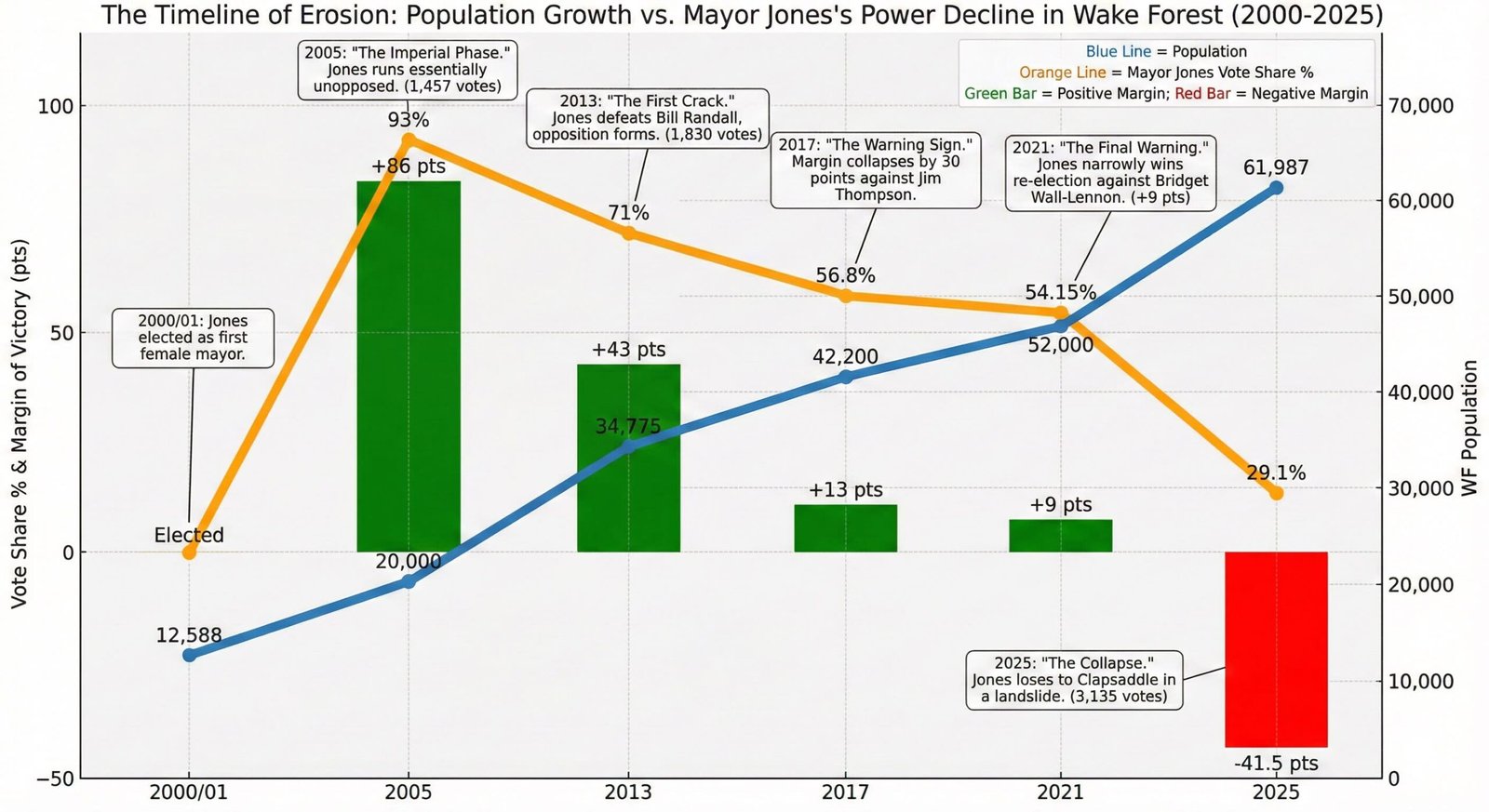
Tracking the decline of the Republican advantage against population growth.
A longitudinal analysis of election returns against U.S. Census data reveals a stark correlation: as Wake Forest’s population grew, the “Old Guard’s” grip on power weakened mathematically in every successive cycle.
The transformation of Wake Forest has been defined by three distinct waves of expansion. Between 2000 and 2010, the town’s population exploded by 139%, followed by a further 58% increase over the next decade. This momentum reached a fever pitch between 2020 and 2025, with an additional 30% surge in just five years, pushing the population past 60,000.
The influx of residents introduced a younger, tech-oriented, and more diverse electorate that felt little allegiance to the town’s historical power structures. This demographic shift fundamentally altered the political landscape, leading to a structural breach in 2019 when Commissioner Adam Wright became the first partisan Democrat to break the Conservative firewall on the Board of Commissioners.
The final collapse in 2025 was accelerated by an internal fracture. The local GOP made a tactical error. Rather than leveraging the incumbent advantage of Nick Sliwinski, a moderate who had secured nearly 25% of the vote in 2021, they officially endorsed a slate of challengers—Thomas Dement and Pam James.
This move effectively orphaned Sliwinski, who subsequently became Wake County’s first Forward-aligned Republican candidate. Moderates, alienated by “Culture War” rhetoric, either stayed home or defected to the Democratic ticket
The tension between the Old Guard and the new electorate came fully to the surface in September 2025 during the Pride Proclamation scandal.
Public records obtained by Wake Forest Matters revealed that Mayor Jones intended to issue a proclamation recognizing LGBTQ+ History Month but retracted it after emails from Southeastern Baptist Theological Seminary (SEBTS) leadership.
The retraction was a fatal miscalculation. To the religious right, Jones looked weak. To the new majority, it looked like their elected government was subservient to an unelected religious institution.
The New “Managerial-Legal Alliance”
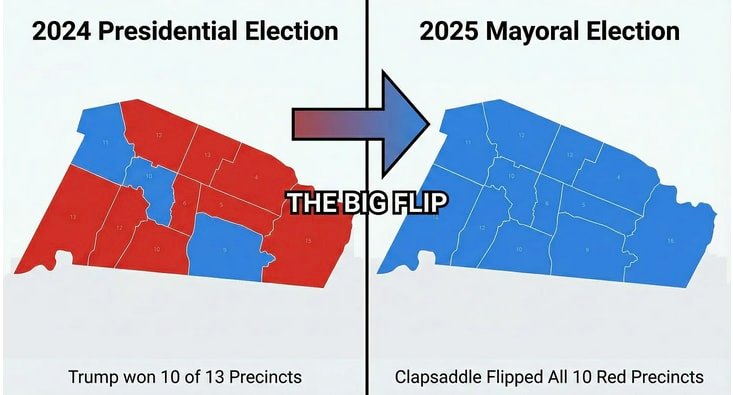
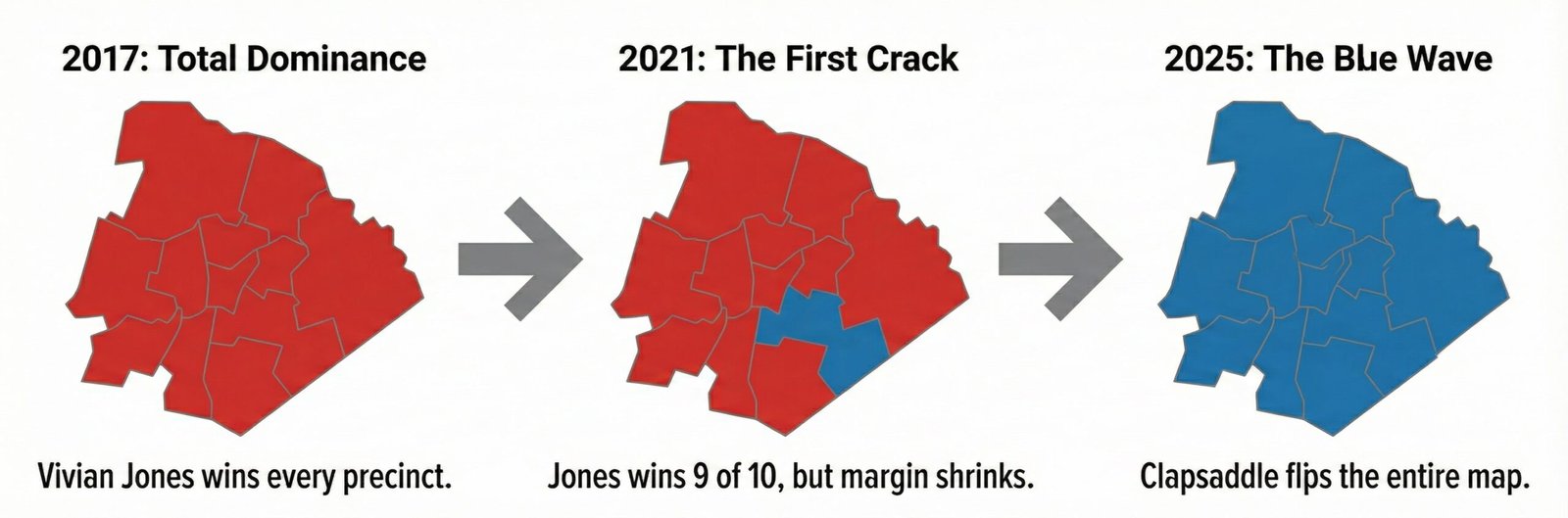
The November 2025 election results confirmed the realignment. The precinct data tells the story of the “Firewall” failure.
A comparison of the 2024 POTUS results against the 2025 Mayoral returns shows the total collapse of the Republican firewall in Wake Forest. Local voters are increasingly decoupling municipal governance from national partisan identity.
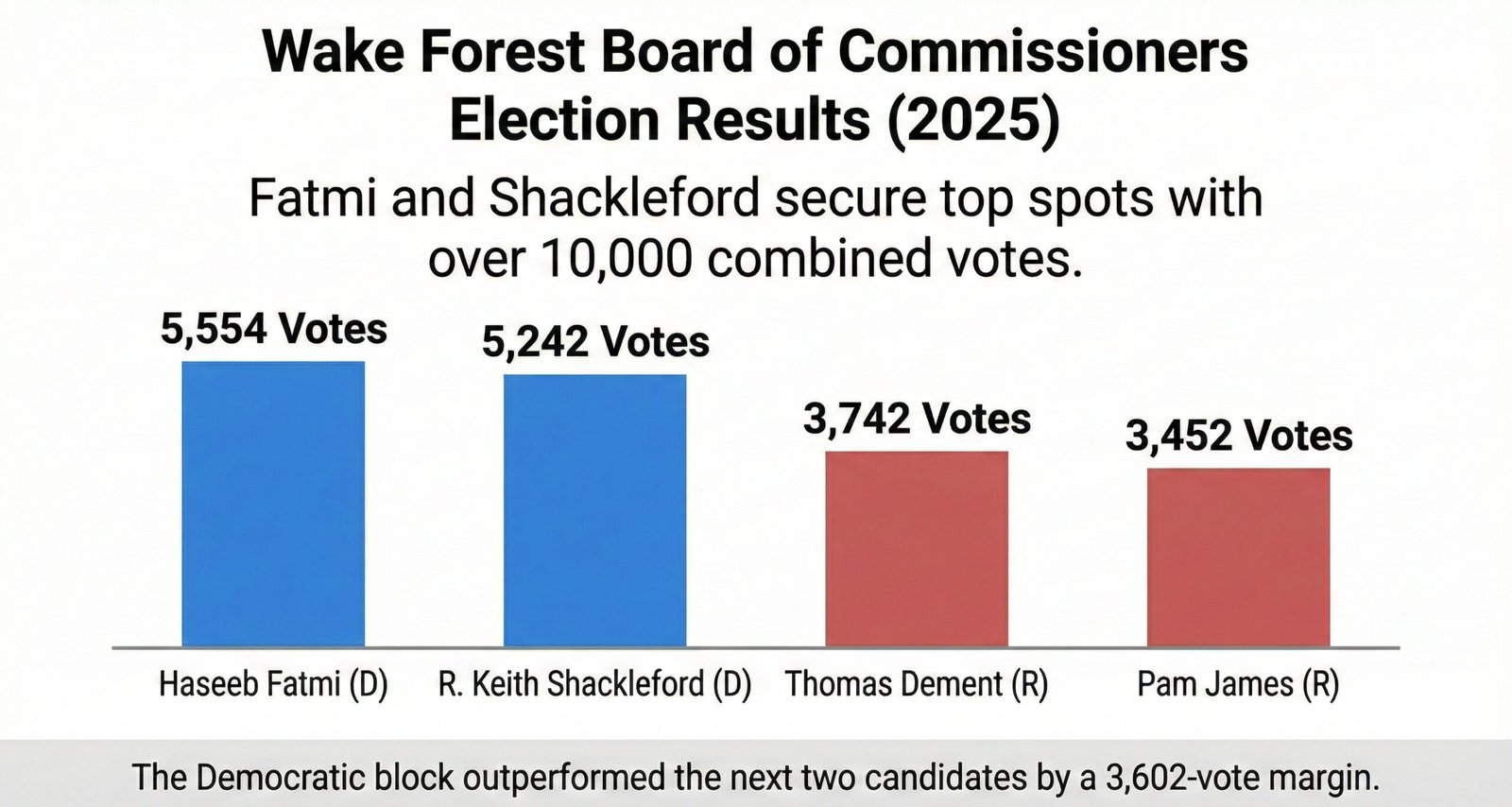
The result is a Board that looks radically different, not just in party, but in profession. The new Democratic hegemony isn’t driven by activist energy, but by a “Managerial-Legal Alliance.” This trio represents the new center of gravity: rigorous, procedural, and focused on managing the town’s growth.
Mayor Ben Clapsaddle: A retired Army Colonel and former project manager who ran on prioritizing proactive infrastructure, fiscal responsibility, and equitable representation for all.
Commissioner Haseeb Fatmi: Freshman member of the Board, an attorney and process-oriented progressive. Commissioner Fatmi has the distinction of winning the most votes of any candidate in 2025.
Commissioner Keith Shackleford: Served as Mayor Pro-Tem on previous Board, a resident with deep roots, a long-serving local attorney, and an institutionalist who serves as the bridge between the town’s history and its future.
Conversely, Commissioner Faith Cross remains the sole Republican on the Board. Elected in 2023 with the backing of Wake County GOP and Christian conservative groups, she represents the “social conservative” wing. However, with the defeat of her ideological allies in 2025, Cross is politically isolated.
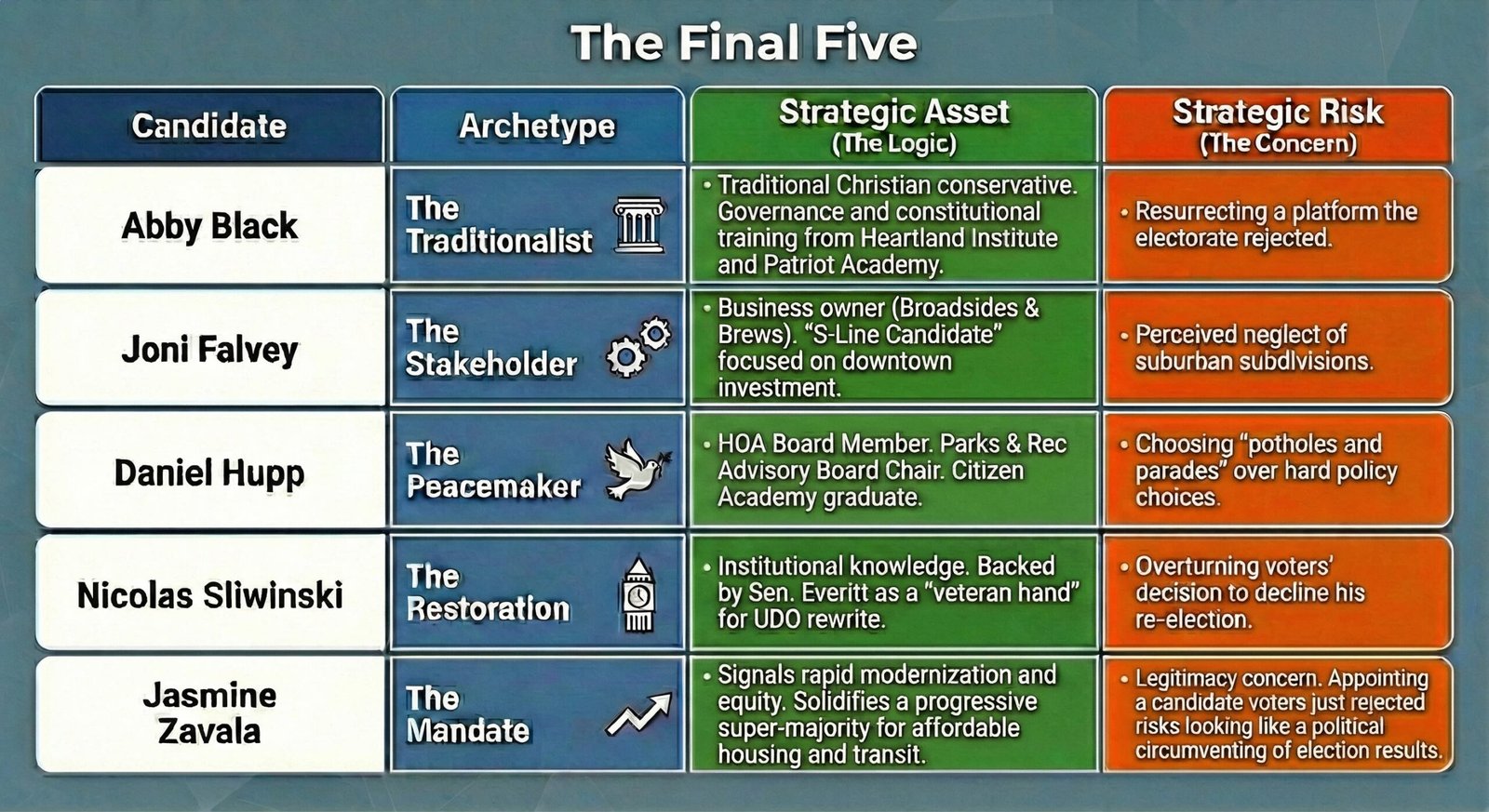
The Final Five
From a pool of fifteen applicants, five finalists have emerged to fill the empty seat. Wake Forest Matters has conducted a review of their application dossiers to understand who they are and who they represent.
How the final candidates represent distinct paths for the future of the Board.
The Bellwether of the Burbs
Ultimately, what is happening in Wake Forest is not an isolated municipal event; it is a microcosm of the tectonic forces reshaping American politics.
Wake Forest serves as a perfect case study for the “Revolt of the Suburbs.” Just as we have seen in collar counties outside Atlanta, Philadelphia, and Phoenix, the “Old Guard” Republican establishment, once the undisputed kings of the cul-de-sacs, has been squeezed out by a pincer movement of demographics and polarization. On one side, they face a diversifying electorate that is younger, more educated, and less religiously affiliated. On the other hand, they are sabotaged by an internal purity test that alienates the very moderate conservatives who once made up their base.
The collapse of the “Jones Coalition” mirrors the collapse of the pre-Trump suburban consensus nationwide. When the local GOP chose to prioritize nationalized cultural wars over competence, they accelerated the exodus of the professional class toward a new “managerial center.”
The Board’s decision on this vacancy is therefore more than a hiring decision; it is a signal to the rest of North Carolina and the country. It will determine if this suburban revolt is a temporary fever to be managed with compromise or a declaration that the old order is truly dead.
Mayor Clapsaddle ran on the slogan “Forward-Together.” This appointment will reveal exactly how the Board interprets that mandate. Is “Forward” a sprint toward modernization, or a deliberate march that brings everyone along?
Local government shifts affect us all. Share this analysis to start the conversation with your neighbors.
Methodology Note:This report is based on an exhaustive review of official election data from 2000–2025, U.S. Census data, and an analysis of the application dossiers obtained by Wake Forest Matters via a public records request to the Town Clerk.
Tom Baker IV is the publisher of Wake Forest Matters, Wake Forest’s only independent local newsroom. A Wake Forest native, Navy veteran, and intelligence professional, Tom launched Wake Forest Matters to bring serious accountability journalism to his hometown. Tips and story ideas: publisher@wakeforestmatters.com