Two Jurisdictions, One Wake Forest: While we all share the same local identity, your address determines how you vote and how you’re taxed.
Wake Forest is in a season of major decisions: new housing, changing traffic patterns, rezonings, and long‑range planning that will shape the town for decades.
If you listen to public meetings or local conversations, you’ll hear a wide range of perspectives—but a common source of confusion shows up again and again:
Two neighbors can share the same Wake Forest “identity” (ZIP code, schools, stores, local roads) and still fall under different legal jurisdictions.
That isn’t a judgment about anyone’s choices or where anyone “belongs.” It’s simply how municipal government works in North Carolina—and understanding it helps everyone have a clearer, calmer conversation about growth and local decision‑making.
Step One: Find Your Jurisdiction (It’s not always obvious)
Before diving in, it helps to know which rules apply to your address. The Town provides an ETJ address lookup tool for determining whether a property is inside the Town Limits, in the ETJ, or outside Wake Forest’s jurisdiction. Wake Forest, NC Maps
You can also see the overall “shape” of these boundaries on Wake Forest’s Town Jurisdictions map (December 2018).
Two Jurisdictions, One Community
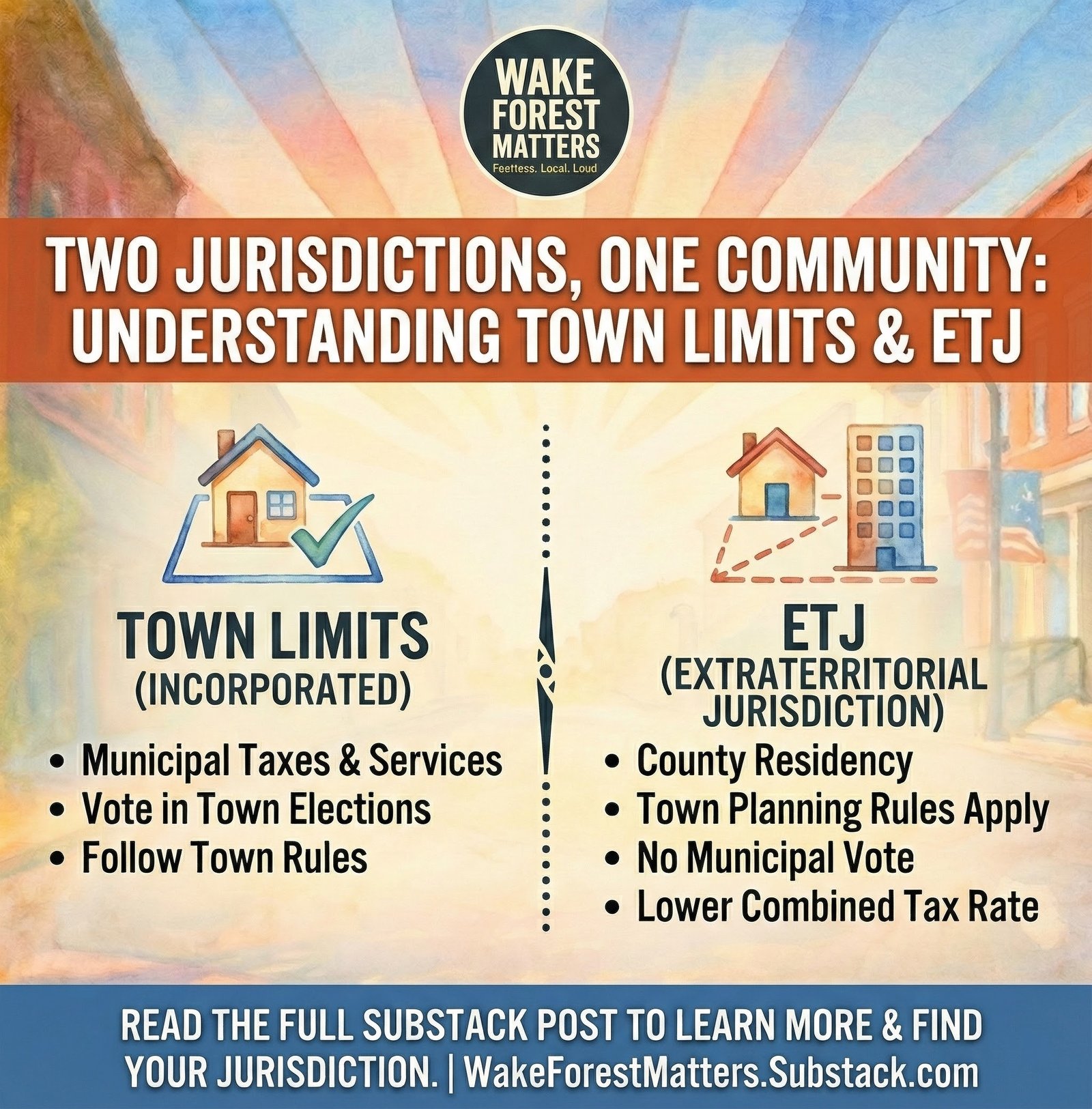
1) Corporate Limits (Wake Forest Town Limits)
If you live inside the Wake Forest Town Limits, you are part of the incorporated municipality.
In practical terms, that usually means:
You pay Wake County property taxesandWake Forest municipal property taxes
You receive municipal services provided by the Town (along with county services that everyone receives)
You vote in Wake Forest municipal elections (Mayor and Board of Commissioners)
2) Extraterritorial Jurisdiction (ETJ)
If you live in the ETJ, you live outside the Town Limits in unincorporated Wake County—but your property is still subject to Wake Forest’s planning and development rules.
Wake Forest explains it this way: properties within the Town Limits or the ETJ are assigned to a zoning district, and areas in the ETJ follow the Town’s zoning and building regulations (rather than county zoning) so that development and infrastructure can be planned consistently as the Town grows. Town of Wake Forest, NC
North Carolina law allows a municipality’s ETJ to extend beyond its border up to:
1 mile for any city,
up to 2 miles for cities between 10,000 and 25,000 population, and
Town Limits = municipal government + municipal taxes + municipal elections
ETJ = county residency, but town planning rules apply
Neither status is “better.” They’re different legal arrangements—with different responsibilities and benefits.
Why Some Residents Vote in Town Elections—and Others Don’t
This is one of the most important (and most misunderstood) points:
People in the ETJ do not vote in Wake Forest municipal elections.
People in the Town Limits do vote in Wake Forest municipal elections.
That difference isn’t about whether someone is “from here” or whether their concerns matter. It’s about how election eligibility is defined: municipal elections are limited to residents of the municipality (within the corporate limits).
A helpful nuance: ETJ residents can still have formal input—just not through the ballot
State law requires ETJ representation on specific appointed boards (such as the planning board and board of adjustment) when those boards have authority in the ETJ. North Carolina General Assembly
Wake Forest also has an advisory board application process that explicitly includes ETJ residents, and the Town has previously requested ETJ applicants for planning roles. Town of Wake Forest, NC
So while ETJ residents don’t vote in Town elections, there are structured ways for ETJ residents to participate in planning oversight—alongside public comment, emails, community meetings, and county‑level engagement.
A Practical Example: The Property Tax Difference (A $500,000 Home)
A common question is: “If the Town is making zoning decisions, why isn’t voting automatic?”
One reason this gets complicated is that Town Limits and ETJ residents typically contribute to local government budgets in different ways—primarily through municipal property taxes.
Note: This comparison is about property tax rates. It doesn’t include fees, utilities, or special districts that can vary by neighborhood. Tax rates also change over time.
What That Difference Generally Supports
That additional municipal property tax helps fund the Town’s services and operations—things like local public safety functions, staffing, administration, planning, parks, street maintenance for Town‑maintained streets, and other town‑provided programs and amenities.
At the same time, it’s also true that many essential services are county or state responsibilities, no matter where you live (schools, many major roads, courts, public health, etc.). Wake Forest and Wake County are both part of daily life for almost everyone in the area—just in different ways.
So What Does This Mean for “Voice” and “Buy‑In”?
A neutral way to describe the “social contract” here is:
Living inside Town Limits means you take on municipal taxes and receive municipal services—and you elect the leaders who manage those municipal responsibilities.
Living in the ETJ means you keep county residency and typically pay a lower combined property tax rate—but the Town’s development rules still govern your property, and your participation is routed through ETJ representation and public process rather than municipal elections.
Understandably, people sometimes feel surprised by this arrangement—especially because the “Wake Forest” identity doesn’t stop at the Town Limits sign.
Paths Forward for ETJ Residents Who Want Municipal Voting (and Services)
Use the Town’s ETJ lookup and advisory board application process, Wake Forest NC Maps
submit comments during public hearings,
engage with Wake County leadership on county‑level issues, and
participate in community groups that influence priorities and outcomes.
Moving the Conversation Forward
Wake Forest is one community, even when the legal boundaries are different.
The goal of understanding Town Limits vs. ETJ isn’t to rank anyone’s opinions or assign anyone a “right” to care. It’s to clarify how municipal authority, services, and elections are structured—so conversations about development and growth can be more informed and less frustrating for everyone.
Tom Baker IV is the publisher of Wake Forest Matters, Wake Forest’s only independent local newsroom. A Wake Forest native, Navy veteran, and intelligence professional, Tom launched Wake Forest Matters to bring serious accountability journalism to his hometown. Tips and story ideas: publisher@wakeforestmatters.com