If the Capital Improvement Plan (CIP) is a window into the soul of the town’s bureaucracy, then the view for 2026-2031 is expensive.
Tonight, (January 6), the Board of Commissioners will review the Updated CIP for FY 2026-2031. Last year, the town’s “identified need” in the 2025-2030 Capital Improvements Plan (CIP) Update had hit a staggering $496 million
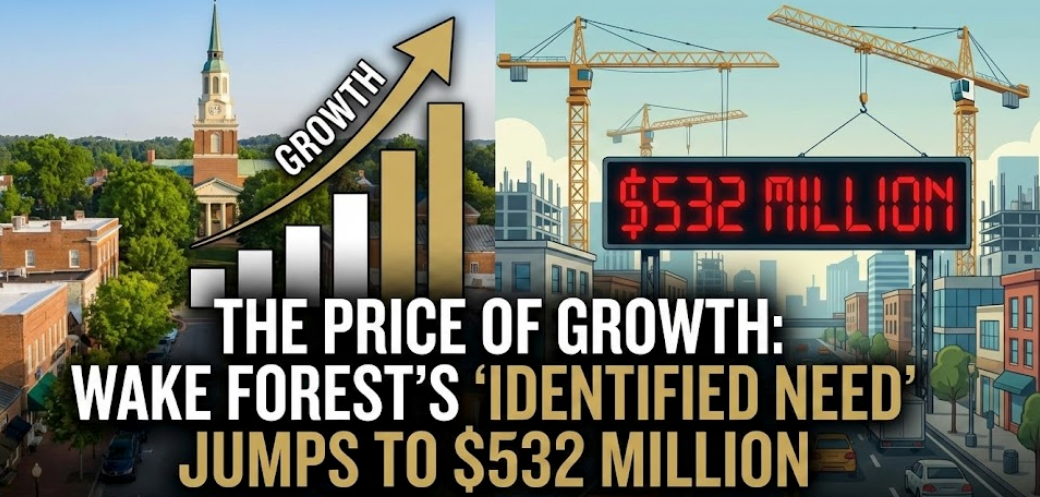
That number is now $532 million, according to the 2026-2031 CIP Update
In just 12 months, the cost to build the infrastructure, parks, and facilities required by our explosive growth has increased by $36 million. Even more striking is the immediate bill: The funding request for Year 1 (FY 2026-2027) alone is $91.7 million.
Here is the breakdown of the new plan, how it compares to the previous one, and what residents should watch for during tonight’s discussion.
The New Number: $532 Million vs. $496 Million
The increase to $532 million indicates that inflation and scope creep remain concerns. But the real story is in what is driving that number.
While the previous CIP focused heavily on “Pavement Preservation” and playing catch-up, this new plan is dominated by massive facility construction and greenway expansion.
The Big Ticket Items for Year 1 (FY 26-27): The town has identified $91.7 million in needs for next year. Where is it going?
Fire Station #6: This is the big one. The plan allocates $17.3 million in Year 1 for this new station. It is moving from “planning” to “debt issuance” this spring.
Greenway Expansion: The 2022 bond funds are being deployed. Smith Creek Greenway Phase 2 & Trailhead is slated for $6.3 million in Year 1, and Phase 3 is another $2.7 million.
Town Hall “Maintenance”: This is a sleeper item. The CIP lists $5.85 million in Year 1 for “Town Hall Maintenance.” Looking at the details, this isn’t just fixing leaks; it includes a significant renovation of the ground and first floors and HVAC overhauls.
The Comparison: What Changed from Last Year?
Comparing this document to the FY 25-30 plan reveals shifting priorities:
The Pavement Pause? Last year, “Pavement Preservation” was the headline emergency. In this new plan, the Street Resurfacing & Pavement Condition Survey (AM-3) project shows only $100,000 allocated for Year 1. While there is a separate $381,000 item for “Preservation and Maintenance,” the significant paving construction funds ($1.85M+) do not appear until Year 2 (FY 27-28). Did we fix the roads, or did we kick the can?
S-Line Reality Check: The town is investing significant funds in the S-Line rail project. The plan allocates $2.6 million in Year 1 for the NCDOT S-Line Project, specifically for “mobility hub” planning and grants. This confirms that the town is betting heavily on the train’s arrival.
The “Wish List” grew: The Mobility Hub Building (a $32.7M parking/transit structure) has been pushed to the future (Year 5), but it remains on the books as a massive unfunded liability.
What Residents Should Watch Tomorrow
When the Board discusses this tomorrow night, look past the PowerPoint slides and ask these three questions:
1. The Debt Load: The CIP shows $22.9 million in “Installment Purchase” funding for Year 1. This is essentially putting projects on the town’s credit card (separate from the voter-approved bonds). With debt service already rising, how will this new borrowing impact the tax rate?
2. The Town Hall Renovation: A $5.85 million renovation to Town Hall in a single year is a significant expense. Is this strictly necessary for operations, or is it an aesthetic upgrade happening while neighborhood street paving appears to be paused?
3. The “Unfunded” Future: Look at the “GO Bonds” lines. There is $175 million allocated to a “Future Referendum 2028,” plus another $80 million for a future, undated referendum. That is over $250 million in projects (such as the S. Main Street corridor and the Miller Park expansion), contingent on future votes. This CIP is effectively the blueprint for the subsequent two bond campaigns.
Review the 2026-2031 Capital Improvements Plan Update Here: https://www.wakeforestnc.gov/budget-management/capital-improvement-plan-cip
The Bottom Line
The cost of living in a “boom town” is showing up on the bill. We have moved from a $496 million problem to a $532 million problem in one year.
Meeting Details:
What: CIP Work Session (FY 2026-2031)
When: Tuesday, Jan 6, 2026
Where: Board Chambers, Wake Forest Town Hall, 301 S. Brooks Street.
Why it matters: Because $91.7 million of decisions are being made right now.
Tom Baker IV is the publisher of Wake Forest Matters, Wake Forest’s only independent local newsroom. A Wake Forest native, Navy veteran, and intelligence professional, Tom launched Wake Forest Matters to bring serious accountability journalism to his hometown. Tips and story ideas: publisher@wakeforestmatters.com