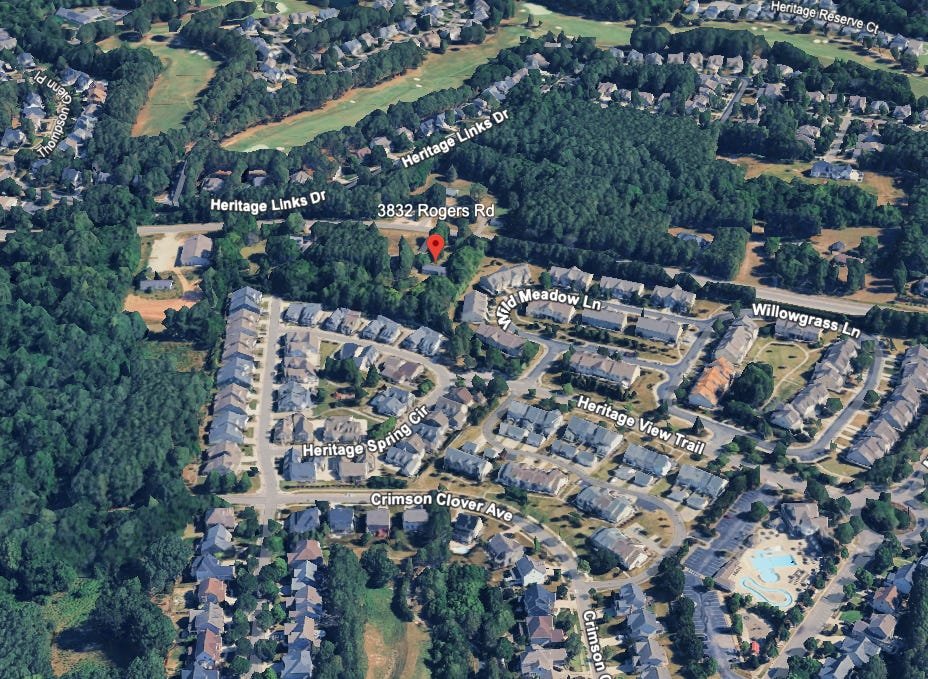
If you drive Rogers Road daily, you know the spot. It’s that dense patch of trees on the south side, right across from the entrance to Heritage Links Drive and just west of the Golden Poppy Court cul-de-sac.
The subject property at 3832 Rogers Road, Wake Forest, NC.
Right now, it’s a quiet, green buffer. But on December 4th, the owner and developer will present a plan to rezone this 3-acre parcel from Residential (R-30) to Neighborhood Mixed-Use (NMX-CD). Their goal is to build a daycare and office space.
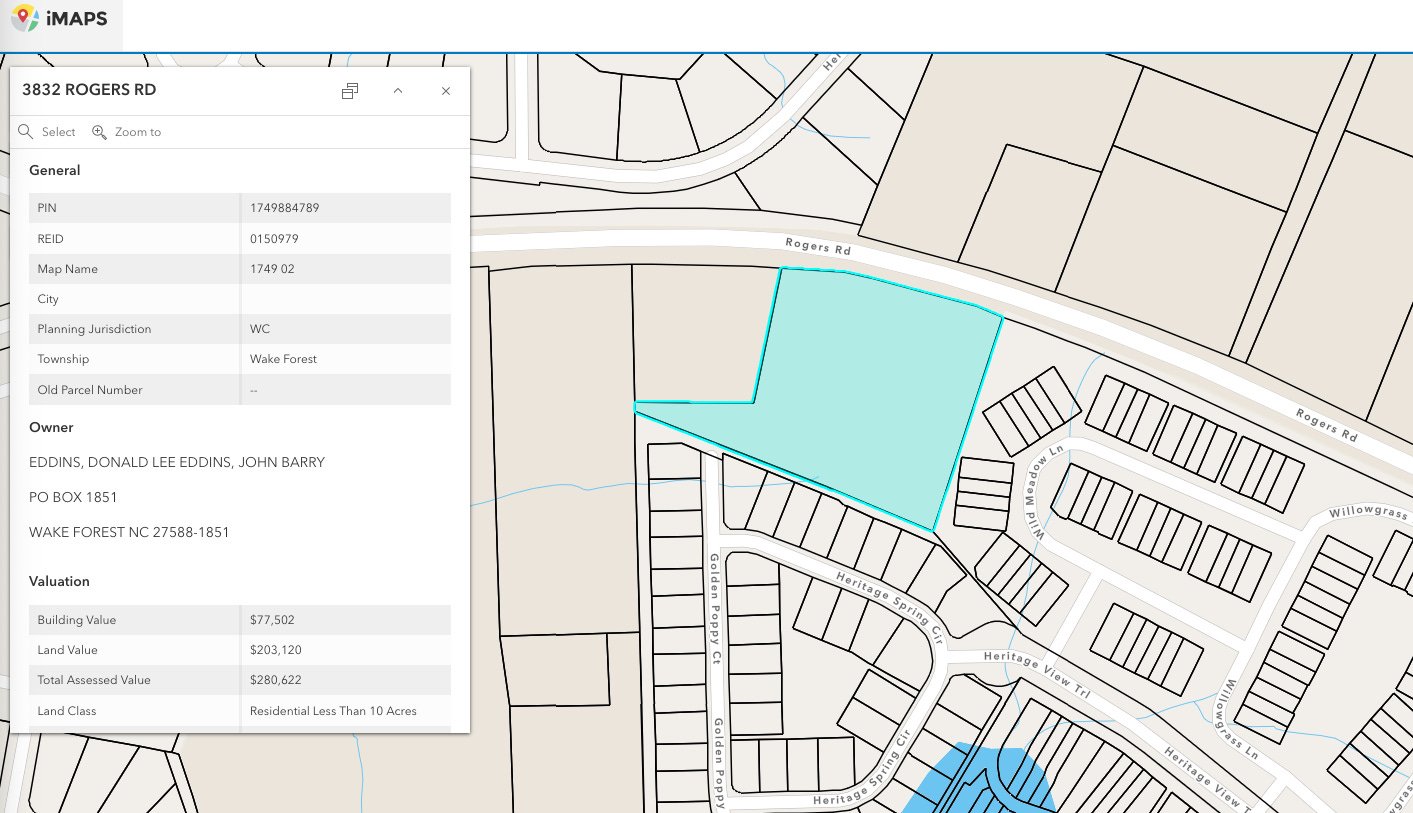
A snapshot from Wake County’s iMAPS system showing the parcel’s current boundaries and its total assessed tax value of $280,622.
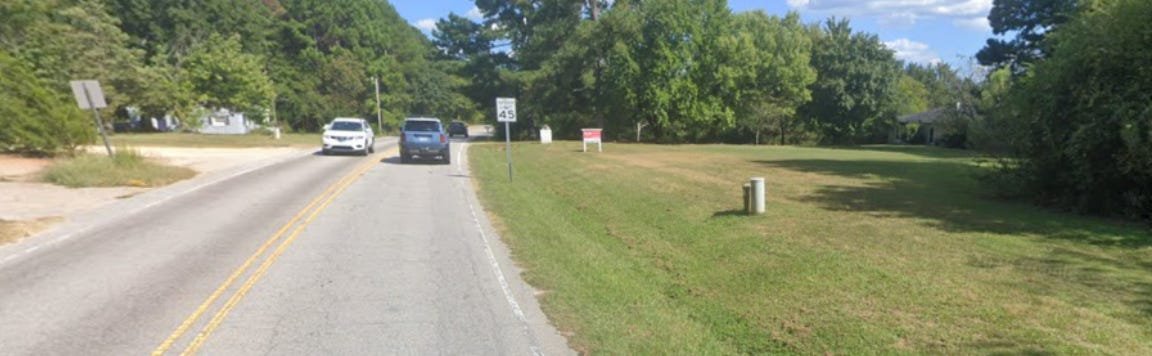
Street View (Heading West): A view traveling west on Rogers Road. The subject property is seen on the left. This perspective highlights the proximity to the road and the street’s existing residential character.
Street View (Heading East): A view traveling east on Rogers Road. The subject property is on the right, currently an open grassy lot with a “For Sale” sign, backing up to the tree line.
For our community—ranging from young families in Heritage Spring to retirees on the golf course—this isn’t just about “one more building.” It’s a classic case of Town Finances vs. Neighborhood Quality of Life.
Here is the balanced breakdown of why this matters, depending on where you sit.
The Case FOR the Rezoning (The “Fiscal Hawk” Perspective)
Why is this good for your tax bill and town services?
If you are a retiree on a fixed income or a resident concerned about rising property taxes, this proposal has a substantial upside: Math.
The “Cash Cow” Effect: Commercial properties (like offices) typically pay significantly more in property taxes per acre than residential homes. They are the “anchor” that stabilizes the town budget.
The School Service Gap: If this land stays Residential (R-30), a developer could build 3 or 4 large homes. Those homes would likely add children to our already crowded schools (Heritage Elementary/Middle/High).
Reality Check:In Wake County, residential property taxes rarely cover the full cost of educating the students who live there.
Low Impact Services: An office building doesn’t require school buses, doesn’t use the library, and doesn’t flush toilets at 7:00 PM. It pays into the system without drawing heavily from it.
The Verdict: If you want robust town services (police, fire, parks) without your taxes fluctuating wildly to pay for new schools, commercial zoning like this is the “vegetables” of a healthy town diet.
The Case AGAINST the Rezoning (The “Neighborhood” Perspective)
Why are immediate neighbors worried?
If you live on Golden Poppy Court, Heritage Spring Circle, or Wild Meadow Lane, the “tax base” argument feels abstract when you’re staring at a construction site.
The “Traffic Peak” Problem: A daycare operates differently from an office. It creates two massive spikes in traffic: morning drop-off (7:30–9:00 AM) and evening pick-up (4:30–6:00 PM). Rogers Road is already a major artery; adding 50+ cars turning left during rush hour is a valid safety concern.
Noise & Privacy: Currently, the residents on Golden Poppy Court have a thick forest as a backyard neighbor. Swapping that for a daycare playground means trading silence for the sound of children playing. While joyful, it is a significant change in noise levels for abutting properties.
Loss of Green Canopy: That 3-acre patch provides visual relief and helps absorb drainage. Paving it over for a parking lot changes the character of the Rogers Road corridor from “scenic” to “suburban strip.”
The “Third Way”: The Conditional District
How to find the middle ground.
Most people want a town that works and a peaceful home. This is where the “CD” in the zoning application (NMX-CD) becomes your best friend.
“Conditional District” means the developer isn’t just asking for a blank check; they have to agree to specific rules to get approved. This is where the neighborhood can negotiate.
Instead of a binary “YES” or “NO,” attendees at the meeting can push for Conditions that mitigate the “Cons” while keeping the “Pros”:
The Buffer Condition: Ask for a 50-foot undisturbed vegetative buffer along the property lines shared with Golden Poppy Court, rather than the standard 10 or 20 feet. (Keep the trees!)
The Lighting Condition: Require that all parking lot lights be “full cutoff” (pointing down) and turned off one hour after closing to protect the night sky for Heritage Links residents.
The Access Condition: Discuss a “Right-in/Right-out” turn lane on Rogers Road to prevent dangerous left turns during rush hour.
Why You Should Go
Whether you are a YIMBY (Yes In My Backyard) who wants a stronger tax base, or a neighbor who wants to protect your peace, the outcome is decided by those who show up.
Meeting Details:
Date: Thursday, December 4, 2025
Time: 6:00 PM
Location:Joyner Park Community Center (703 Harris Rd, Wake Forest, NC 27587)
Don’t just go to fight. Go to shape the result.
Here is a guide to help you and your neighbors prepare for the meeting. This is designed to move the conversation from “Angry Mob” to “Strategic Negotiation,” which is far more effective in getting what you want.
The Strategy: “Yes, If…”
The most powerful phrase in a zoning meeting isn’t “NO.” It is “We could support this, IF…”
When you say “No,” the developer ignores you and hopes they have the votes on the Town Board. When you say “Yes, if…” you are offering them a path to approval, but only on your terms. This makes them motivated to solve your problems.
Section 1: The “Smart Neighbor” Question List
Don’t just ask general questions. Ask technical ones that force them to make specific commitments.
Topic A: Traffic & Safety (The Big One)
The Context: Daycares have distinct “pulse” traffic—everyone arrives between 7:30–9:00 AM and leaves between 4:30–6:00 PM.
The Questions:
“Have you performed a trip generation study specifically for a daycare of this size? What are the projected peak AM and PM trip numbers?”
“Will you commit to a Right-In/Right-Out only entrance on Rogers Road to prevent dangerous left turns across traffic during rush hour?”
Topic B: Buffers & Privacy
The Context: You don’t want to see the parking lot, and you don’t want to hear the playground.
The Questions:
“The standard buffer is often 15-20 feet. Would you be willing to commit to a Type A Opaque Buffer of 50 feet along the rear property line shared with Golden Poppy Court?”
“Will this buffer be ‘undisturbed’ (leaving existing trees) or ‘planted’ (you cut everything down and plant small saplings)? We strictly prefer undisturbed.”
“Will there be a fence in addition to the trees? If so, what material? (Ask for vinyl or wood privacy fencing, not chain link).”
Topic C: Noise & Operations
The Context: A daycare playground is noisy. An office is silent. You need to manage the loud part.
The Questions:
“Where is the playground located on the site plan? Can you commit to placing the playground on the Rogers Road side of the building, so the building itself acts as a sound shield for the neighbors in the back?”
“Will you agree to a condition that no outdoor amplification systems (speakers, bells) will be used?”
“What are the proposed hours of operation? Will you commit to no business operations after 7:00 PM?”
Topic D: Lighting
The Context: You don’t want your backyard lit up like a stadium at night.
The Questions:
“Will you commit to using Full Cutoff LED fixtures (shoebox style) that direct light 100% downward?”
“Will you agree to a ‘house-side shield’ on any pole lights near the residential property lines?”
“Can you write a condition that parking lot lights will be dimmed or turned off one hour after closing?”
Section 2: Engagement Etiquette (How to Win)
Assign Roles: Don’t have 10 people ask about traffic. Have one “Traffic Person,” one “Buffer Person,” and one “Noise Person.” It makes you look organized and formidable.
Get it in Writing (The “Conditions”): This is a Conditional District (CD) rezoning. That means if the developer says, “Sure, we can do that” at the meeting, you must say: “Great. Will you add that to the formal List of Conditions in your application?”
Note: If it’s not on the list of conditions, it doesn’t exist.
Be the “Good” Neighbors:
Bad Approach: “You’re greedy and ruining our town!” (Developer shuts down, gets defensive).
Good Approach: “We understand this is a good location for a business, but we have families here. We need to find a way to make this invisible and inaudible from our backyards. How can we work together on that?” (Developer sees a path to winning and cooperates).
Take Notes: Designate one person to take minutes. If the attorney says, “We won’t cut down those oak trees,” write it down, date it, and email it to the Town Planning Director (Jennifer Currin) the next day.
A Note on Civility and the “Commons”
Finally, a word on how to approach Wednesday night.
Neighborhood Meetings can easily become heated. It is natural to feel protective of your home, your view, and your peace. It is also natural to worry about the rising cost of living and the future solvency of our town. These are not opposing values; they are just different priorities bumping into each other on a map.
When we, as neighbors, walk into the Joyner Park Community Center, let’s leave the “Us vs. Them” mentality at the door. The developer is not a villain; they are a business person looking for an opportunity. The neighbor who speaks in opposition to the project is not a “NIMBY obstructionist”; they are a resident trying to protect their sanctuary. The supporter is not a “sellout”; they are a citizen concerned about the tax burden on our community.
We all share the same roads. We all rely on the same police and fire departments. We are all stewards of the same “commons.”
The best outcome for Wake Forest won’t come from shouting matches or silence. It will come from rigorous, specific, and civil debate. It comes from looking at a map, doing the math, and finding a solution that respects the neighborhood while funding the future.
So, bring your questions. Bring your concerns. But most importantly, bring an open mind and a handshake for your neighbors—regardless of which side of the issue they stand on.
Tom Baker IV is the publisher of Wake Forest Matters, Wake Forest’s only independent local newsroom. A Wake Forest native, Navy veteran, and intelligence professional, Tom launched Wake Forest Matters to bring serious accountability journalism to his hometown. Tips and story ideas: publisher@wakeforestmatters.com