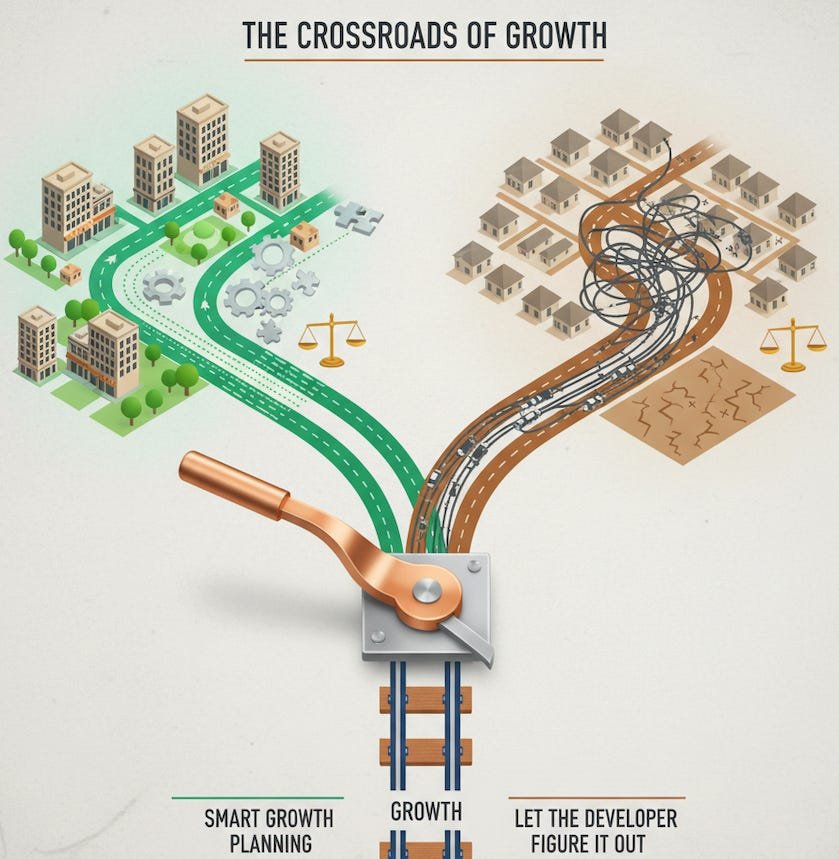
The choices we make about growth profoundly shape our community’s future. This visual illustrates the two distinct paths Wake Forest faces: one of thoughtful, integrated “Smart Growth Planning” that leads to fiscal balance and a thriving town, and another of uncoordinated development that often leaves us with sprawling, inefficient outcomes. Which path will we choose?
If you’ve ever attended a public hearing for a controversial development, you’ve heard the frustrated question from the public: “Why can’t the Town just say no?”
One key reason growth feels out of control is that, by design, much of it is beyond the Town Board’s direct discretion. This isn’t a local choice; it’s a matter of state law. Under North Carolina’s Chapter 160D, our foundational land-use law, if a developer’s subdivision or site plan meets the standards already written in our town ordinances, its approval is often a simple administrative matter.
Furthermore, legal concepts such as “permit choice” and “vested rights” can lock in projects based on the rules in place when they filed their applications, even if the community’s vision has changed. This reality deeply frustrates residents—and, often, the local elected officials who have to approve projects they may not personally support.
But “our hands are tied” is not the same as “we are helpless.” Wake Forest still has meaningful tools to shape its future, if we have the foresight to use them methodically. The key is to shift our power from the end of the process (the public hearing) to the beginning (the rule-writing).
Here are the tools we still have:
Conditional Zoning with Clear Policies: This is our most potent tool. Instead of a simple “yes/no,” conditional zoning allows the Town to approve a project subject to specific conditions. But this only works if those conditions are based on clear, adopted policies for things like connectivity, multimodal design, and architectural standards.
Development Agreements: For large, complex sites, the Town can negotiate binding development agreements. These can lock in developer obligations for time-phased infrastructure, cost-sharing for public amenities, and performance triggers that must be met before the next phase can be built.
Impact & Utility Fees: Within the authority granted by the state, we can and must charge fees that reflect the real, auditable costs new development imposes on our water, sewer, and transportation systems. These must be reviewed regularly to ensure they match reality.
“Fix-It-First” Capital Policy: We can align our capital improvement plan with our growth approvals. This means approvals for new projects should be timed to match the funded capacity on our key corridors.
Radical Transparency: A simple public-facing dashboard showing project statuses, traffic mitigation plans, and delivery milestones would build public trust and hold both staff and developers accountable.
State law may set the rails, but it does not prevent us from planning the route. The more specific, defensible, and clear our policies are on the front end, the better our outcomes will be on the back end.
Tom Baker IV is the publisher of Wake Forest Matters, Wake Forest’s only independent local newsroom. A Wake Forest native, Navy veteran, and intelligence professional, Tom launched Wake Forest Matters to bring serious accountability journalism to his hometown. Tips and story ideas: publisher@wakeforestmatters.com