
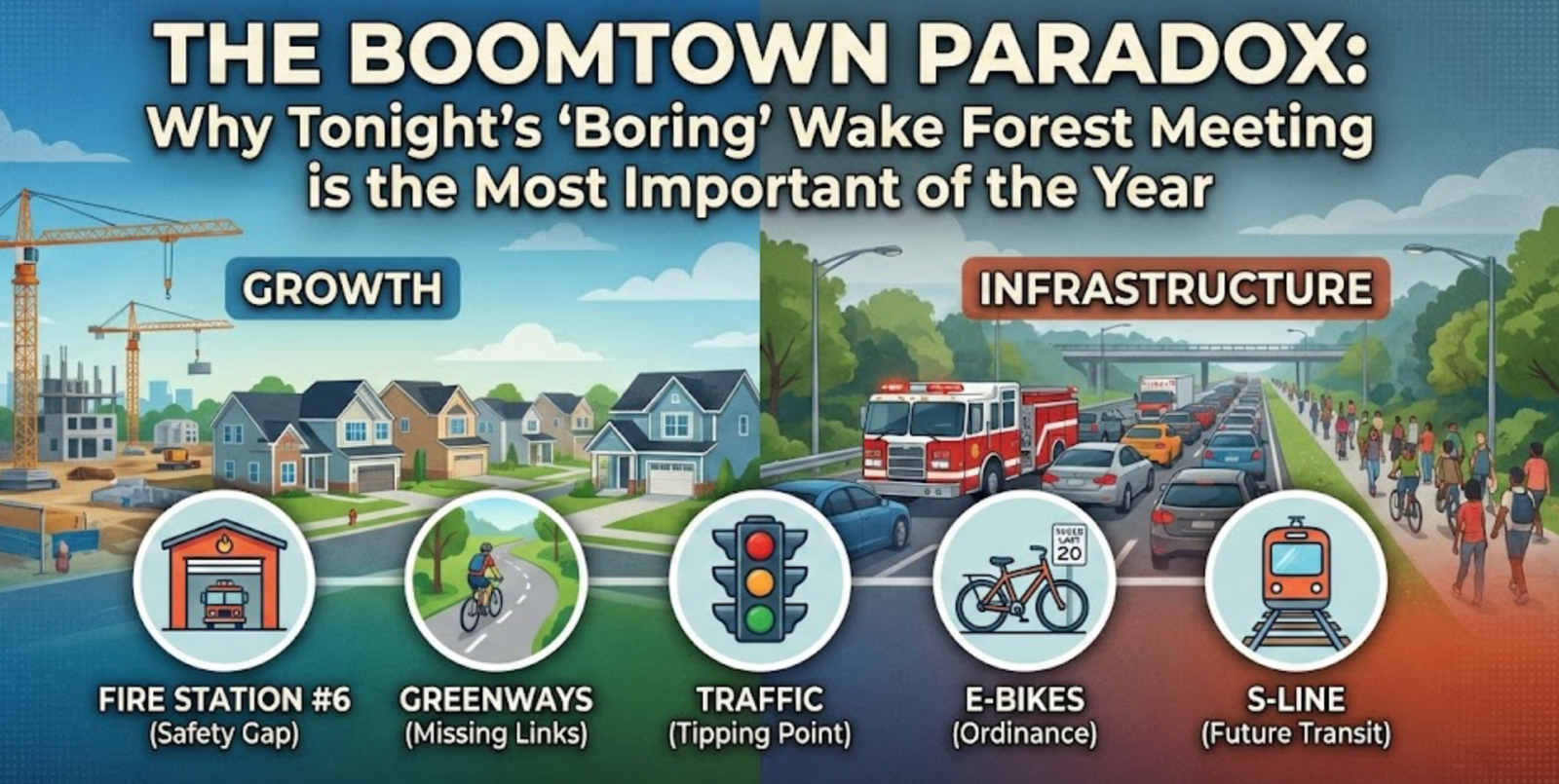
To the uninitiated observer, the agenda for the Wake Forest Board of Commissioners (BOC) meeting on January 20th might appear to be a standard procedural list, a collection of contract approvals, ordinance tweaks, and routine annexations. A superficial reading suggests a municipality simply keeping the lights on: paying for traffic signals, updating parking rules, and accepting federal grants.
However, a forensic analysis of the agenda packet, historical context, and the town’s long-term financial planning reveals a pivotal moment for Wake Forest.
The town currently stands at a friction point, a moment of profound tension between two opposing forces. On one side is the rapid, inexorable pressure of residential growth, exemplified by the Rosedale developments and the sprawling subdivisions pushing the Extraterritorial Jurisdiction (ETJ) limits. On the other is the desperate race by municipal infrastructure, fire protection, traffic management, and connectivity, to catch up.
The decisions made in the Town Hall board chambers tonight will not merely authorize spending; they will define the town’s operational capability and legal authority for the next decade. This is not just a meeting about paying bills; it is a meeting about securing the physical and legal framework of Wake Forest.
Below is an analysis of the six most critical items on the agenda.
1. The Safety Infrastructure Gap: Fire Station #6 and the Cost of Delay
- Agenda Reference: Item 8.A (CIP Update – Priority 1)
- Location: 1621 and 1701 Wait Avenue
- Total Project Cost: $17,379,000 (Debt issuance scheduled for March/April 2026)
While not listed as a standalone voting item on the regular agenda, Fire Station #6 is the silent center of gravity for tonight’s meeting. It permeates the Capital Improvement Plan (CIP) discussion (Item 8.A) and represents the town’s most significant immediate capital outlay.
Understanding the urgency of this facility requires looking beyond the ledger and into the operational realities of the Wake Forest Fire Department (WFFD). The primary driver for Fire Station #6 is the aggressive residential expansion in the northeast quadrant of Wake Forest. Residential density is the enemy of response times if infrastructure does not scale concurrently. Fire protection is governed by rigorous metrics of time and distance. The National Fire Protection Association (NFPA) Standard 1710 requires a response time of four minutes for the first engine company. Without Station #6, units responding to Wait Avenue and the surrounding Averette Road corridor are traveling from existing stations that are geographically ill-situated to meet these metrics during peak congestion.
Crucially, the meeting context reveals that Station #6 is not merely a garage for parking trucks; it is a regional training campus. The approved designs include a “Burn Building,” a training tower for high-rise simulations, and specialized zones for vehicle extrication. By localizing this capability, the town significantly reduces “out of service” time for crews, allowing them to train while remaining in their primary response district. This transforms a sunk cost into an operational multiplier.
The vote to approve the CIP today is effectively the “point of no return.” By approving the plan, the Board is committing to the debt service that will fund this $17M+ asset, acknowledging that a massive catch-up investment is no longer optional.
2. Bridging the Green Divide: The “Missing Link” Strategy
- Agenda Reference: Item 8.A (CIP Update – Smith Creek Phases 2 & 3)
- Funding: 2022 Bond Implementation
The Capital Improvement Plan includes significant funding allocations for the Smith Creek and Dunn Creek Greenways. To the urban planner, these are vital transportation arteries designed to stitch together a fragmented suburban landscape.
The CIP prioritizes two specific projects funded by the 2022 Bond Referendum. These are not merely extensions; they are “bridge” projects.
- Smith Creek Greenway Phase 2 ($6,341,000 – Priority 1): This 1.1-mile segment is a critical north-south connector extending from Burlington Mills Road to Ligon Mill Road. It connects the Kitchin Farms neighborhood directly to the greenway system, transforming the greenway from a destination residents must drive to into an amenity that starts at their doorstep.
- Smith Creek Greenway Phase 3 ($2,721,000 – Priority 1): This 0.8-mile segment bridges the gap between Ligon Mill Road and the existing Sanford Creek Greenway near Heritage High School.
Why This Matters Now
These projects represent the culmination of the “Missing Link” strategy. By completing Smith Creek Phases 2 and 3, Wake Forest effectively creates a continuous paved artery from the Heritage High School area all the way to the Neuse River. The CIP allocation in this agenda serves as the financial green light to move these projects from design to construction.
3. The Traffic Tipping Point: Forestville Road & Coach Lantern Avenue
- Agenda Reference: Item 5.B (Consent Agenda)
- Action: Approval of Construction Contract ($648,448)
Item 5.B on the Consent Agenda requests approval for a traffic signal contract at Forestville Road and Coach Lantern Avenue. While a single traffic light might seem trivial, the financial context of this bid is telling.
The CIP allocates a total of $640,000 for traffic signal projects in FY 2026-27 (split between project GTP-19 and GTP-19b). The bid for this single intersection is $648,448. This indicates that the Forestville/Coach Lantern signal is effectively consuming the entire annual allocation for signal projects.
The need for a signal here is driven by “hot spot” analysis. As development along Forestville Road has intensified, the delays for vehicles trying to exit Coach Lantern Avenue have reached unacceptable Levels of Service (LOS). By placing this on the Consent Agenda, staff is signaling that the delay is administrative and the solution is technical. The Board is simply clearing the backlog to get shovels in the ground.
4. Regulating the Micromobility Wave: The E-Bike Ordinance
- Agenda Reference: Item 5.C (Consent Agenda)
- Action: Ordinance Amendment (Chapter 30, Article III)
It was the passage of Senate Bill 576 in 2025 that finally clarified the regulatory authority of local governments to enforce specific restrictions on electric-assisted bicycles. Item 5.C is Wake Forest’s legislative response to this state mandate.
The Necessity of the Amendment The amendment focuses on aligning the town code with state law while addressing local safety concerns on crowded greenways.
- Defining the Classes: The ordinance aligns town code with the state’s definitions (Class 1, 2, and 3), clarifying what is a bicycle and what is a moped.
- Helmet Mandates: Utilizing the specific authority granted by SB 576, the town is moving to require helmets for riders under 18 (or potentially 16).
- Greenway Speed Limits: The ordinance likely codifies a speed limit on greenways for all devices. Since banning E-bikes entirely is legally complex, capping the speed allows the town to permit their use for commuting while mitigating the danger to pedestrians.
The CIP Connection
While the ordinance sets the rules, the CIP reveals the town is planning for E-bike infrastructure down the road. Project PWSW-7 (Microtransit Bicycle Library) envisions a town-run E-bike lending program, though funding ($25,000) is not slated until FY 2029-30. The ordinance tonight lays the legal groundwork for that future infrastructure.
5. The Legal Patch: Restoring the Handicap Parking Fine
- Agenda Reference: Item 5.F (Consent Agenda)
- Action: Ordinance Amendment (Chapter 30, Article IV, Section 30-131)
Document: Attachment_B_Ordinance_2026_XX_Chapter_30_Article_IV_Section_30-131.docx 1
Item 5.F stems from a significant disruption in North Carolina municipal law involving the decriminalization of local ordinances. Following the passage of Senate Bill 300 (2021), the General Assembly decriminalized many town ordinances to prevent citizens from accumulating criminal records for minor regulatory offenses.
However, this transition created a legal loophole. If an ordinance wasn’t explicitly rewritten to authorize civil penalties(tickets), the town lost its efficient enforcement mechanism. The amendment to Section 30-131 restores the town’s ability to issue civil citations for handicap parking violations. It ensures that Wake Forest Police have the clear legal standing to place a monetary ticket on the windshield of a violator, ensuring that accessibility rights are backed by enforceable law.
6. The Long Game: The S-Line Mobility Hub
- Agenda Reference: Item 8.A (CIP Update – Priority 1)
- Project Match: $2,625,000 (Project GTP-11)
Lurking in the high-priority section of the CIP is the NCDOT S-Line Project (GTP-11). This project is the linchpin of Wake Forest’s economic development strategy for the next 20 years.
It is important to distinguish between the two S-Line projects in the CIP. The $2,625,000 allocated in Priority 1 for FY 26-27 is specifically the local match required to unlock federal grant funding (likely RAISE or similar) for the planning, design, and right-of-way acquisition of the Mobility Hub.
This is distinct from the Mobility Hub Building (Project P-2), a separate $32.7 million line item for the actual vertical construction of the station, which remains unfunded in the current fiscal year and is slated for future bond referendums.
Insight: This investment signals that Wake Forest is betting the house on Transit-Oriented Development (TOD). By securing the land and design funds now, the town hopes to anchor downtown development and prevent the S-Line from becoming a bypass that ignores the local economy.
The Financial Blueprint: The “Maintenance Surge”
- Agenda Reference: Item 8.A (CIP Update)
- Total Year 1 Ask: $91,760,000
The Capital Improvement Plan is the roadmap for all the projects discussed above. The FY 2026-2027 allocation of $91.76 million is a staggering figure, but a closer look reveals that “keeping the lights on” is costing more than new growth this year.
While the headline-grabbing Priority 1 projects (like the S-Line match and Fire Station #6) total $36.8 million, they are actually outweighed by Priority 2 projects, which total $45.5 million. This inversion is driven by massive facility maintenance bills coming due:
- Town Hall Maintenance (AM-4): $5.85M allocated just for Year 1 to address HVAC and space reconfiguration.
- Ailey Young Park Improvements (PRCR-10): $5.55M allocated to rehabilitate this historic park.
- Fire Station #1 Renovation (PF-11): $8.8M total project cost looming in future years.
The story isn’t that the town is spending money; it’s how they are spending it. The fact that maintenance (Priority 2) is outpacing new growth (Priority 1) suggests a town that is working double-time: furiously building for the future while paying the deferred costs of the past.
Key Documents & Links
- Official Agenda & Packet
- 2026-2031 Capital Improvement Plan (CIP) Update
- E-Bike Ordinance Draft
- Handicap Parking Draft

Tom Baker IV is the publisher of Wake Forest Matters, Wake Forest’s only independent local newsroom. A Wake Forest native, Navy veteran, and intelligence professional, Tom launched Wake Forest Matters to bring serious accountability journalism to his hometown. Tips and story ideas: publisher@wakeforestmatters.com