
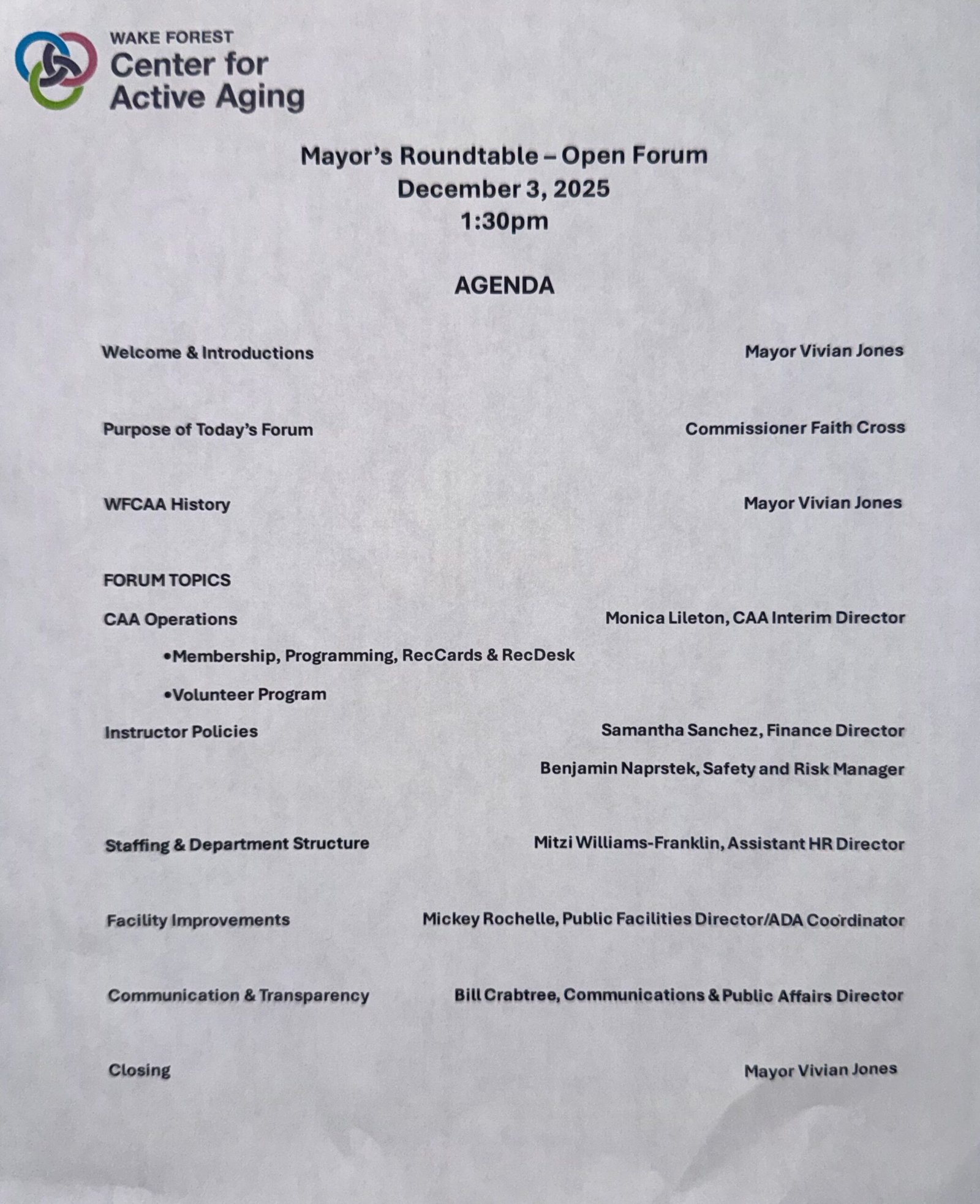
The air in the Wake Forest Center for Active Aging (WFCAA) was thick with anticipation on Tuesday, December 3, 2025. A packed room of concerned residents and stakeholders gathered for a Mayor’s Roundtable Open Forum, eager for clarity on the ongoing—and often confusing—transition of the Center from the non-profit Resources for Seniors (RFS) to the direct management of the Town of Wake Forest.
The overarching theme of the meeting, led by Mayor Vivian Jones and Commissioner Faith Cross, was to address the confusion and dispel the “lot of misinformation” that has circulated in recent weeks.
The Town’s first step was to address a key piece of early miscommunication: they apologized for initially messaging that there would be “no changes for the first full year,” a promise that proved impossible to keep. As Assistant HR Director Mitzi Williams-Franklin explained, unexpected circumstances—including staffing changes, HVAC challenges, and process adjustments—required the Town to act sooner than anticipated.
The Core Conflict: Why the Change Was Necessary
Why did the facility, previously known as the Northern Wake Senior Center, need to transition to municipal management at all?
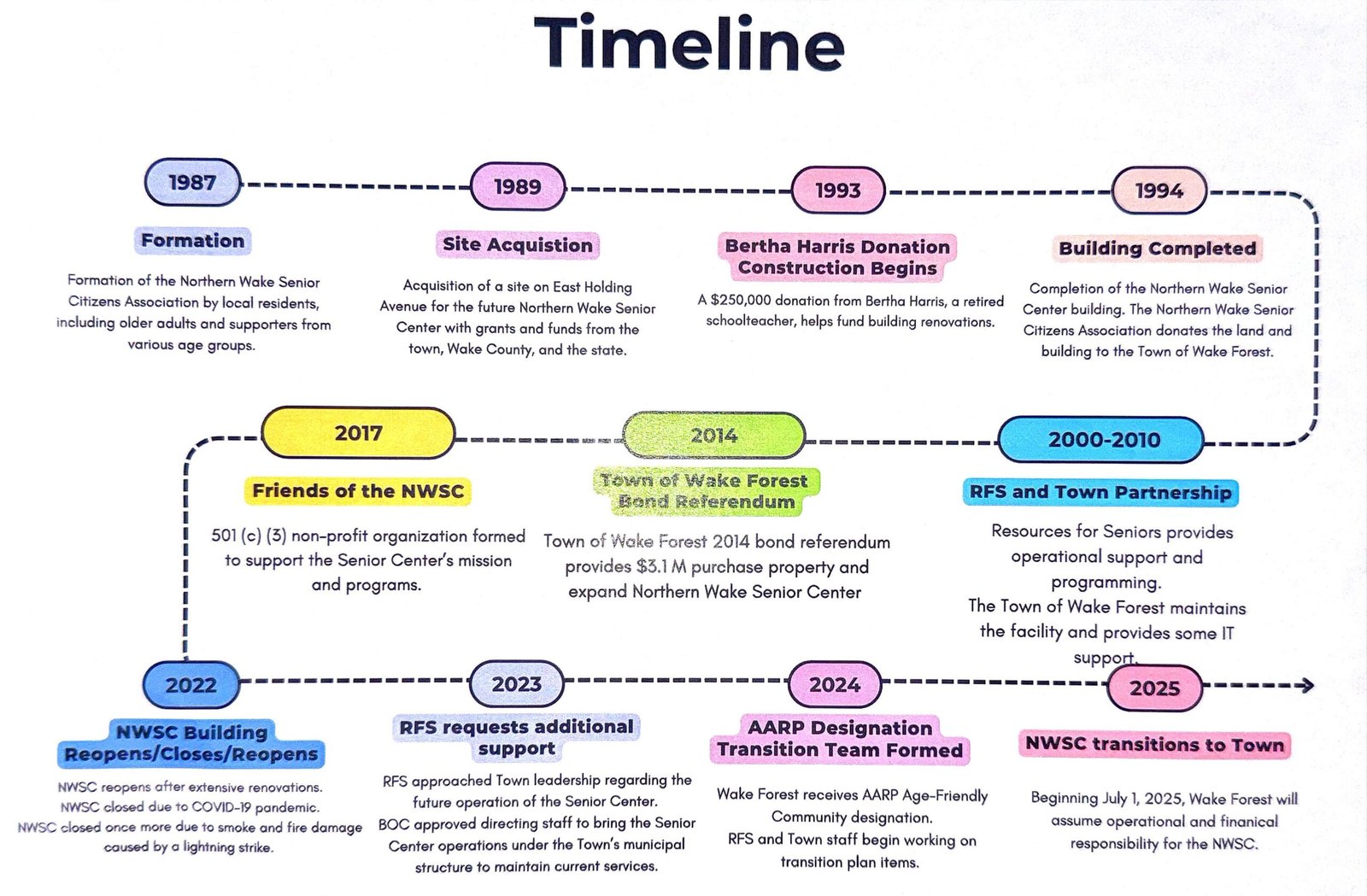
Mayor Vivian Jones laid out the history, noting the Center was always “one of the busiest and most active of all the centers in Wake County”. However, the Town was approached in 2023 because Resources for Seniors (RFS) eventually “just did not have the financial capacity of continuing to provide all the services” that the members wanted. The Town Council agreed to consider taking over the programming to ensure the Center remains a great place for seniors.
The transition, however, brought immediate operational challenges. The Town, unlike a non-profit, “must follow laws and regulations that non-profits sometimes do not have to follow”. This complexity was compounded when certain staff, volunteers, and instructors “decided not to work with the Town,” forcing the new administration to “step back and figure out what to do”.
This administrative expansion required physical changes as well. Facility Director Mickey Rochelle confirmed that renovations are underway to convert a storage room and a former office into multi-staff offices to accommodate new hires. This move, which involved relocating some exercise equipment to a more public area, was necessary because there was simply no room for new staff, with one current employee, Jacob Phipps, reportedly working out of what amounts to a storage closet.
Policy Spotlight: Fees, Access, and Technology
The Town’s leadership was ready to tackle the Top 5 concerns raised by the community survey, dedicating significant time to addressing new policies.
The Non-Resident Shift
Interim Director Monica Lileton addressed the core financial changes:
Non-Resident Fee: A $25 annual fee for non-residents will take effect on January 1, 2026.
Priority Registration: Wake Forest residents receive priority registration three days before non-residents. This policy stems from the fact that residents’ tax dollars help fund the operational budget, and it was implemented after an overwhelming percentage of non-residents were found to be filling class slots.
A non-resident member pushed back, noting that the $25 fee was not an issue, but the priority registration felt unfair. Lileton confirmed that, as of the meeting, no classes were actually filled, and most were at 25% capacity or less.
The Tech Evolution (and Burden)
The transition also marks the end of the old SchedulesPlus system. The WFCAA will fully transition to the Town’s RecDesk software in January, requiring members to use a bar-coded key tag to scan in.
While staff pledged to be available for assistance on dedicated days and through how-to videos, a resident and former city council member eloquently voiced the frustration felt by many older members:
“The technology can be overwhelming for some of the older people. And I would suggest… that we go back to the paper and pencil that everybody’s comfortable with, rather than trying to ask very old people to learn new technology, and hire somebody to then input the data.”
The member suggested that aging is a stressful process, and requiring older adults to learn complex technology defeats the purpose of making the center accessible.
A Look at the Road Ahead
The panel detailed several plans to move forward:
Programming: Staff are actively recruiting instructors to expand classes in fitness, arts, and education, including offering evening and weekend options. They will also begin sending out class and instructor surveys in the coming months.
Facility Status: Maintenance Director Mickey Rochelle provided an HVAC update, confirming that repairs are ongoing but that the unit’s age and non-standard parts make the process difficult.
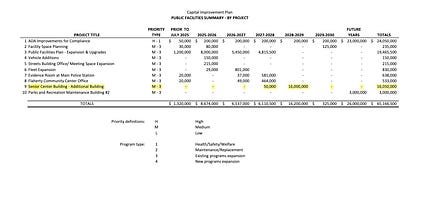
Long-Term Vision: The Town acknowledged the community’s broader vision, confirming that the WFCAA’s charter originally included all of Northern Wake County. When asked directly if there are plans for a second senior center, the Town confirmed that they are committed to addressing that need in the future, and in the 2026-2030 CIP released on December 3, 2025, there is a line item for an additional Senior Center Building for $16,050,000

The newly released Capital Improvement Plan (CIP) Public Facilities Summary includes a crucial line item that speaks to the long-term commitment discussed at the forum. Project #9, ‘Senior Center Building – Additional Building,’ allocates $16,050,000 in funding starting in FY 2028-2029, confirming the Town’s financial backing for a second facility to address the current and future needs of the Center for Active Aging. Addressing Food Insecurity: One member highlighted the importance of promoting Meals on Wheels’ “Friendship Cafe,” noting that the free meal service for seniors 60+ has not been advertised at the center or in the weekly newsletter. Staff immediately agreed to arrange reminders and promote the service.

The ‘Friendship Cafe’ initiative, referenced by an attendee during the Open Forum, provides a crucial service for seniors 60 and older across Wake County. This program, which helps address food security and provides much-needed social connection to improve health and wellness, is offered free of charge Monday through Friday from 9:30 AM to 12 PM. Transparency: Communications Director Bill Crabtree noted that all updated information, including the new staff directory and the results of the community survey, is being posted on the Town website and in the Wednesday Wink, which enjoys an impressive 66% open rate.

Conclusion: Beyond the Meeting
In her closing remarks, Mayor Jones acknowledged the tough but necessary conversations: “I hope maybe I can come now and join in… We all have to stay active, for if we stay active, then we stay younger”.
The Town made a clear appeal to the community: “These are the people that are doing the work, so they’re the ones you need to really talk to”. Staff hung back after the meeting to address individual concerns, providing a final layer of direct communication.
This Open Forum successfully addressed the most immediate questions about the WFCAA’s future operations. However, many questions remain about the decisions that led to this point.
What’s Next?
This public meeting provides the perfect springboard for a deeper look into the WFCAA transition. To truly understand the whole picture—from the historical factors that necessitated the shift away from RFS to the current operational plans—my investigative report will now focus on analyzing the Town’s public records, including the financial contracts, internal memos, and the entire timeline of the transfer.
The Town’s action today, confirming the $16 million funding line item for a second facility in the Capital Improvement Plan, provides a significant new data point. Stay tuned for the next update: once the documents from the public records request are received and thoroughly analyzed, I will provide a much deeper, refined, and documented account for residents, members, and the entire community to see the context behind every decision.