
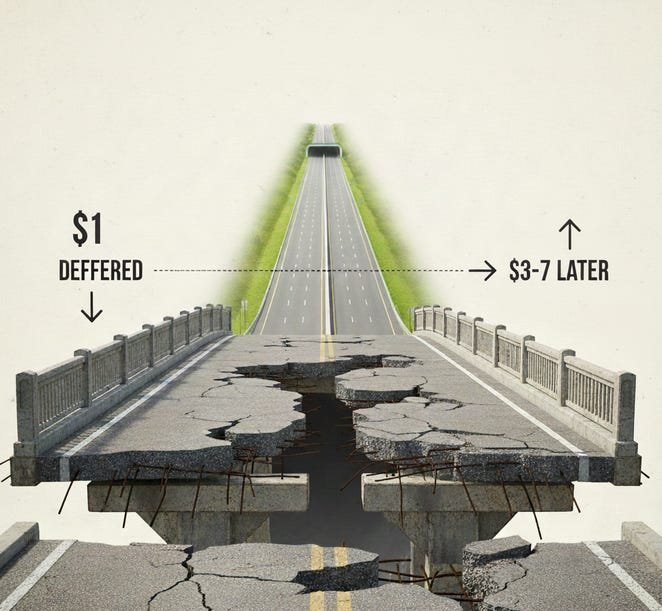
We’ve discussed budgets and revenue, but the most visible challenge for residents is often our infrastructure. We all see it: more congestion on critical roads — a symptom of the Wake Forest infrastructure cliff fix-it-first advocates warn about, more wear and tear on our pavement, and significant projects that seem to move at half-speed.
That’s not just annoying; it’s costly. National research on public infrastructure is clear: every dollar of deferred maintenance can turn into three to seven dollars of repairs and replacement costs later. This is especially true for roads, bridges, and public facilities.
Deferred maintenance is not a savings. It is a debt, and it accrues interest.
Addressing the Wake Forest Infrastructure Cliff With Regional Alignment
Our local planning cannot happen in a vacuum. To spend our money wisely, we must align our local work with two massive regional projects that will define our transportation network for decades:
- The US-1 (Capital Boulevard) Upgrade: NCDOT is entering the final design phase to convert this signal-heavy corridor into a controlled-access freeway from I-540 to Wake Forest. This is a game-changer. Wake Forest must align its own adjacent land-use approvals and local road investments to this timeline, ensuring we are ready for the new traffic patterns and not working against them. The recent Star Road rezoning moved in the opposite direction. Despite planners recommending denial due to inconsistency with the corridor’s planned commercial and limited-access future, the project was approved for high-density residential use directly along a corridor that is supposed to transition to freeway standards. This misalignment undermines the very coordination we need—adding long-term traffic conflicts, reducing flexibility for frontage/backage roads, and saddling taxpayers with avoidable infrastructure complications once US-1 is upgraded.
- The NC-96 Youngsville Bypass: This project illustrates how our neighbors are tackling their own chokepoints. After years of limited state funding, Youngsville is moving forward with planning and right-of-way acquisition and pursuing regional/federal support. Our planning for north Wake Forest traffic must anticipate and support this project, which will serve as a critical relief valve for our own downtown.
A Disciplined Approach: Prioritizing Repairs Over New Construction
The playbook for Wake Forest should be disciplined and straightforward: Fix it first.
We must adopt a “fix-it-first” policy that prioritizes maintaining and optimizing what we already have before building new. We must coordinate our capital projects—street paving, utility work, and greenway construction—so we don’t dig up the same street twice. And we must match the timing of new development approvals to the funded capacity of our infrastructure.
This isn’t a flashy policy, but it is the most taxpayer-friendly and responsible one we can adopt.

Tom Baker IV is the publisher of Wake Forest Matters, Wake Forest’s only independent local newsroom. A Wake Forest native, Navy veteran, and intelligence professional, Tom launched Wake Forest Matters to bring serious accountability journalism to his hometown. Tips and story ideas: publisher@wakeforestmatters.com