
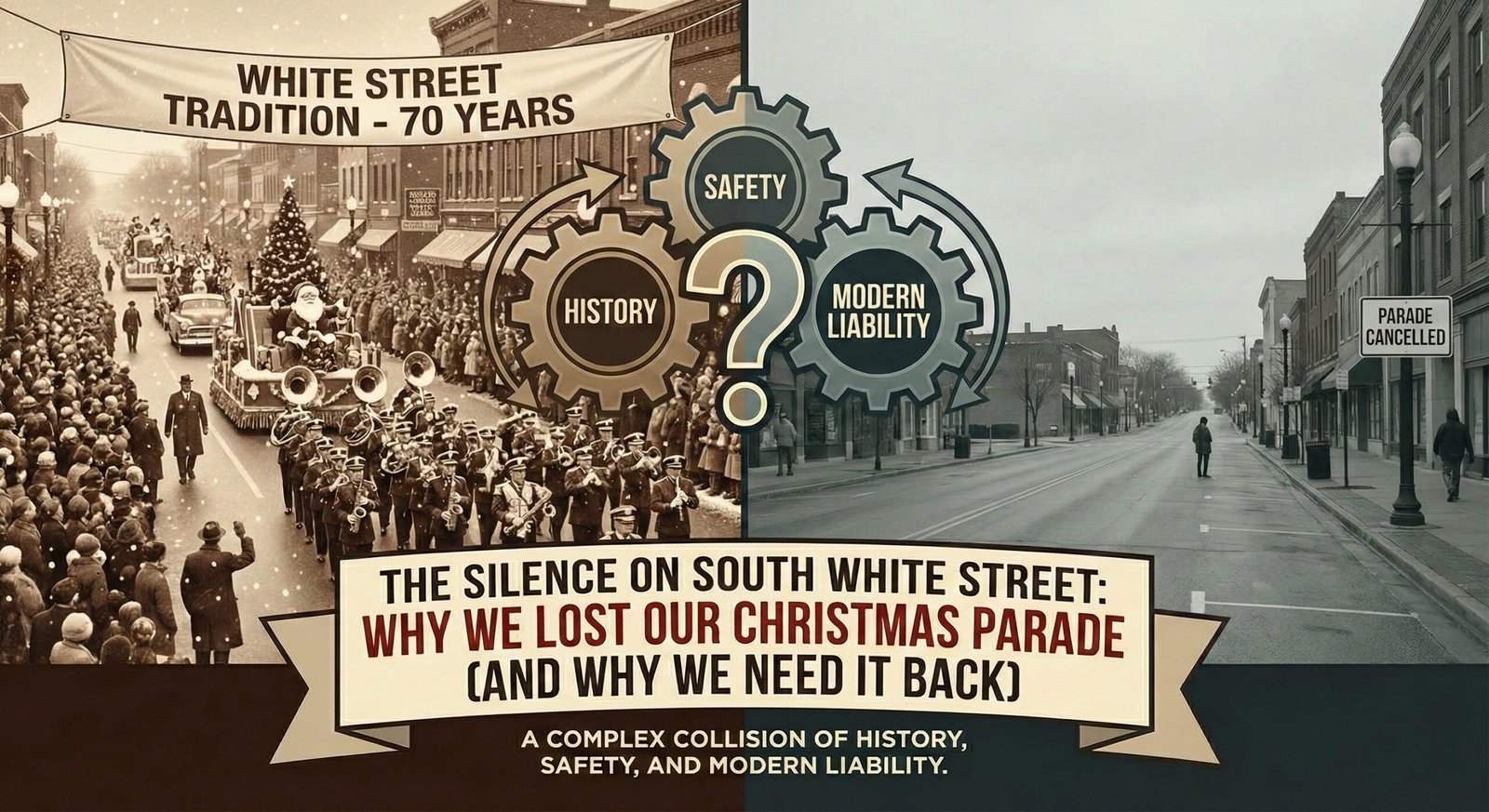
The Wake Forest parade cancelled liability question has stirred deep emotions across our community. I am from here. My roots in this soil are deep.
My great-great-grandfather, John, who was known to everyone as “Peg Leg John,” lost a leg at Gettysburg. Two of his brothers never came home from Petersburg. But John did. He returned to this area not to fight old battles, but to rebuild and move this community forward. He ran a general store, serving his neighbors. His son, my great-grandfather and namesake Tom Baker Sr., followed in those footsteps, owning a store in downtown Youngsville in a building that still stands today.
I know the history and the complexity of “heritage,” which is often hard to explain to those who didn’t grow up here. But let me be clear: I am not sympathetic to the “Lost Cause.”
But this isn’t an essay defending the Sons of Confederate Veterans (SCV). Nor is it an attack on the “New Wake Forest” residents who feel uncomfortable with Confederate imagery.
This is a reflection on a civic tradition that we have lost, and a question about what kind of community we want to be.
The Wake Forest Christmas Parade didn’t end because of a lack of community spirit. It ended because our town was caught in a perfect storm of political polarization, tragic accidents, and the cold, complex reality of modern liability. We have traded a messy, democratic tradition for a safer, more controlled “experience.” And while the new events are wonderful, I believe we are missing something vital.
The Complexity of 2019
If you talk to people around town, you usually hear one of two stories. One side says the parade was canceled to stand against racism; the other says it was canceled to appease a “woke mob.”
The reality is much more difficult—and much more bureaucratic.
For years, the SCV marched without incident. But in 2019, the cultural climate had shifted. Intelligence reports suggested that 200 outside demonstrators—from opposing sides—were planning to descend on our town. Police Chief Jeff Leonard had a genuine fear that these groups would clash, potentially trapping local families in the middle.
The town leadership was placed in an impossible bind. Legally, they likely couldn’t ban a specific group just because their views were controversial; Campbell Law School legal scholars note that the First Amendment protects speech in public forums, even speech that many find offensive. But they also couldn’t ignore the risk of physical confrontation.
So, following the lead of neighboring Garner, they made the hard call to cancel the event entirely. It wasn’t a malicious maneuver; it was a decision made in the interest of public safety. But in doing so, they inadvertently allowed the threat of conflict to silence a community tradition.
The Tragedy that Changed Everything
If 2019 was about political safety, 2022 became about physical safety.
The heartbreaking death of 11-year-old Hailey Brooks in the Raleigh Christmas Parade changed the landscape for every town in North Carolina. She was killed by a truck with faulty brakes and aftermarket modifications. It was a tragedy that shook everyone to their core.
In the wake of that event, the “Shine Like Hailey” legislation pushed for stricter inspections, and the insurance market for parades hardened. Suddenly, organizing a parade wasn’t just a logistical challenge; it was a massive financial liability.
The requirements for indemnification and insurance coverage are so high that a volunteer group cannot assume that risk.
The town isn’t trying to punish us. They are trying to avoid “gross negligence” claims in a litigious world. But the result is the same: the barriers to entry for a traditional parade have become a wall.
“The Joy of the Season”: A Different Kind of Gathering
In place of the parade, we now have “The Joy of the Season.”
It is important to say: these events are good. The ticketed concerts are entertaining, and the Artisan Market helps local merchants. It is a well-managed, safe way to celebrate Christmas.
But there is a distinct shift in the nature of the event.
- A Parade is a civic event. It belongs to the “Commons.” It involves fire trucks, high school bands, historical groups, and scouts walking down the street we all own. It is participatory.
- The Joy of the Season is primarily a curated, commercial series of events. It is safer and easier to manage, but it lacks that chaotic, beautiful element of the whole town passing by in review.
Beyond the Wake Forest Parade Cancelled Liability Debate: Why We Can Have Both
I understand the caution. But personally? I believe we should bring the parade back.
We can have the concerts and the market and the parade to kick it all off. It shouldn’t be an “either/or.”
We pay taxes to the town, the county, and the state for the Commons. These streets belong to the people. As political theorist Hannah Arendt famously argued, the public realm is vital because it is where we appear to one another:
everything that appears in public can be seen and heard by everybody and has the widest possible publicity. For us, appearance—something that is being seen and heard by others as well as by ourselves—constitutes reality.
When we retreat from the streets because we are worried about controversy, we lose that common world. If the Confederates want to march, let them exercise their right. If people want to stand on the sidewalk and protest them, let them exercise their right to do so. That is what a free society looks like. It isn’t always comfortable, but it is necessary.
Unless there is specific intelligence of a real-world violent plot—a conspiracy to do physical harm—we shouldn’t shut down a tradition over words.
The “Lost Cause” myth is, frankly, fading into history. It was once a potent force, but with the passing of generations, we are moving beyond it. My ancestor Peg Leg John didn’t come back from the war to live in the past; he came back to build a store and live in the future. We are a different town now, capable of handling a few hours of disagreement without falling apart.
The Wake Forest parade cancelled liability issue shouldn’t define us. This town should be a place for everyone, where all traditions are accepted, and where we can all join together. That is the heart of the American experiment: pluralism and the public square. As urbanist Jane Jacobs wrote:
“Cities have the capability of providing something for everybody, only because, and only when, they are created by everybody.”
We are safer now. There are no potential clashes on White Street. But we have lost the energy that makes a community feel real. I hope the Christmas parade returns. I hope the town finds the courage to welcome it back. Because a community that is afraid to walk down the same street together isn’t fully using the freedom we’ve inherited.
Tom Baker IV is the publisher of Wake Forest Matters, Wake Forest’s only independent local newsroom. A Wake Forest native, Navy veteran, and intelligence professional, Tom launched Wake Forest Matters to bring serious accountability journalism to his hometown. Tips and story ideas: publisher@wakeforestmatters.com