
The Wake Forest Board of Commissioners meets Tuesday, March 17 at 6:00 p.m. in the Board Room at Town Hall, 301 S. Brooks Street. As always, the meeting airs live on WFTV 10 and streams on the Town’s Public Meetings Portal. Here’s what residents should know heading in.
Two Public Hearings
The biggest action items on Tuesday night come during the public hearing portion of the agenda.
A South Main Street Rezoning Tangled Up with the S-Line (RZ-25-02)
Tyler Davis, a local dentist who owns Davis Family Dentistry at 814 South Main Street, is asking the Board to rezone two parcels totaling 0.46 acres at 810 and 814 South Main Street from General Residential 3 (GR3) to Neighborhood Business (NB). Davis purchased the neighboring duplex at 810 S. Main and wants to expand his dental practice and dental sleep apnea clinic into the existing building. According to the application, no major exterior alterations are planned beyond what’s needed for zoning compliance and ADA accessibility.
On its face, this is a classic infill story, a local business owner looking to grow along a gateway corridor into downtown. The Planning Board voted 6-0 at its February 10 meeting to recommend approval, finding the request consistent with the Community Plan. Town staff agrees, noting the rezoning aligns with the Land Use Plan’s designation of the properties as Neighborhood Commercial.
But the geography of this parcel makes it uniquely complicated. The property sits at the southwest corner of West Holding Avenue and South Main Street, and that intersection is directly in the path of the multi-billion-dollar S-Line High-Speed Rail project, backed by a $1.09 billion federal grant from the Federal Railroad Administration. The State of North Carolina is actively working to restore high-performance passenger rail between Raleigh and Richmond, and the line runs through the heart of Wake Forest. The Town’s own Comprehensive Transportation Plan calls for the realignment of West Holding Avenue through this area to accommodate the S-Line, which means NCDOT may eventually need to acquire the corner lot at 810 S. Main.
Understanding the scale of what’s coming down the corridor is essential context here. The Town’s 2026-2031 Capital Improvement Plan identifies the S-Line as one of its highest-priority projects, a Priority 1, Health/Safety/Welfare classification, with a $5.775 million local match commitment to secure a federal RAISE grant. Of that, $3.35 million has already been approved, and the remaining funds must be obligated by April 1, 2028. But the local match is just the entry ticket.
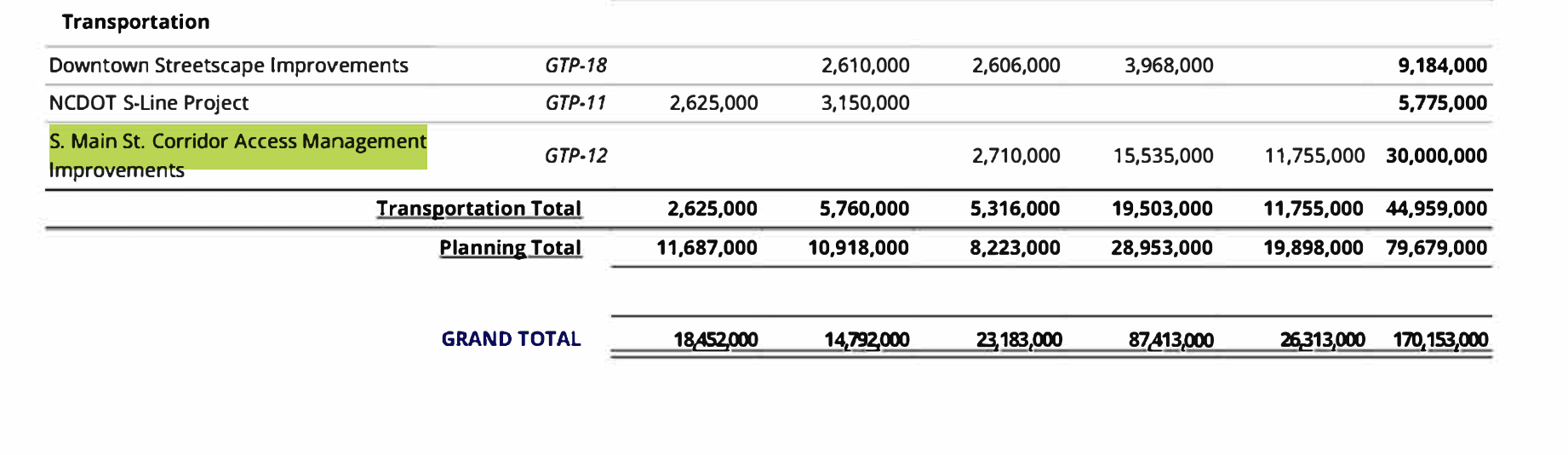
The CIP also includes a $30 million South Main Street Corridor Access Management project, labeled “Concept B: Full Optimization,” that would bring roundabouts, bike lanes, and pedestrian infrastructure to the same stretch of road where Dr. Davis’s dental practice sits. Add in the $32.75 million Mobility Hub building planned at the future S-Line station, an income-generating mixed-use facility funded through a future bond referendum, and the total public investment planned for this corridor exceeds $68 million. This isn’t a rezoning that happens in a vacuum. It happens in the path of one of the largest infrastructure commitments in the town’s history.
The conflict hasn’t gone unnoticed. On January 21, 2026, the US-1 Council of Planning, a regional advisory body that includes representatives from CAMPO, NCDOT, and surrounding municipalities, officially noted that the proposed rezoning does not conform to the adopted S-Line Record of Decision designs. The Council recommended that the Town and property owners engage with NCDOT’s Rail Division about the funded rail project’s impact on their property.
Here’s where it gets interesting. Town staff met with NCDOT Division of Rail staff on January 15 to discuss the conflict. State officials told them they currently have no plans for advanced acquisitions and did not object to the rezoning. So the regional planning body says it doesn’t conform. The state agency says it’s fine — for now.
That puts the Board in a delicate position. Under North Carolina law, municipalities must tread carefully when restricting current, lawful property rights based on future state infrastructure plans — especially after the North Carolina Supreme Court’s 5-2 decision in Schooldev East, LLC v. Town of Wake Forest in late 2024, which forcefully reaffirmed the state’s public policy favoring free use of private land. In that case, the court ruled against the Town, finding that ambiguous local ordinances or future planning desires cannot arbitrarily block otherwise compliant development. Denying Davis his rezoning based on a future road realignment, when NCDOT itself declines to acquire the property today, could expose the Town to legal risk and accusations of regulatory overreach.
But there’s another way to read this. By approving a commercial rezoning on a parcel that NCDOT will likely need to acquire someday, the Town may be setting up a future eminent domain proceeding at a significantly higher commercial valuation than the current residential assessment. Someone will pay the difference. The question is who, and when.
The neighborhood meeting held at the property on November 20, 2025, drew zero attendees during the 30-minute session, though the applicant says most nearby owners were contacted directly and signed acknowledgment and support forms. Fifty-three addresses within 500 feet were notified by mail.
If you want to speak on this item, proponents speak first, opponents second, and each side gets three minutes.
Fire Station 6: An $18 Million Public Safety Investment
The Board will also hold a public hearing on the installment financing for Fire Station 6, located at 1621 and 1701 Wait Avenue near Old Murray Drive. The Town is seeking an installment purchase agreement under N.C. General Statute 160A-20 in a principal amount not to exceed $18 million to fund the construction and equipping of the new station. State law requires a public hearing before entering into the agreement.
This is not a standard neighborhood firehouse. The campus will span roughly four and a half acres, and the building itself will be a 22,344-square-foot, two-story facility, nearly three times the size of Wake Forest’s typical fire stations, which average around 8,000 square feet. The facility includes three apparatus bays, crew living quarters, a dedicated weight room, and a 4,000-square-foot training room that seats over 50 staff. Outside, a specialized training tower built with “Conex” shipping containers will allow live-burn scenario training on-site — eliminating the need for Wake Forest crews to travel to Jordan Lake for that type of training. The guaranteed maximum price from the selected contractor, Edifice LLC, totals $18,553,907, which breaks down to roughly $17.23 million for the core station and $1.32 million for the training tower.
The urgency behind the project is written in the numbers. The Wake Forest Fire Department responded to 6,007 emergency calls in FY 2024, and the department’s own performance data shows the 90th-percentile EMS response time has ballooned to 501 seconds, well above the 350-second target. Mutual aid from neighboring departments currently accounts for 11.9 percent of fire response, meaning roughly one in eight calls already depends on outside help. The station is designed to serve the rapidly expanding populations in the northern and eastern parts of town, where developments like the 1,000-home Rosedale community have stretched existing response times. Wake Forest currently holds an elite ISO Class 1 fire rating, a classification achieved by less than one percent of fire departments nationwide, and one that significantly lowers homeowner and commercial insurance premiums across town. Maintaining it requires response times within the strict four-to-six-minute window mandated by national NFPA 1710 standards. Station 6 is a direct response to growth threatening those standards.
Station 6 is also just one piece of a much larger fire infrastructure pipeline. The Town’s 2026-2031 Capital Improvement Plan identifies more than $33 million in fire-related capital needs over the next five years: Station 6 itself at $17.4 million, the renovation of the aging Station 1 at $8.86 million, the replacement of Station 5 at $1.5 million, plus a rolling program of engine replacements, radio upgrades, and specialized equipment totaling another $5.3 million. The Fire Department’s annual operating budget already runs $13.95 million, 83 percent of which is personnel costs, making it the second-largest line item in the General Fund behind only Police. Every new station compounds that operational baseline.
The financing timeline is aggressive. Following Tuesday’s public hearing, the Town plans to file with the Joint Legislative Committee on March 20, accept proposals from financial institutions by March 27, file the formal LGC application by April 2, and seek Local Government Commission approval at its May 5 meeting. If all goes as planned, the Town closes on the loan in the second half of May. The Town’s AAA bond ratings from all three major agencies, S&P, Fitch, and Moody’s, should help secure favorable terms, and the current outstanding debt of $43.47 million sits comfortably within an $841 million statutory debt margin. Debt service currently consumes 8.9 percent of governmental expenditures, well below the Town’s self-imposed 15 percent policy cap.
Worth noting: the Town will also need to hire approximately 15 new full-time firefighters to staff the facility around the clock. That operational cost — on top of the debt service — will exert real, ongoing pressure on future budgets.
Presentations
Before the hearings, the Board has a full slate of presentations.
The meeting opens with a proclamation recognizing Women Veterans Month. The Board will also hear an Age Friendly Community Update and receive a presentation on the Sustainability Plan Existing Conditions from Blue Strike Environmental, the consulting firm the Town engaged in July 2025 to lead a Town-wide sustainability planning process. Since the project kicked off, Blue Strike has completed greenhouse gas calculations, a climate vulnerability assessment, and various public engagement efforts. Tuesday’s presentation will share initial findings and gather Board feedback. The presentation materials will be posted to the project webpage after the meeting.
The Board will also recognize two members of the Wake Forest Police Department. Officer Michael Lawson, who joined as an Auxiliary Police Officer in January 2003, is being honored with a resolution of appreciation after more than 23 years of service. Lawson served as the department’s Chaplain throughout his entire tenure and was a SWAT member for 22 years. He also serves as Director of Campus Security at Southeastern Baptist Theological Seminary, bridging the Town and the Seminary on security matters. His separation date is April 1, 2026.
Captain Matt Perkinson, who began his law enforcement career with the Norlina Police Department in December 1994 and joined Wake Forest PD in January 2005, is retiring effective April 1 after more than 20 years with the department. Perkinson rose from Patrol Officer to Captain overseeing Special Operations, serving along the way as a Drug Investigator, Canine Officer, and Impact Lieutenant. He earned his Advanced Law Enforcement Certificate, the FBI-LEEDA Trilogy award, and a canine award from Crime Stoppers.
Digging Into the Consent Agenda
Nine items are bundled into the consent agenda, which the Board typically passes with a single vote and no debate. Any Commissioner or citizen can request that an item be pulled for separate discussion, and given what’s in this batch, it’s worth reading carefully.
The Ailey Young House and Northeast Gateway Park (Item 5.H)
This one deserves its own section. Tucked into the consent agenda is the formal endorsement of a vision plan for what may become one of the most culturally significant public spaces in Wake Forest’s history.
The Ailey Young House, located at 320 North White Street, is widely believed to be the oldest African American historic structure remaining in Wake Forest. Built in the late 1800s as rental housing by Wake Forest College Professor William G. Simmons, it was part of a post-Civil War development known locally as “Simmons Row.” The house became the childhood home of Allen Young, a towering figure in the town’s history who founded the Wake Forest Normal and Industrial School, providing vital education to Black children during the Jim Crow era, and helped establish Spring Street Presbyterian Church. His daughter, Ailey Mae Young, continued that fierce legacy of civic leadership, breaking entrenched racial and gender barriers to become Wake Forest’s first Black town commissioner.
Despite this profound history, the physical remnants of the Northeast Community’s past have been severely threatened by time, neglect, and the pressures of gentrification. Both the 2021 Northeast Community Plan and the 2022 Historic Preservation Plan called for the Ailey Young House to be preserved and transformed into a premier heritage site. The Town acquired 3.06 acres surrounding the house, creating a protectable parcel bordered by North White Street, East Spring Street, and the Wake Forest Cemetery.
After extensive public design sessions throughout 2024 and 2025, including focus groups with senior citizens, local youth, and the Northeast Community Coalition, the landscape architecture firm McAdams developed a final concept. The feedback from those sessions was clear and deeply personal. Residents didn’t want a loud, active recreational complex. They asked for a place of solitude, reflection, and community gathering, a living testament to Black homeownership, generational resilience, and community hope.
The resulting plan is thoughtfully designed. Because the original structures of Simmons Row and the historic Willis Johnson House have been lost to demolition, the park will feature “wireframe” art installations marking their exact former footprints, ghostly outlines that let visitors see the density and layout of the original post-Civil War neighborhood without fake historical replicas. The plan also includes an interactive “Legacy Tree” inspired by a community engagement exercise where residents wrote their hopes for the neighborhood and hung them on branches, interpretive story cubes detailing the Young family legacy and the history of Black-owned businesses in the area, a meandering multi-use path with an elevated boardwalk crossing the site’s stream, and carefully preserved mature trees with minimal ground disturbance to protect potential archaeological resources below the surface.
The boardwalk and path system will also establish critical pedestrian connections between the historically isolated Northeast Community and the booming downtown corridor, making the park both a memorial and a practical link to Wake Forest’s future.
The financial commitment behind this vision is substantial. The CIP identifies $4.73 million for the Ailey Young House Heritage Site itself, covering archaeology, interpretive design, and construction, plus another $5.55 million for the broader Ailey Young Park Improvements, of which $4.04 million comes from the 2022 GO Bond referendum that Wake Forest voters approved. Combined, that’s roughly $10.3 million dedicated to honoring and connecting this historically underserved neighborhood. The first phase of park improvements is projected to begin in FY 2026-27.
By endorsing this plan, the Board is doing something that goes beyond traditional parks planning. It’s an acknowledgment that public spaces should do more than provide recreation; they can actively combat the historical erasure of communities that helped build this town.
Budget Amendment #4: A $1.59 Million Mid-Year Windfall (Item 5.B)
Budget amendments are the clearest window into a town’s real-time fiscal health. This one recognizes $1,590,775 in newly realized revenues and corresponding allocations.
Wake Forest’s commercial sector is dramatically outperforming expectations.
The Town is recognizing roughly $490,000 in extra Local Option Sales Tax and approximately $719,000 in excess sales tax revenue from Articles 40, 42, and 44. In previous budget cycles, the Finance Department deliberately used conservative revenue forecasts, budgeting sales tax growth below statewide projections to guard against downturns. This mid-year surge proves the local economy is running well ahead of those cautious estimates.
For context, Wake Forest’s total FY 2025-2026 budget stands at $139.3 million, with a $93.975 million General Fund supported by a property tax rate of $0.42 per $100 of assessed valuation, unchanged from last year, on a tax base that has swelled to $12.3 billion. Within that budget, the Town has dedicated specific tax allocations to its two most pressing long-term challenges: 1.5 cents of the tax rate (roughly $1.82 million annually) is earmarked for transportation, and 1 cent ($1.21 million) for housing initiatives. The current fiscal year also added 18 new positions, including a Grants Program Manager, a Fire Training Lieutenant, a Radio Technician, and a five-person stormwater crew, hires that reflect a town scaling up its operational capacity to match its growth.
Rather than banking the surplus, the Town is channeling the windfall, along with a $357,075 drawdown from the Appropriated Fund Balance, directly into capital outlays, including public facilities equipment, fire department vehicles and equipment, and engineering capital projects.
The 203 N. Brooks Street Acquisition (Item 5.G)
The Board will authorize the purchase of a portion of property at 203 N. Brooks Street for $116,000 under N.C.G.S. 160D-1312 and 160D-1315, statutes governing municipal economic development and open space protection. Interestingly, the property is currently owned by Hidden Jewel Ventures LTD, whose registered agent is Chris Jorgensen, the owner of beloved Wake Forest restaurant Norse Brewing. This address sits adjacent to the current Town Hall campus. For over two decades, long-range planning documents, including the comprehensive Renaissance Plan, have proposed expanding or relocating the municipal civic campus to this area of South Brooks Street and Elm Avenue. The CIP sheds some light on the thinking: it includes a $32.2 million Town Hall Maintenance line item that encompasses a potential $16 million North Wing expansion option. Whether this $116,000 purchase is defensive (preventing private redevelopment of a strategically important parcel) or the opening move in an active civic campus expansion, it’s worth watching.
Vehicle Financing at 3.73% (Item 5.A)
The Finance Department secured a $1,432,500 installment purchase agreement through Truist Bank to fund the FY 2025-2026 vehicle fleet, which includes police interceptors, Silverado trucks, a fire rescue unit, and a public works concrete mixer. The 3.73% fixed rate over four years with no setup fees or prepayment penalties was the best of four competitive bids; the highest came in at 5.50%. That spread saves taxpayers real money over the life of the agreement and reflects the tangible value of Wake Forest’s AAA bond rating.
The Engineering Bench (Item 5.C)
Without debate, the Town will approve master service agreements with eight major consulting firms, including AECOM, Dewberry, WSP, and Bolton & Menk, to provide on-call engineering services for a three-year base term. No specific dollar amounts are permanently attached, but locking in eight firms of this caliber signals the immense volume of capital improvement projects on the horizon, from pavement management and traffic impact analysis to stormwater system overhauls.
Appointment of Review Officers (Item 5.D)
A procedural but structurally important item. Under North Carolina statute, municipalities must designate review officers to handle quasi-judicial and administrative review functions, things like processing applications, conducting preliminary reviews of development proposals, and serving as points of contact for regulatory compliance matters. The Board will vote to formally appoint or reappoint these officers. It’s the kind of governance plumbing that most residents never think about until a permit gets delayed or an application gets lost. Keeping these positions filled and current ensures the Town’s regulatory machinery keeps running smoothly as development pressure accelerates.
Citizen Advisory Board Appointments (Item 5.E)
Wake Forest maintains a network of citizen advisory boards that give residents a direct role in shaping town policy: the Planning Board, Historic Preservation Commission, Human Relations Council, Parks/Recreation and Cultural Resources Advisory Board, Public Art Commission, Technology Advisory Board, and Board of Adjustment. Members serve three-year terms and advise the Board of Commissioners on matters within their respective areas. Tuesday’s item appoints or reappoints members to fill current vacancies. For a town that’s growing as fast as Wake Forest, with $532 million in capital needs on the horizon, these volunteer positions carry real influence. If you’ve ever wondered how decisions get made about greenway routes, historic district boundaries, or public art installations, this is where it starts. Applications are accepted through the Town’s website on a rolling basis.
Surplus of Badge and Service Weapon — Officer Michael Lawson (Item 5.F)
The Board will vote to surplus the badge and service weapon carried by Officer Lawson throughout his 23-year career as an Auxiliary Police Officer. Under North Carolina law, municipalities must formally declare property as surplus before transferring ownership. For retiring or departing law enforcement officers, this resolution allows the Town to present the officer with their personal badge and duty weapon as a token of appreciation. It’s a longstanding tradition in law enforcement and a small but meaningful gesture for someone who served as the department’s Chaplain for over two decades and spent 22 years on the SWAT team, all as an auxiliary officer, meaning he volunteered this time on top of his full-time role as Director of Campus Security at Southeastern Baptist Theological Seminary.
Surplus of Badge and Service Weapon — Captain Matt Perkinson (Item 5.I)
The same resolution for Captain Perkinson, who is retiring on April 1 after more than 20 years with Wake Forest PD and over 30 years in law enforcement. Perkinson started his career in Norlina in 1994, joined Wake Forest in 2005, and worked his way up from Patrol Officer through Drug Investigator, Canine Officer, and Impact Lieutenant to Captain overseeing Special Operations. His badge and weapon represent a career arc that spans the entire modern era of Wake Forest’s growth from a small college town to one of the fastest-growing municipalities in North Carolina. Both of these surplus resolutions will pass without debate, but they’re worth a moment of recognition.
Other Business
Under Planning Items, the Board will formally consider the South Main Street rezoning following the public hearing. In Administration and Financial Items, Commissioners will weigh an amended Grant Policy and Procedures, the first major overhaul of the Town’s grant procedures since October 2011. The updated policy creates a dedicated Grants Program Manager position, requires every department to designate a Project Manager for each grant application, and mandates quarterly updates to the Board on all pending, submitted, and active grants. That’s a meaningful structural change for a town preparing to aggressively pursue state and federal infrastructure funding — and the stakes are real. The CIP identifies $532 million in total capital needs over the next five years, and nearly a third of that depends on a $175 million future bond referendum the Town hopes to put before voters in 2028. Maximizing grant capture isn’t optional; it’s a fiscal survival strategy.
The meeting wraps with department monthly reports for January and February, the March tax report, a Commissioners Report, and a closed session under N.C.G.S. 143-318.11(5).
Questions Worth Asking
If you’re thinking about showing up Tuesday, or even just watching from home, here are some of the questions that deserve attention at this meeting.
On the South Main Street rezoning: The CIP makes clear that the South Main corridor is slated for more than $68 million in public investment, the S-Line local match, the corridor access management project, and the Mobility Hub. By approving a commercial rezoning on a parcel that NCDOT will likely need to acquire, is the Town effectively setting up a future eminent domain proceeding at a significantly higher commercial valuation? NCDOT says they have no current acquisition plans, but “current” isn’t “never,” and the local match funds must be obligated by April 2028. Who bears the financial burden of unwinding this commercial development when the rail expansion becomes physically inevitable? And what did the Board learn from the Schooldev East decision about the legal risks of restricting property rights based on future infrastructure plans?
On Fire Station 6: The $18.5 million price tag is one of the largest single capital expenditures in recent town history, but it’s only the first chapter. The CIP identifies more than $33 million in fire infrastructure needs over the next five years, including the renovation of Station 1 and the replacement of Station 5. With the department’s 90th-percentile EMS response time already at 501 seconds, 43 percent above the 350-second target, and mutual aid accounting for nearly 12 percent of all responses, the operational case is clear. But who’s paying for the pipeline beyond Station 6? The live-burn training tower alone costs $1.3 million, and neighboring municipal departments are expected to use the facility for training, effectively making a Wake Forest neighborhood into a regional emergency services hub. Have those neighboring jurisdictions been asked to share in the capital cost? And with 15 new full-time firefighters needed to staff the station on top of a $13.95 million annual fire budget that’s already 83 percent personnel, what’s the projected fiscal impact over the next decade?
On the sustainability plan: What did the greenhouse gas inventory actually reveal about Wake Forest’s biggest emissions sources? What specific feedback came out of the public engagement process? Sustainability planning only works if it reflects the community it’s supposed to serve. This is the right time to ask how resident input is shaping the plan’s direction.
On the Ailey Young House park: The endorsed vision plan is beautiful, culturally significant, and community-driven, and it’s now backed by real money. The CIP identifies roughly $10.3 million in combined funding for the heritage site and park improvements, with $4.04 million coming from the 2022 GO Bond that voters already approved. That said, an endorsed vision with identified funding is still not a completed project. What’s the construction timeline? Is the Town pursuing state historical preservation grants or federal community development block grants to supplement the bond funds? And how will the Town protect the potential archaeological resources beneath the site during construction?
On Budget Amendment #4: The $1.2 million-plus sales tax windfall is encouraging — but the bigger fiscal picture demands attention. The CIP identifies $532 million in capital needs over five years, and nearly a third of that — roughly $175 million — depends on a future bond referendum the Town plans to put before voters in 2028. Wake Forest voters approved a $75 million bond in 2022 (of which $22 million has been issued, with another $23.4 million planned for October 2026). A $175 million ask in 2028 would be more than double the last referendum. Is the Board confident the electorate will support that, and what happens to the projects in the CIP if the referendum fails?
On the grant policy overhaul: With $532 million in identified needs and a tax rate the Board has chosen to hold steady at $0.42 per $100, aggressive grant capture isn’t optional, it’s existential. The new Grants Program Manager position is a start. But what’s the target? How much in federal and state grant funding does the Town realistically expect to capture in the next five years, and which CIP projects are most competitive for outside funding?
And on the consent agenda generally: budget amendments, property acquisitions, multi-year engineering contracts, and a parks vision plan that will define the cultural identity of an entire neighborhood are all passing in a single vote with no debate, unless someone pulls an item. Any Commissioner or citizen can make that request. That’s not being difficult. That’s doing the work.
Why Show Up
Public hearings and comment periods are the most direct tools residents have to shape local decisions—and recent events prove that stepping up to the microphone gets results.
The recent pushback against the Municipal Service District (MSD) expansion is a prime example. When the town considered extending the downtown tax boundary, affected property owners didn’t stay home. They showed up and used their public comment time to firmly reject being included.
Contrast that with the November neighborhood meeting for the South Main rezoning, which drew zero attendees. Fifty-three households were notified; the applicant waited at his dental office for thirty minutes and went home.
The same principle applies to the proposed Fire Station 6. A public hearing for an $18 million debt obligation isn’t a mere formality. It’s a statutory requirement meant to ensure taxpayers are heard before local government takes on that level of spending. Even outside of scheduled hearings, the general public comment period offers three minutes to put any issue—traffic, development, parks, or taxes—on the official record. While the Board can’t take immediate action that night, those comments direct staff priorities and shape future agendas. The MSD outcome is clear proof: the process works, but only when people show up to use it.
The Bigger Picture
Wake Forest is at a crossroads that doesn’t come along very often. The Town’s population has grown 196 percent since 2005 and is projected to nearly double again in the next 15 years. The 2026-2031 Capital Improvement Plan puts a number on what that growth demands: $532 million in identified infrastructure needs over five years, funded by a patchwork of existing bonds, future debt, grant applications, developer contributions, and — critically — a $175 million bond referendum that hasn’t gone to voters yet. The decisions being made in that Board Room on Tuesday night — how we zone our land along a future high-speed rail corridor, how we finance the infrastructure that keeps our families safe, how we honor the communities that helped build this town, how we plan for sustainability- are not routine business. They’re generational. They’ll shape the physical, financial, and cultural landscape of Wake Forest for decades.
None of this requires you to be an expert. You don’t need to have read all 298 pages of the agenda packet (though it helps — and that’s part of why Wake Forest Matters exists). You just need to care enough to pay attention, ask good-faith questions, and hold your elected officials accountable — not with hostility, but with the kind of engaged, respectful citizenship that makes local government actually work.
Our Commissioners are volunteers. They give up their Tuesday nights to make decisions on our behalf. The least we can do is show up, listen, and let them know we’re watching — not to catch them doing something wrong, but because we’re all in this together. Good governance isn’t a spectator sport. It’s a partnership between the people who serve and the people they serve. And the decisions formalized in this single meeting — from the millions in quiet debt authorization to the microscopic adjustments in commercial zoning — will permanently alter the community we share.
So whether you come to the podium or just tune in on WFTV 10, be part of the process. Wake Forest works best when we all do our part.
How to Participate
If you want to speak during a public hearing, you’ll get three minutes at the podium. Proponents speak first, opponents second. If you want to address the Board on any other topic during public comment, sign up with the Town Clerk before the meeting using the Public Comment Form on the Town website. You’ll get three minutes.
If you can’t attend in person, the meeting will be available live on WFTV 10 and the Town’s online Public Meetings Portal. Archived video will remain available for one year.
The full agenda packet is available on the Town of Wake Forest Public Meetings Portal.
Wake Forest Matters covers local government for the residents of Wake Forest. We believe transparency and civic engagement aren’t partisan ideas; they’re the foundation of a healthy community. If you found this preview useful, share it with a neighbor. The more of us paying attention, the better off we all are.

Tom Baker IV is the publisher of Wake Forest Matters, Wake Forest’s only independent local newsroom. A Wake Forest native, Navy veteran, and intelligence professional, Tom launched Wake Forest Matters to bring serious accountability journalism to his hometown. Tips and story ideas: publisher@wakeforestmatters.com