When the Wake Forest Board of Commissioners sits down for its work session on Thursday, November 6, at 6 p.m., they won’t be voting yet — but they’ll be setting the stage for the next round of decisions that shape how this town grows, spends, and looks in the years ahead.
Work sessions are where more profound deliberations take place before the “official” votes later in the month. Here’s what matters most on the agenda — and why you should care.
What does that mean?
Highway Business (HB) zoning allows commercial uses such as gas stations, small retail, and offices.
General Residential 10 (GR10) allows housing, up to 10 homes per acre, such as condos or townhomes.
The Conditional District (CD) part means the developer must submit a specific site plan and conditions (like buffers, sidewalks, and height limits) that the town can enforce.
So, in plain terms, the owner wants to build housing rather than commercial space on land originally intended for a roadside business.
Why is this important?
This spot sits near the U.S. 1 corridor, one of Wake Forest’s fastest-developing areas. The town’s challenge is balancing housing demand with traffic, schools, and infrastructure that can keep up.
The agenda packet includes a Transportation Impact Analysis (TIA) and a North Carolina Department of Transportation (NCDOT) review — both signal traffic is a genuine concern here. There’s also a memo from the U.S. 1 Council of Planning, which oversees growth along the highway, suggesting this project connects to larger regional road plans.
For context: “up to 10 units per acre” across 14 acres could mean as many as 140 new homes, though the final number will likely be smaller once conditions and roads are factored in.
Expect this rezoning to spark debate when it comes up for an official public hearing later this month. Some commissioners may push for tighter traffic controls or fewer units. Others may see it as a way to add much-needed housing options.
2. Following the Money: September Financial Reports
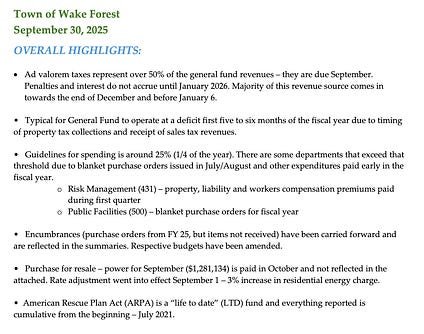
The board will also look at September’s monthly financial summary — basically a quarterly progress check on how Wake Forest’s Fiscal Year 2026 budget is holding up.
This report tracks:
Revenues — primarily property and sales taxes.
Expenses — everything from public safety to parks and utilities.
Enterprise funds — the separate accounts for electric, water/sewer, and stormwater services.
One note in recent years: Wake Forest has managed growth without raising its property tax rate. These early reports show whether that strategy is sustainable as the town takes on new capital projects (like roads, fire stations, and parks).
You may also see mentions of ARPA, which stands for the American Rescue Plan Act — the federal COVID-era funding that towns have been using for one-time projects like infrastructure, broadband, or community improvements. Those funds are winding down, so the town’s budget will increasingly rely on its own revenue base.
It’s dry reading, but these updates tell you whether the town’s financial footing keeps pace with its growth — and whether new developments are paying for the impacts they create.
3. People and Planning: A Century of Life, and a Look Ahead
The meeting starts on a joyful note: a proclamation honoring Mary M. Williams on her 100th birthday — a reminder that civic life isn’t just about zoning codes and line items, it’s about people who’ve built the community we’re living in today.
After that, commissioners will preview the draft agenda for their November 18 business meeting, when they’ll vote on items such as the Star Road rezoning and other consent items (routine approvals bundled together).
Plain-English Explainers
Rezoning: A change in how a property is allowed to be used — from one category (like “business”) to another (like “residential”).
Public Hearing: When residents can speak directly to the board about a proposed change, usually with three minutes per person.
Conditional District (CD): A rezoning that includes specific promises or design details from the developer, making it more controlled than a standard zoning change.
Transportation Impact Analysis (TIA): A traffic study showing how new development would affect nearby roads and intersections.
Why It All Matters
Work sessions are where the board and staff have the candid conversations — the ones that determine how our town grows and who benefits. The Star Road project, in particular, could reshape part of Wake Forest’s southern edge and test how we handle housing demand while protecting quality of life.
Whether you support growth or worry about its pace, understanding what’s on the table is the first step toward shaping it.
Show Up, Speak Up
📍 Town Board Work Session
Thursday, November 6, 2025 – 6:00 PM
Wake Forest Town Hall Board Chambers
Broadcast live on WFTV-10 and the Town’s Public Meetings Portal.
` fvc ghnc📍 Next Business Meeting (votes & public hearings)
Tuesday, November 18, 2025 – 6:00 PM
Democracy is a verb.
Wake Forest needs voices — informed, respectful, and brave enough to speak up for the kind of town we want to live in.
We’ll be there. Hope you will too.
Wake Forest Matters
Fearless. Local. Loud.
Tom Baker IV is the publisher of Wake Forest Matters, Wake Forest’s only independent local newsroom. A Wake Forest native, Navy veteran, and intelligence professional, Tom launched Wake Forest Matters to bring serious accountability journalism to his hometown. Tips and story ideas: publisher@wakeforestmatters.com