There is a story Haseeb Fatmi’s grandfather used to tell about a mountain.
When Fatmi was a young boy, his family took a trip to Boone. Driving through the Blue Ridge, they passed a sign for Grandfather Mountain. Young Haseeb turned to his grandfather — Sabir Ahmed Chowdhury, poet, activist, civil rights champion, a man who had survived two independence movements and whose legacy scholars pursue PhDs to document — and announced that the mountain must be named for him.
Sabir played along.
“Whenever he would introduce me to someone,” Fatmi says, “that was the story that he told.” Years later, when Sabir had a stroke and the family flew to Bangladesh, when he met Fatmi’s wife for the very first time, it was still the story he reached for.
Advertisement
Sabir Ahmed Chowdhury died in February 2026. The night after he passed, his grandson stood at the Wake Forest Board of Commissioners dais and took a point of personal privilege. He talked about a man born in the 1920s who had seen more history than most people read about — and who was also, simply, a grandfather who took a scared child’s hand in an elevator and made everything okay. A man who was humble, who loved his family, who believed that what mattered most were the people around you and the time you had with them.
“Our time on this earth is brief and fleeting. We can’t waste it.” — Haseeb Fatmi
You could spend a lot of time on the vote totals and the legislative agenda before getting to the person. But that moment — that eulogy from a government dais the night after losing his grandfather — tells you more about Haseeb Fatmi than most of the rest of it.
Fatmi grew up in Raleigh, moved from Durham at age two, across the street from Laurel Hills Park. He went to UNC Chapel Hill and then Fordham Law, which took him to New York — Astoria, Syracuse, White Plains. He had always planned to come back to North Carolina. He got married. They looked for a house.
They fell in love with Wake Forest. Bought a house. And for a while, that was just where they lived.
The change came during the 2024 election cycle. He was volunteering with the coordinated campaign, training hundreds of volunteers — many from out of state — on the local issues specific to Wake Forest. Somewhere in all those door-knocking shifts and precinct phone banks, he realized he had become the person people called when they needed to understand this town.
“I realized I had become the subject matter expert. As I canvassed and engaged with my neighbors, I felt truly at home.” — Haseeb Fatmi
His first move in politics had not been running for anything. He became a precinct chair and held it for three years — knocking doors, writing postcards, working to elect other people. Good candidates, he says. People who cared about the same things he did. Getting himself into office was never the point.
“I wasn’t trying to get myself elected. I was trying to get others elected.” — Haseeb Fatmi
Everybody in his family went into computers. His father, his mother, his sister, his brother-in-law. “So obviously,” Fatmi says, with the timing of someone who has told this before, “I was going to go into computers. Wrong.”
What got him instead was a middle school program: Capital Area Teen Court, run through the Wake County Juvenile Crime Prevention Council. Teen Court diverts first-time juvenile misdemeanor offenders out of the criminal system entirely. Instead of formal proceedings, they complete a restorative program — classes, community service, volunteer work. If they finish, the charge is expunged. And the hearings themselves are run by other young people: youth advocates arguing in front of a teen court judge, a peer jury deciding the outcome.
Fatmi started as a juror. Then an advocate. Then a mentor and youth trainer. Twenty-six years later, he still shows up — now as one of the judges.
“Teen Court made me fall in love with the law and litigation. It set me on my career path.” — Haseeb Fatmi
That path included time as a litigator and three years clerking for two federal judges — which is where the governing philosophy that would define his time in Wake Forest took shape. Federal judges, he explains, aren’t just required to act ethically. They’re required to avoid anything that would give the appearance of impropriety. The legitimacy of a ruling doesn’t rest only on whether the decision was right. It rests on whether the process was beyond questioning.
“In addition to making sure that everything they do is ethical and aboveboard, they are also required to avoid anything that would give the appearance that something might be untoward.” — Haseeb Fatmi
He carried that standard with him onto the commissioner dais. This publication has taken to calling it the Fatmi Method.
He had just earned more votes than any candidate in the history of Wake Forest Town Commissioner races. He believes that happened because people were worn down — by the rhetoric, by politicians who treated public service as a ladder rather than a job, by the noise. He ran a campaign focused on issues. When racist and xenophobic attacks came his way, he didn’t return fire. He thinks the restraint mattered. People showed up.
The December 2025 swearing-in was already tense. With Commissioner Clapsaddle moving to the mayor’s chair, a board seat was vacant, and residents were ready to argue about it. Speakers at the podium demanded the third-place finisher from the election be appointed. One cited a Facebook comment allegedly made by a sitting commissioner — “Good luck with that” — as evidence of bad faith.
Fatmi arrived with a motion already written. A rigid, multi-point process: an application window from December 19 to January 14, a board retreat to select interviewees on January 16, public interviews at the January 20 regular meeting, a vote. Timeline fixed, proceedings public, everything on the record. He had cleared it with town staff and lined up his colleagues before the night began.
As this publication reported at the time, the transparent process critics had come demanding was already on the table before they finished demanding it.
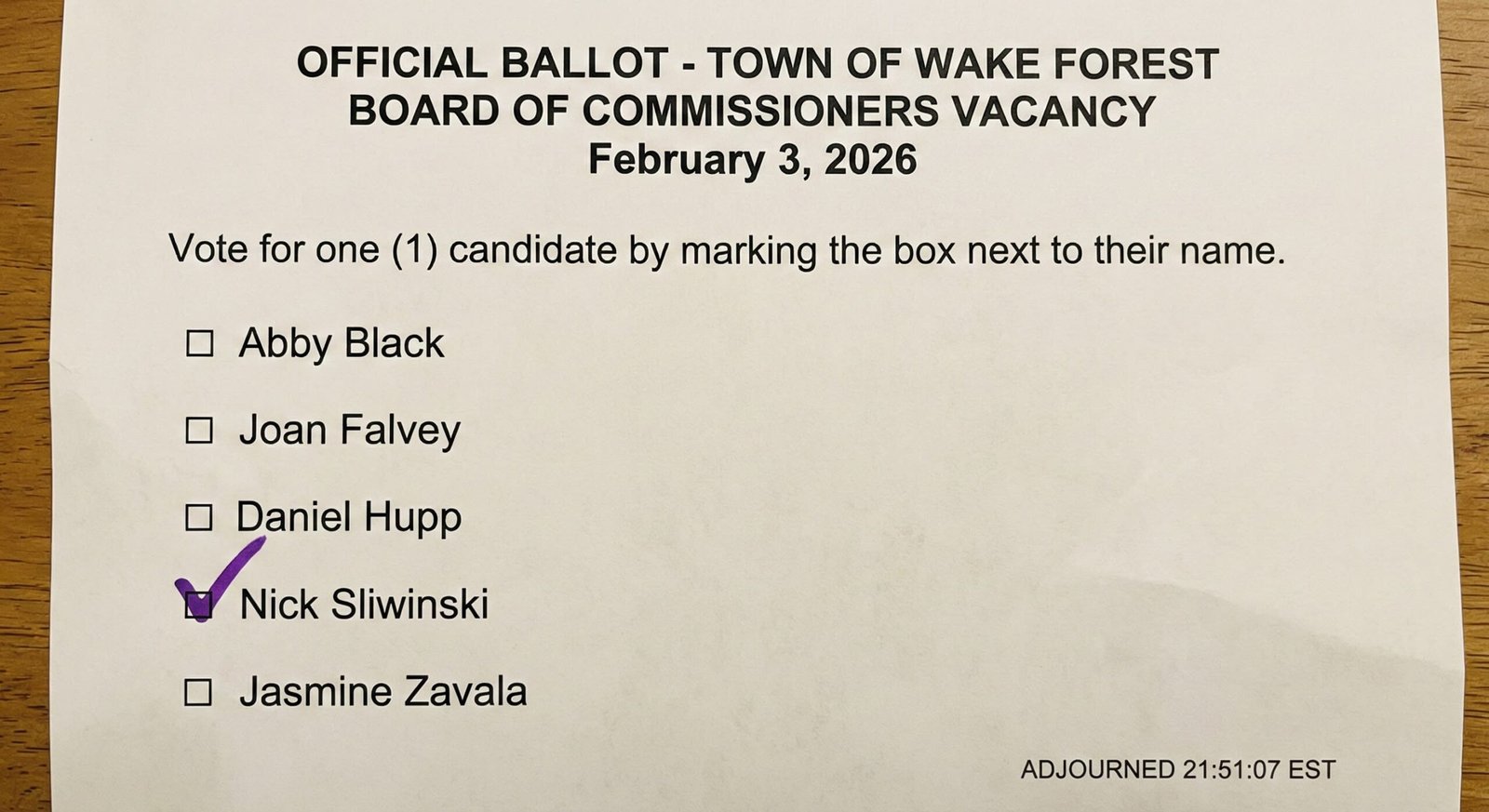
What followed was a 231-minute marathon — five candidates, sequestered separately, answering standardized questions read aloud by Town Manager Kip Padgett, votes signed by name and read aloud in public. Fatmi cast one of the split votes, holding out for new voices on a board he believed had been handed a mandate for change. The process held. It became the Wake Forest standard.
The months that followed were not quiet ones for the board.
Fatmi was in the middle of all of it — the $95 million Ligon Mill Road corridor alignment, the S-Line rail grant deliberations, the downtown Municipal Service District tax vote where the board, after hearing from residents, rejected the proposed increase. He voted. He asked questions. He showed his work.
In April, on a monuments and statues policy vote, he cast the lone dissent — arguing, as he often did, for more public participation before the board decided. His colleagues disagreed. He recorded his objection and moved on.
Then came May 19.
Fatmi took the mic during commissioner reports.
Senator Terence Everitt had vacated his seat in NC Senate District 18. After “a lot of considerations and deliberations, a lot of internal and external discussions, a lot of talking to family, a lot of prayer,” Fatmi told the room, he had been nominated and voted to fill it. He expected the appointment finalized by the end of the week.
“My tenure here has been absolutely phenomenal. I’ve absolutely enjoyed serving Wake Forest. I hope that I’ve done a good job during this short period. Wake Forest, I think, is a well-oiled machine.” — Haseeb Fatmi
Advertisement
Not everyone on the dais had been told in advance. Commissioner Faith Cross said so plainly: “This is the first time you’ve shared this information personally with me, so this is a very odd way for you to share it with your board. It would’ve been nice to hear about this ahead of time.”
It was the most candid exchange this publication has witnessed from that dais in recent memory. And it captured something honest about his tenure: he moved fast, worked from conviction, and the process sometimes got to the room before the conversation did.
The racist and xenophobic attacks that started during his commissioner campaign have continued since the Senate appointment — slurs on social media, attacks on his name, his faith, the color of his skin. He talks about it the way litigators talk about hostile evidence: directly, without flinching, without dwelling.
“As a litigator, you have to have thick skin. Things like that don’t bother me personally. Hate speech directed at me isn’t really directed at me. It’s directed at everyone who looks like me. People have already started calling me slurs on social media based on the color of my skin, my faith, and my name. Other people see that, and they know that hateful rhetoric is about them, too.” — Haseeb Fatmi
He is a Muslim man with a Bangladeshi family name running a competitive state Senate race in North Carolina. He doesn’t ask anyone to skip past that. He asks that they meet him first.
“I want to meet you. Let’s sit down and chat. I want to hear from you.” — Haseeb Fatmi
The vote totals from his commissioner race, he argues, tell you where Wake Forest actually stands. Historic turnout. People showed up and chose something different. The voices throwing slurs are loud, he says. They are not the majority.
The Senate seat was not the plan. Fatmi had mapped out two full terms on the board. But conversations — ones he’s been asked to keep private — shifted the math. Local leaders told him he would still be serving Wake Forest, just from a bigger room. Others said it more plainly: we need you in this seat.
SD18 — Wake and Granville counties — was held by Democrat Terence Everitt by roughly 100 votes. It’s one of the seats Democrats need to break the legislative supermajority and give Governor Josh Stein’s veto actual weight.
“We are dealing with extreme gerrymandering where, for years, our elected officials in power have drawn maps to skew the results and choose their voters, instead of running fair elections where voters choose their officials. If we have any chance in one day fixing this system and protecting our fundamental right to vote, it starts with holding this seat.” — Haseeb Fatmi
The legislative agenda tracks directly back to what he worked on locally. SB 833 would return planning authority to local governments — the same state restrictions on downzoning that frustrated Wake Forest’s growth management come up repeatedly in that bill. SB 370, which passed the Senate and has been sitting in House Rules since last year, targets the certificate-of-need system blocking a northern Wake County hospital and keeping healthcare options concentrated in Raleigh. The problems haven’t changed. The address has.
He’s already reaching out to leaders in Granville County. Same approach as Wake Forest: share your number, answer your messages, show up.
“Same strategy. Just on a wider scale.” — Haseeb Fatmi
At the end of every Board of Commissioners meeting, Fatmi closed the same way: Be good to each other.
Not a campaign line. Not a brand. Just the thing his grandfather modeled — the man who told the same story about a mountain every time he introduced his grandson.
“I think empathy — being good to each other — is the backbone of a functioning society. Where we all look out for each other and care.” — Haseeb Fatmi
The vacancy process he built on his first night is being run again right now, as Wake Forest figures out who fills the seat he’s vacating. He designed it to work without him. It does.
Senator Haseeb Fatmi represents Senate District 18, covering parts of Wake and Granville counties.
Tom Baker IV is the publisher of Wake Forest Matters, Wake Forest's only independent local newsroom. A Wake Forest native, Navy veteran, and intelligence professional, Tom launched Wake Forest Matters to bring serious accountability journalism to his hometown. Tips and story ideas: publisher@wakeforestmatters.com