
A few days ago, a reader dropped a comment on our piece about Chesterfield Village and the Neuse North Plan that stopped me in my tracks.
“I believe that the numbers of seats on the WF Bd of Commissioners needs to be increased by 2… and that 1 of those new seats should be elected by voters in the ETJ. Decisions made by the Town have a huge impact on ETJ residents…”
This comment strikes at the heart of what we talk about here. It identifies a moral failing in our local governance, a “Democratic Deficit.”
I’ve spent a career analyzing stability and political violence, from the fragility of emerging democracies abroad to the rising temperature of our own discourse at home. I am a 12th-generation North Carolinian; my family fought in the Revolution and WWII to secure the franchise. I take the concept of “voting” seriously.
The instinct to expand the franchise to bring more people into the fold of our democracy, is noble. It is the goal of pluralism. We want our neighbors in the Extraterritorial Jurisdiction (ETJ) to have a stake in the community. When you tell thousands of people, “You must follow our zoning rules, but you cannot speak,” you are planting the seeds of resentment.
But here is the hard truth: We cannot just give the ETJ a seat.
It’s not because we don’t want to. It’s because the machinery of American election law, specifically the 14th Amendment, makes it mathematically and legally impossible under our current system.
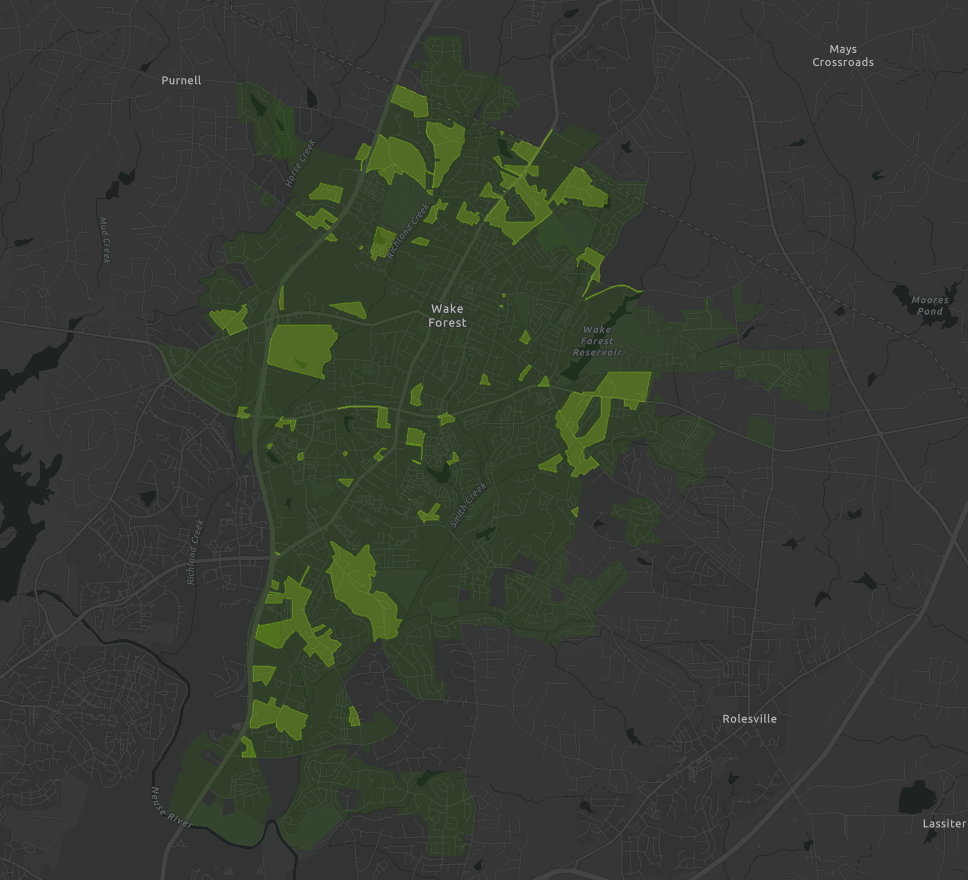
First, we have to look at the map.
The ETJ is land just outside our corporate limits. Residents there don’t pay town taxes, but they are subject to our planning and zoning. It feels like “regulation without representation,” and frankly, it is.
But in North Carolina, municipalities are “creatures of the state.” We operate under Dillon’s Rule, which means Wake Forest only has the powers Raleigh explicitly gives us. And Raleigh says, under N.C.G.S. § 163-55, that you must reside inside the corporate limits to vote.
The Supreme Court backed this up in 1978 in a case called Holt Civic Club v. City of Tuscaloosa. They ruled that a city can police and zone its borderlands without granting those residents a vote. It might not feel fair, but it is the settled law of the land.
“But,” you might ask, “why can’t we just change the Town Charter to add a special seat?”
This is where we run into the Equal Protection Clause and the principle of “One Person, One Vote.”
In the landmark case Reynolds v. Sims, the Supreme Court ruled that legislative districts must be roughly equal in population.
Let’s run the numbers for Wake Forest:
Town Population: ~60,000
ETJ Population: ~5,000 (estimate)
If we added two seats to the Board (making it a 7-member body) and reserved one of those seats exclusively for the ETJ, we would be breaking the Constitution.
Why? Because that one Commissioner would represent only 5,000 people, while the other six Commissioners would represent 10,000 people each. That means a vote cast by an ETJ resident would be mathematically twice as powerful as a vote cast by a Town resident.
In our attempt to enfranchise the ETJ, we would be disenfranchising the citizens of Wake Forest. The courts would strike it down in a heartbeat.
This isn’t just a Wake Forest problem. This is a structural problem that mirrors what we see at the state and federal levels.
Whether it’s the Senate filibuster allowing a minority to block the majority, or gerrymandered districts in Raleigh that insulate representatives from their voters, we are seeing a crisis of mechanics. When the machinery of government no longer matches the reality of the population, you get friction. You get “The Troubles.”
We are seeing that friction right now on our streets and in the “growth machine” of development. We have a governance model designed for a sleepy railroad town trying to manage a booming metro area.
So, if we can’t give them a seat, what do we do? We cannot leave thousands of our neighbors in political limbo, governed but ignored.
Annexation: The only constitutional way to give ETJ residents a vote is to bring them fully into the town. They pay taxes, they get services, they get a vote. It’s a clean transaction.
Legislative Action: If the General Assembly actually cares about the will of the voters they should look at modernizing the ETJ statute to allow for a creative solution, perhaps a non-voting delegate or weighted representation.
Until then, we have to rely on advisory power. State law (Chapter 160D) mandates that the ETJ has seats on the Planning Board. That is currently their only voice.
We need to listen to it. Because at the end of the day, the folks in the ETJ aren’t just lines on a zoning map, they are our neighbors.
Check to see if you live in the ETJ

Tom Baker IV is the publisher of Wake Forest Matters, Wake Forest’s only independent local newsroom. A Wake Forest native, Navy veteran, and intelligence professional, Tom launched Wake Forest Matters to bring serious accountability journalism to his hometown. Tips and story ideas: publisher@wakeforestmatters.com