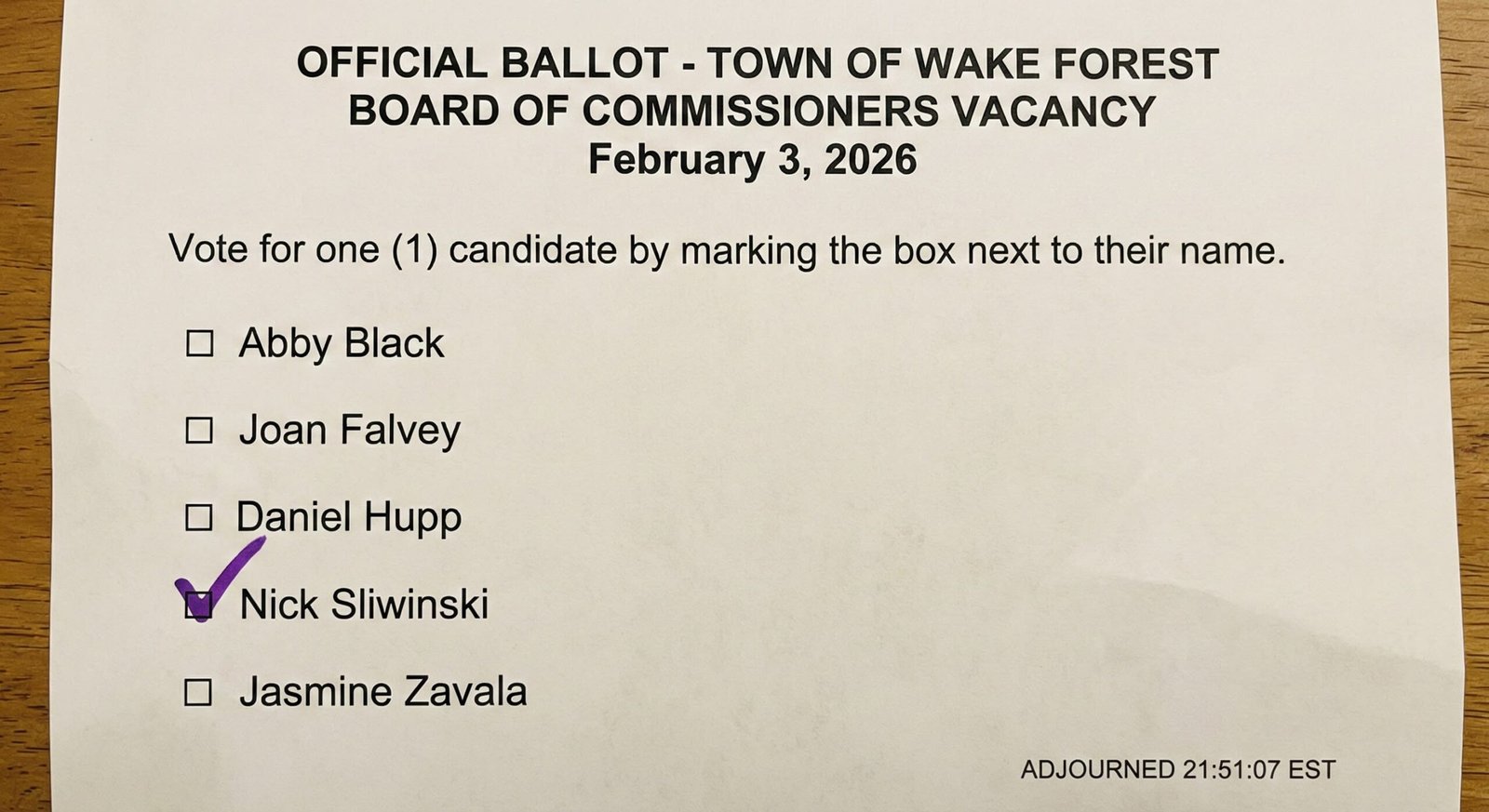
The Wake Forest board vacancy appointment process is underway. When Commissioner Ben Clapsaddle won the mayor’s race in November, Wake Forest didn’t just gain a new mayor. It suddenly faced a Wake Forest board vacancy appointment question that goes deeper than any one vote: How do we fill the vacancy he leaves behind in a way that strengthens—not weakens—our local democracy?
Almost immediately, a familiar suggestion surfaced: “Just appoint the third-place finisher from November. They got the next-most votes.”
It sounds tidy. It sounds logical. It sounds democratic.
Advertisement
But it isn’t.
In fact, the idea that the third-place finisher should automatically be favored for an appointment is based on a misunderstanding of how our elections work—and what they actually tell us about voter preferences. A vacancy is not a baton handoff. It’s a new democratic responsibility, and it deserves a real process.
If Wake Forest wants to maintain the trust voters just placed in their new mayor and commission majority, the path forward is clear:
Open the application process to everyone.
Require all prospective candidates to apply.
Hold public interviews at an open meeting.
Evaluate everyone on equal footing.
That’s the only process that respects voters, respects democratic legitimacy, and respects the significance of a seat on the Board of Commissioners.
The core problem is simple: our voting system doesn’t produce a ranked list of candidates. Wake Forest uses a “vote for up to two” plurality bloc election. That system tells us only one thing:
Who the top two winners are
It does not tell us:
Whom did voters prefer next
Whom voters found acceptable
How voters felt about any losing candidate
How close or distant someone was from earning broad support
Finishing third doesn’t mean “next most preferred.”
It just means “not in the top two.”
The ballot never asked voters, “Who should fill a future vacancy if one opens?”
And we shouldn’t pretend it did.
A Vacancy Is Not a Continuation of November
Appointments exist because sometimes the voters don’t choose the next person. That makes the process fundamentally different from an election—and more demanding, not less.
A commissioner appointed in December isn’t filling “Seat 3.”
They’re filling the remainder of a specific term, chosen by the people already elected to govern.
That job has different expectations, different responsibilities, and requires a different kind of evaluation than a five-way campaign.
This is why professional boards, nonprofit boards, corporate boards, and governing councils everywhere use a familiar standard:
Start fresh. Open the process. Interview publicly. Choose deliberately.
Only local politics treats vacancy appointments like a participation trophy.
Elevating November’s losing candidates by default creates three serious problems:
1. It confuses campaigning with governing
Running for office is not the same as being qualified to govern. It shows interest, not readiness.
2. It misreads voter intent
November voters chose the top two. They did not endorse a ranking of the rest.
3. It blocks new, qualified voices
Wake Forest is full of people with planning experience, civic leadership, policy expertise, and community credibility—people who may not have wanted to run a whole campaign but would serve competently on the board.
Advertisement
Why close the door on them?
If we want good governance, we should enjoy the strongest pool of applicants, not the most convenient.
Wake Forest Board Vacancy Appointment: Make Everyone Apply
The fairest, most transparent appointment process is also the easiest to understand.
Here’s what Wake Forest should do:
Open a public application window.
Let any eligible resident apply.
Publish the applications for public review.
Sunshine builds trust.
Hold public interviews at an open meeting.
Candidates should answer questions about growth, infrastructure, collaboration, budgeting, and community engagement.
Invite public comment.
Voters should see the applicants and respond to them.
Deliberate in public.
No pre-decided outcomes. No hidden assumptions.
Require the same process for everyone—including losing candidates.
If they want to serve, they should show up, answer questions, and compete on merit.
If a losing candidate is genuinely the best choice, the process will make that clear.
If not, the process will maintain the seat’s integrity.
Either way, democracy wins.
This Process Actually Aligns With What Voters Said in November
Voters overwhelmingly chose:
predictable process
managed growth
data-driven policy
A transparent, structured appointment process honors those values.
An automatic “third-place gets first dibs” shortcut doesn’t.
Better process = better governance.
A Line Worth Repeating
A vacancy appointment is not a consolation prize. It’s a public trust. And public trust must be earned, not inherited.
Wake Forest voters just sent a clear message about what kind of leadership they want. The new Board can reinforce that message—or undermine it—based on how they fill this seat.
Choosing transparency, openness, and a competitive process is the choice that strengthens both the Board and the public’s confidence in it.
Wake Forest Matters is an independent, nonpartisan newsroom covering Wake Forest, NC. We report on local government, schools, business, and community life — free to read and reader-supported. Fearless. Local. Loud.