The Wake Forest local divide is deepening. A Note on Public Discourse: I intended to remain radio silent until January, but recent discussions compel a brief return to the frequency. While I am hesitant to amplify the “noise” of online comment sections, I cannot stand by while misinformation is weaponized to distort the public record, widening the Wake Forest local divide.
We are seeing a classic deployment of psychological deflection—tactics designed to recast aggressors as victims and facts as opinions. To leave these assertions unchallenged is to acquiesce to a false reality.
Journalism isn’t just about reporting the news; it is about protecting the baseline of truth. I am writing this update not to argue with individuals, but to ensure that the historical record of this town reflects what actually happened, rather than what a select few wish had happened.
In the quiet days at the end of the year, just before Christmas, when a town should be resting, Wake Forest has instead been subjected to a masterclass in distraction.
Advertisement
If you look at the comment sections of local forums, you will see a flurry of activity: accusations of bullying, demands for “real proof” of historical events, and even attempts to pull a spouse’s military rank in civilian discussions. It is loud, emotional, and entirely performative.
But if you look past the noise, you will see something else: a Town Board quietly trying to do its job.
We are witnessing a collision between two distinct approaches to governance. One is the “Fatmi Method”—a reliance on statutes, transparent timelines, and legal precision. The other is the Politics of Grievance—a chaotic blend of victimhood, entitlement, and noise.
The danger isn’t just that the grievance politics are annoying. The danger is that they are effective at stopping the actual work we need to do.
The Anatomy of the Distraction
The recent online skirmishes have revealed three tactics used to derail substantive governance at Wake Forest.
1. The Weaponization of Victimhood (DARVO)
When local agitators are challenged on facts—whether it’s election law or the specific definition of a vacancy—they rarely debate the statute. Instead, they immediately shift the narrative to their own feelings. This isn’t accidental; it is a calculated psychological tactic known as DARVO (Deny, Attack, and Reverse Victim and Offender).
In this cycle, the agitator denies the reality of their initial aggression, attacks the credibility of the person citing the rules, and then reverses the roles to portray themselves as the victim of “bullying” or “exclusion.” The goal is to short-circuit the debate: it avoids accountability, confuses the issue, and gaslights the community into questioning the objective reality of the law.
We saw this clearly this week. When valid questions were raised, the response wasn’t a defense of policy; it was a cry of “bullying” and “safety.” By casting themselves as victims, they force Town Commissioners to waste energy proving they are“nice,” rather than proving they are competent.
2. The Entitlement of Rank
Perhaps the most telling moment of the week was a demand for deference based on military hierarchy. The comment— “my husband outranks you”—is a perfect encapsulation of the “Modern Tory” mindset. It assumes that authority comes from status, not citizenship.
This is antithetical to local government. In a town hall, a Commander has the same three minutes to speak as a janitor. The refusal to accept this equality is what drives the anger. They are not mad that they aren’t being heard; they are mad that they aren’t being obeyed.
3. The Denial of Reality
The demand for “proof” of the January 6th attack on the U.S. Capitol seems absurd, but it serves a function. It signals that we are not operating in a shared reality. If we cannot agree on what happened on national television, how can we possibly agree on traffic studies or water usage rates?
The “Fatmi Method”: Boring, Legal, and Necessary
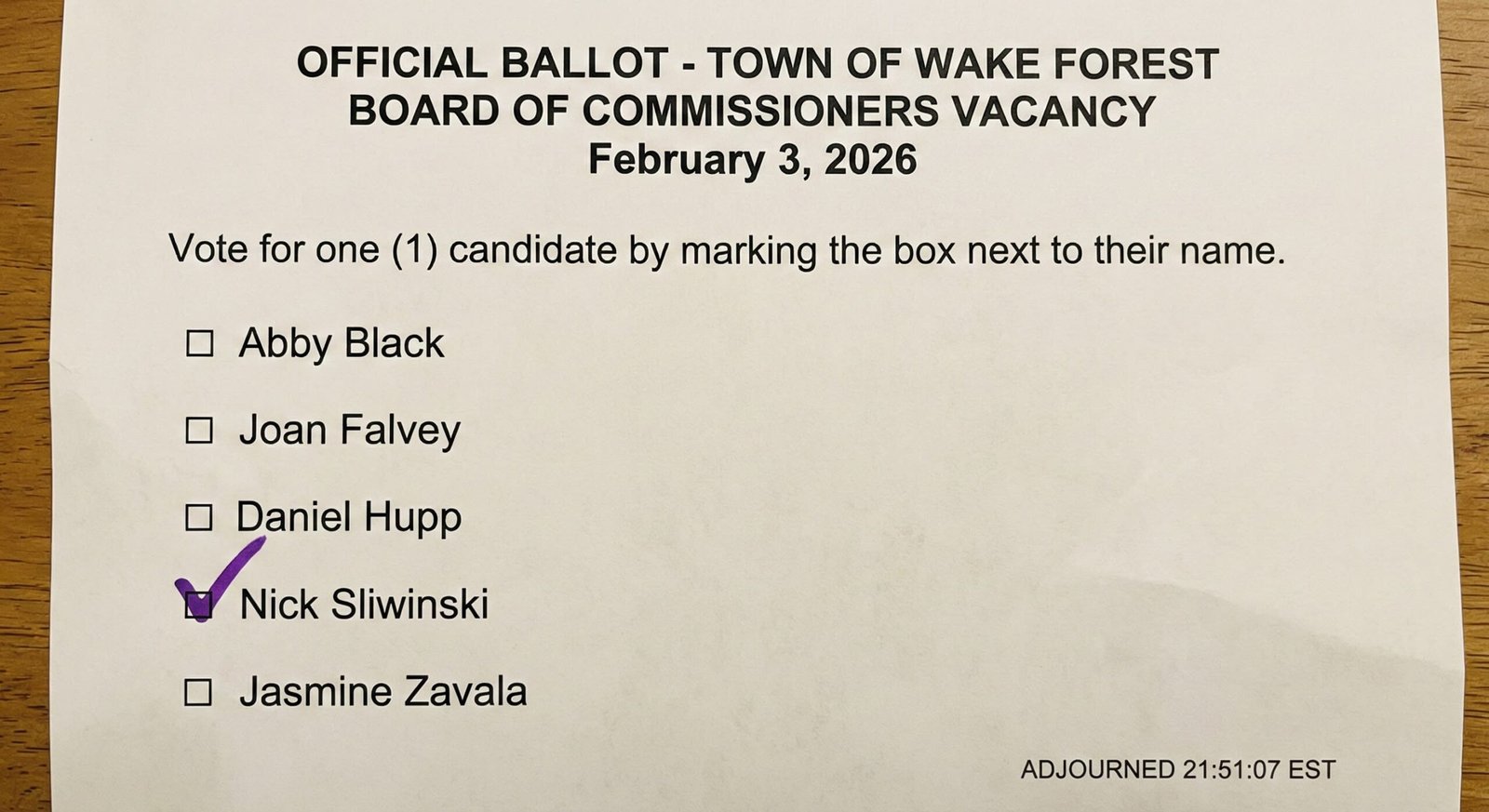
Contrast this noise with what I call the “Fatmi Method,” named after the procedural motion introduced by Commissioner Haseeb Fatmi to fill the current board vacancy.
The method is unexciting. It relies on N.C.G.S. § 160A-63. It sets boring deadlines (Jan 14). It schedules public interviews (Jan 20).
Advertisement
And that is exactly why it is working.
The “Fatmi Method” is an immune response to populism. It replaces “backroom deals” and “whisper networks” with a rigid, transparent administrative record. It denies the mob the chaos it craves by suffocating it with process. It is the realization that the only way to protect the town from the Noise is to strictly adhere to the Law.
The Wake Forest Local Divide: The Real Issue is Not Your Neighbor
While we argue about rank and insurrection on Facebook, the Growth Machine continues to turn.
Developers are still filing permits. The clear-cutting continues. Traffic patterns are shifting. The pressures of rapid expansion—infrastructure strain, school overcrowding, and the displacement of longtime residents—are the actual threats to our quality of life.
The politics of grievance solves none of these problems.
Complaining about “safety” in comments doesn’t pave a road.
Denying January 6th doesn’t lower your property tax assessment.
Pulling rank doesn’t stop a rezoning case.
The reason the recent election results looked the way they did—and the reason the Board is holding the line now—is that the silent majority of Wake Forest residents are tired of the theatrics. They want the potholes fixed. They want the trees saved. They want a government that works.
Be A Villager
We have serious work to do in 2026. The distinction between “Town Limits” and “ETJ” is a legal line, but it is not a community line. We all sit in the same traffic. We all shop at the same stores. We are all neighbors.
We need everyone—Town and ETJ alike—to stop performing for the audience and start participating in the process.
Stop trying to “win” the comment section.
Start reading the Unified Development Ordinance.
Stop pulling rank.
Start applying for advisory boards.
The Board has given us a roadmap for the vacancy appointment process. It is transparent. It is fair. It is open.
Let’s ignore the noise, trust the process, and get back to work.
Wake Forest Matters is an independent, nonpartisan newsroom covering Wake Forest, NC. We report on local government, schools, business, and community life — free to read and reader-supported. Fearless. Local. Loud.