The solutions we’ve explored—like fair-share PILOTs (Part 5) and a “fix-it-first” maintenance plan (Part 6)—are critical. But they are defensive measures. They help us hold the line, patch the leaks, and make the system fairer.
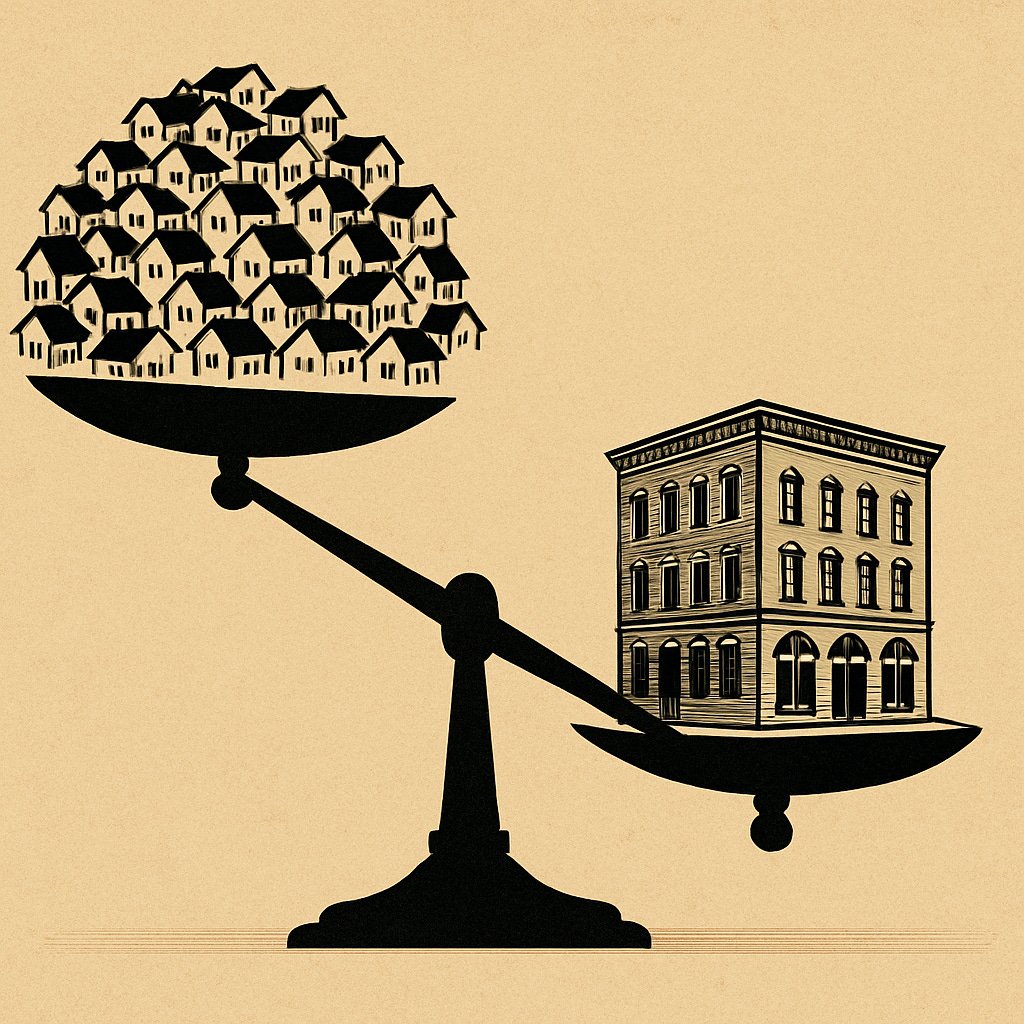
They do not, however, fix the fundamental cause of our structural deficit: our growth is fiscally unbalanced. We are a town that has become brilliant at approving residential subdivisions, which cost more in services than they generate in revenue. If we are going to survive as a small city without bankrupting our homeowners, we must get brilliant at something else. We need to go on offense. We need a proactive Wake Forest revenue-positive growth strategy designed to recruit revenue-positive growth.
The Math Nobody Talks About: Tax Revenue Per Acre
The most dangerous myth in local government is that “all growth pays for itself.” It doesn’t. The type of growth matters profoundly. The most important metric our town leaders should be using—and aren’t—is fiscal productivity, or property tax revenue per acre. When you analyze development this way, the picture becomes painfully clear.
- A 2024 analysis from Smart Growth America and the firm Urban3 highlights a stark example in Asheville, NC. A single downtown building on less than an acre generates $634,000 in property taxes per acre. A few miles away, a 34-acre Walmart, despite its high total value, generates only $6,500 per acre.
- The same studies show a six-story mixed-use building in Raleigh generates over $110,000 per acre.
- Sprawling single-family subdivisions, with their vast networks of roads, pipes, and public safety demands, are the least productive of all. They are often a net-negative liability for a town, costing more in long-term maintenance and services than they ever provide in property taxes.
Our structural deficit (Part 3) is a direct result of approving low-value-per-acre development for decades. The only way to fix our budget is to change our land-use “crop.” We must stop growing out with low-yield subdivisions and start growing up with high-yield, revenue-positive commercial and mixed-use projects in the right places.
The Difference Between a Wish List and a Battle Plan
So, how do we attract this “good” growth? We can start by looking 20 miles down the road at Holly Springs, NC.
For years, Holly Springs was in the same boat as Wake Forest—a fast-growing bedroom community. But they made a different choice. They didn’t just react to growth; they built a battle plan to win the growth they wanted.
While Wake Forest’s strategic plan (2022-2027) uses passive language like “encourage and protect small businesses” and “develop a business attraction plan,” the Holly Springs plan is a model of proactive, specific execution:
- They Set a Hard Goal: Their plan explicitly states a goal to “Pursue a residential/non-Dresidential tax base ratio of 70%/30%.” This measurable target drives every decision they make.
- They Targeted Industries: They didn’t wait to see who would show up. They “concentrate[d] business recruitment efforts” on specific, high-value industries: Life Sciences, Advanced Manufacturing, and IT.
- They Prepared the Land: Holly Springs invested millions in partnership with the county and state, to make large tracts of land “shovel-ready”—with utilities, infrastructure, and zoning already in place. This removes risk and time for a company, giving it a massive competitive advantage.
- They Built the Workforce: They partnered with Wake Tech to ensure a talent pipeline was ready to fill the new jobs.
The result? Holly Springs is now a global life-science hub, having landed FUJIFILM (a $3.2 billion investment), Amgen, and Ypsomed ($195.4 million investment), creating thousands of high-wage jobs and fundamentally balancing their tax base.
This is the difference between a passive, “business-friendly” climate and a proactive strategy.
The Wake Forest Revenue-Positive Growth Strategy Playbook
Wake Forest can —and must —do the same. This isn’t about becoming Holly Springs; it’s about becoming a fiscally resilient version of ourselves. This is the final, essential plank of our Small-City Operating Model (Part 7).
Our proactive economic “battle plan” should have four main objectives:
1. Do the Math.
Commission our own “Value per Acre” analysis.
Rationale:
- Cities that use Value-per-Acre analysis (e.g., Asheville, Brainerd, Sarasota) consistently find that mixed-use and compact commercial development generates 5–20 times more tax revenue per acre than low-density subdivisions.
- Conversely, low-density residential growth typically costs more in services (roads, fire, utilities) than it generates in revenue, especially when new infrastructure must be maintained over 20–40 years.
- Without this analysis, decisions are driven by assumptions and political pressure—not by long-term fiscal sustainability.
- Producing our own dataset gives elected leaders a neutral, evidence-based tool to explain “why this project here” to the public.
2. Define the Win.
Set a clear, measurable residential-to-non-residential tax base ratio (like Holly Springs).
Rationale:
- Many fast-growing towns become financially strained because the residential tax base grows much faster than the commercial/industrial base, shifting costs to homeowners.
- A stronger non-residential base reduces reliance on property taxes and helps fund parks, public safety, and transportation without annual tax increases.
- Peer communities that set ratios—Holly Springs, Apex, and Fuquay-Varina—have used them to guide rezoning decisions, prioritize infrastructure, and attract higher-value employers.
- A target ratio (75/25 or 80/20) provides a clear scoreboard for both investors and the public, signaling a commitment to balanced growth.
3. Prepare Our “Product.”
Identify and pre-zone key corridors (e.g., US-1/Capital Blvd) for high-value development and make them shovel-ready.
Rationale:
- Economic development research shows that site readiness is often the #1 factor determining whether a community makes the short list for employers.
- Companies—especially in life sciences and advanced manufacturing—now expect utility capacity, zoning certainty, and environmental due diligence to be in place before they will even visit a site.
- Pre-zoned, infrastructure-ready corridors dramatically reduce risk for developers, accelerating projects by 6–18 months and making us more competitive.
- Aligning with NCDOT and utilities ensures we plan proactively, not reactively, leading to higher-value private investment along our most visible corridors.
4. Target and Recruit.
Develop a professional recruitment strategy with Wake County Economic Development to attract med-tech, small-scale manufacturing, and corporate HQ prospects.
Rationale:
- Small businesses are essential, but, by themselves, do not broaden the tax base—they generate slower revenue growth and often need more support services.
- Wake County is a global hub for life sciences, tech, logistics, and clean manufacturing—all sectors that are growing and align with our workforce and infrastructure.
- Targeted recruitment yields significantly better results than passive marketing; communities that actively recruit see higher-wage job creation and more stable long-term investment.
- WCED already has pipelines, data, and prospect flow—partnering closely with them gives us access to regional branding power and industry networks we cannot build on our own.
A real Wake Forest revenue-positive growth strategy means we cannot solve a deficit created by residential growth by simply approving more of it. The only way to protect our homeowners, fund our infrastructure, and preserve our quality of life is to change the mix.
This is the final, and most important, piece of the puzzle. It’s how we stop reacting to growth and, finally, start leading it.
Tom Baker IV is the publisher of Wake Forest Matters, Wake Forest’s only independent local newsroom. A Wake Forest native, Navy veteran, and intelligence professional, Tom launched Wake Forest Matters to bring serious accountability journalism to his hometown. Tips and story ideas: publisher@wakeforestmatters.com