Wake Forest water restrictions take effect April 20 as the Wake Forest drought 2026 reaches record severity. Raleigh Water activating Stage 1 announced on April 15. This is what changes — and why the answer is to kill your lawn NC Piedmont and grow native plants instead of watering more carefully.
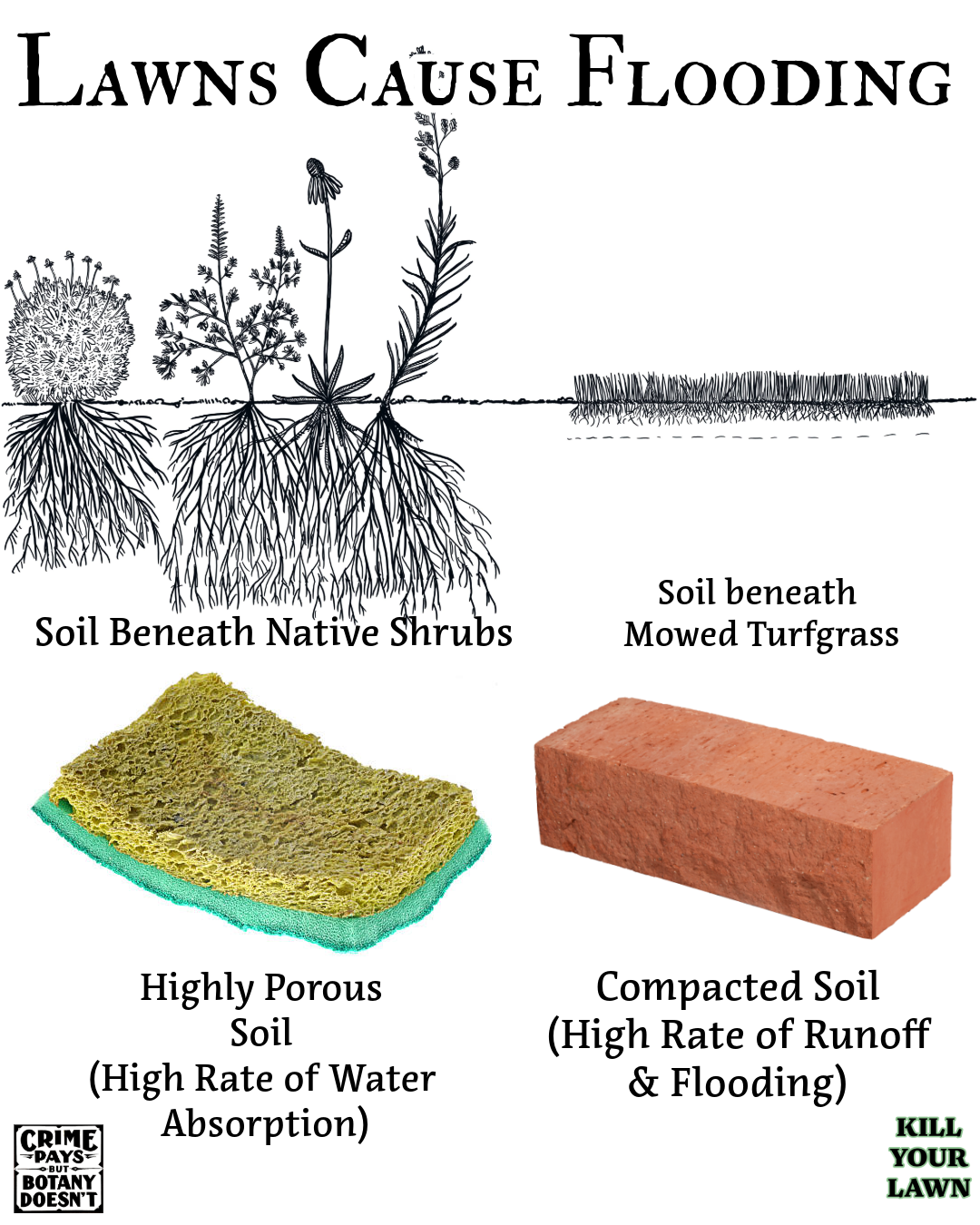
Infographic: Crime Pays But Botany Doesn’t — native plant root systems create highly porous soil that absorbs water; mowed turfgrass compacts soil, causing runoff and flooding.
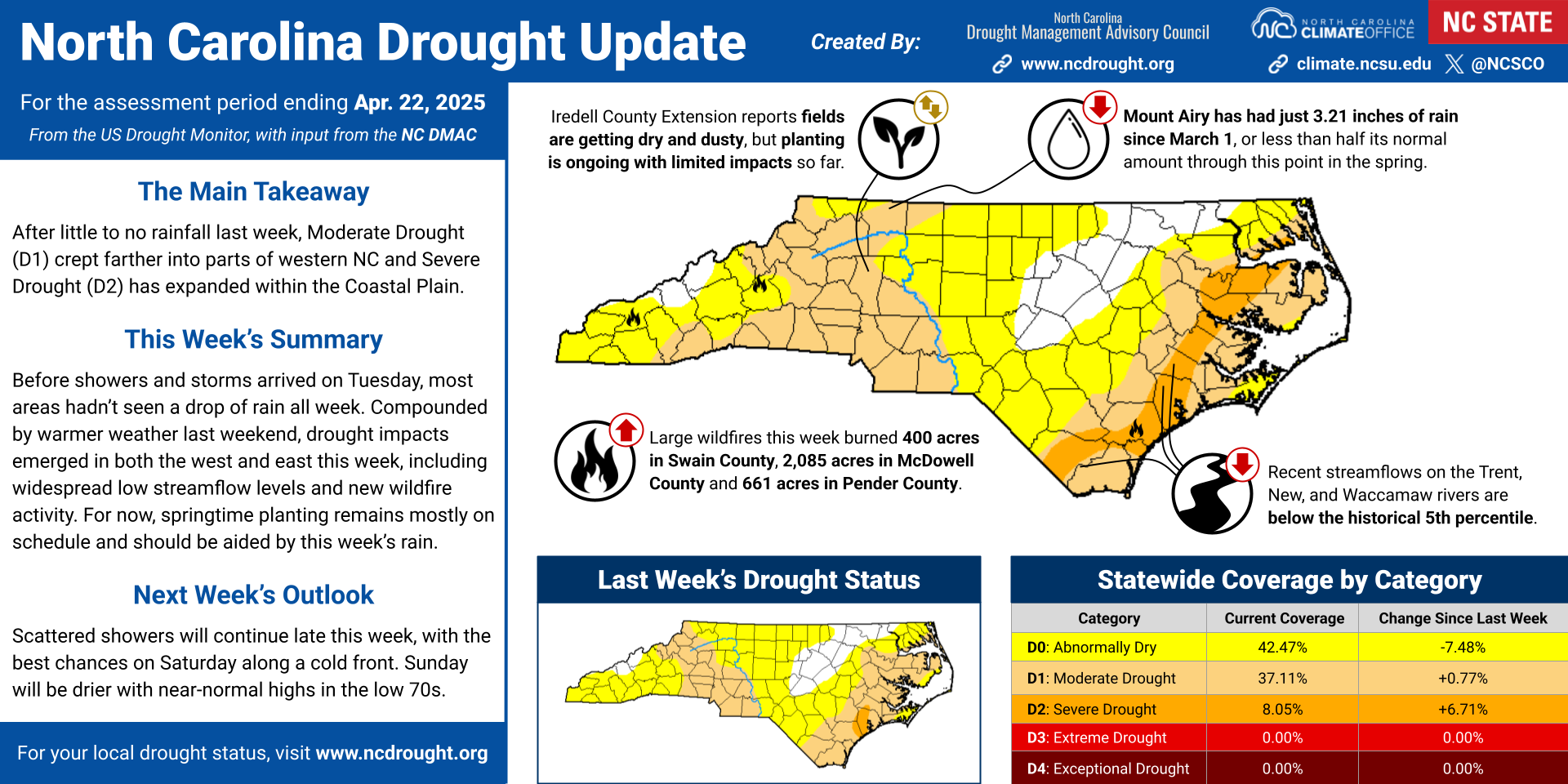
Central North Carolina is in a drought. The Wake Forest drought 2026 is the most severe on record. This is the driest year on record at RDU, running more than five inches below average rainfall. As a result, every county in the state carries a drought designation. The NC Forest Service has issued a statewide burn ban. Stream gauges across the region are at record lows.
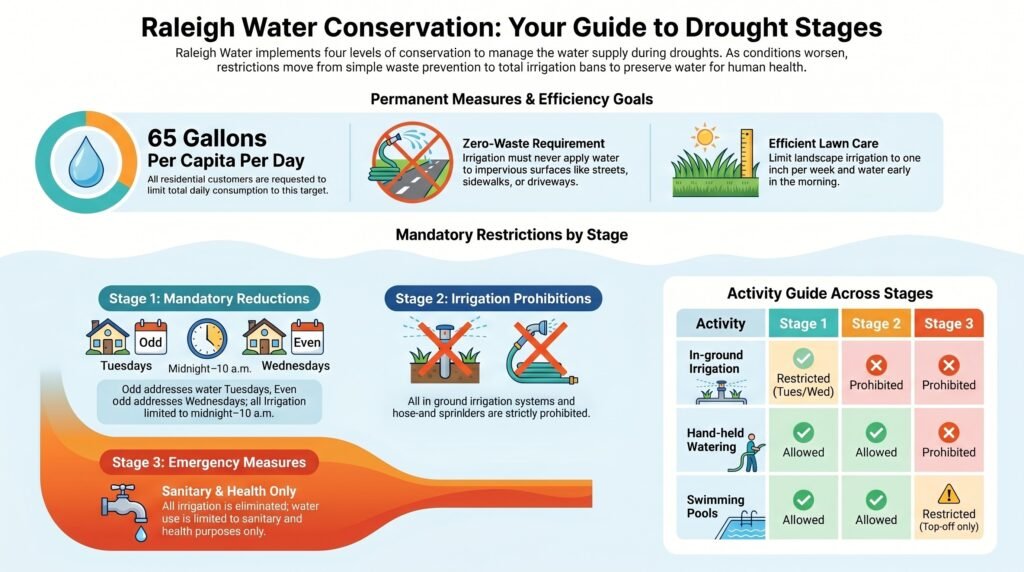
On April 15, Raleigh Water announced Stage 1 water-use restrictions. They take effect April 20. The water restrictions apply to all customers of the Raleigh Water system, including Wake Forest.
That last part, however, sometimes gets lost. Wake Forest has been a Raleigh Water customer since 2005. That year, the Town and the City merged their water and sewer systems. The City of Raleigh owns and operates the infrastructure that delivers water to your tap and fills your irrigation system. When Raleigh moves, Wake Forest moves with it.
What the Wake Forest Water Restrictions Actually Mean
Starting Sunday, here is what changes for most Wake Forest households.
Sprinklers (automatic and manual): One watering day per week, between midnight and 10 a.m. Odd-numbered addresses water on Tuesdays. Even-numbered addresses water on Wednesdays.
Hose-end sprinklers: Allowed 6–10 a.m. or 6–10 p.m. on your designated day.
Handheld hoses and drip irrigation: Unrestricted.
Restaurants: Serve tap water only upon request.
Hotels: Ask guests staying more than one night to reuse towels and linens.
According to Raleigh Water, the drinking water supply remains healthy. Falls Lake sits at 84% of its supply pool. The city also holds secondary reserves at Lake Benson and Lake Wheeler, both near capacity. In fact, Raleigh activated Stage 1 not because the system is failing, but because its Water Shortage Response Plan is designed to act early. That’s the right call. The Wake Forest water restrictions are designed to act early, before the system is stressed.
Current drought conditions across North Carolina. Source: NC State Climate Office.
But the Wake Forest drought 2026 raises a harder question — one that has nothing to do with which day you can run your sprinklers: Why, then, are you irrigating a lawn at all?
Wake Forest’s Lawn Problem: Not a Default. It’s a Choice.
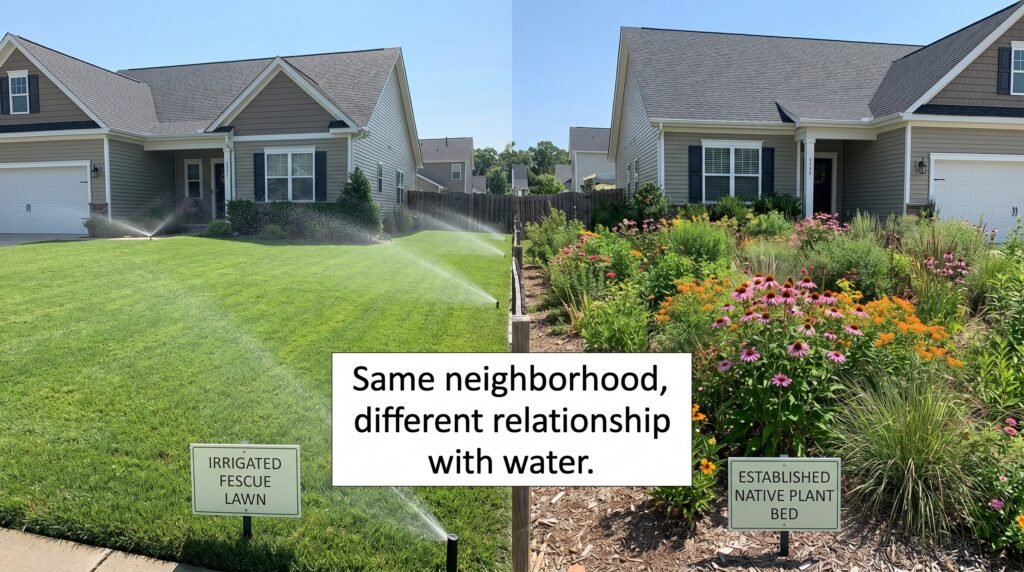
The standard residential lawn — closely mowed monoculture turf, typically fescue or Bermuda — is not a neutral baseline. It is an actively maintained artifact, not a natural state. Keeping it alive requires water, fertilizer, fuel, time, and periodic chemical input to sustain something the Piedmont ecosystem never asked for and does not support.
Turfgrass provides almost nothing to the local food web. It does not feed pollinators, nor does it support the insects that birds depend on. Soil goes unbuilt. Stormwater goes unretained. What turfgrass does do is consume water — a lot of it — to maintain an appearance of tidiness that is, historically speaking, a fairly recent cultural import.
This matters as Wake Forest continues to grow rapidly. Every irrigated fescue front yard is a small, ongoing tax on a shared resource.
The Wake Forest drought 2026 is making that cost visible. So are the water restrictions.
Wake Forest Water Restrictions and Your Watershed
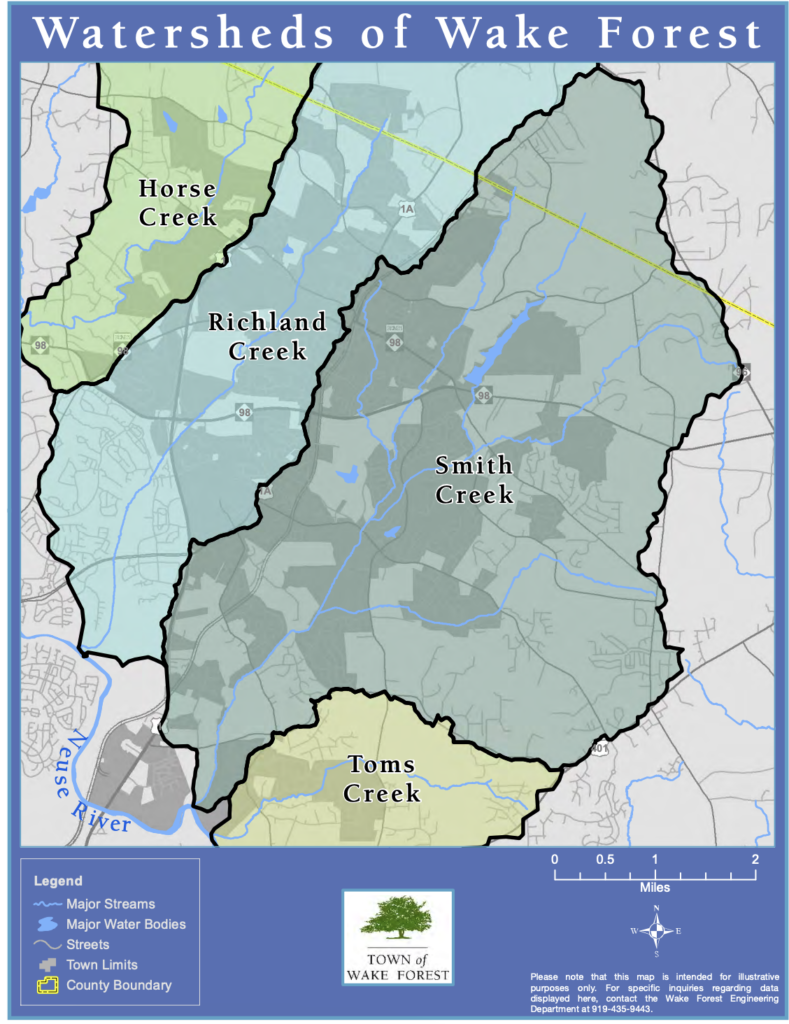
Wake Forest drains into the Neuse River through four named subwatersheds: Horse Creek, Richland Creek, Smith Creek, and Toms Creek. Named tributaries include Sanford Creek, Austin Creek, Hatters Branch, and Spring Branch. Consequently, every raindrop that falls on a Wake Forest yard, roof, or parking lot ends up in one of these streams. Then, those streams flow to the Neuse. The Neuse flows to Pamlico Sound. As the Town’s Engineering Department puts it: what we do here can have an effect all the way to the ocean.
Two of Those Streams Are Already Failing
Smith Creek and Toms Creek are both formally impaired under the Clean Water Act — designated for lack of aquatic macroinvertebrates, the small organisms that indicate a functioning stream ecosystem. These are not preliminary findings. The Town is actively studying both under ARPA-funded watershed restoration programs. They are regulatory designations documenting streams that have already degraded under development pressure.
Horse Creek carries its own regulatory weight. It drains directly into Falls Lake — the reservoir that supplies drinking water to more than half a million people across seven municipalities, including Wake Forest. In 2011, North Carolina adopted the Falls Lake Nutrient Management Strategy (the Falls Lake Rules) in direct response to repeated harmful algal blooms caused by nutrient pollution from surrounding development. Wake Forest must meet pollution reduction targets under those rules. The ARPA-funded Horse Creek Watershed Study exists to develop the compliance measures the Town needs to meet them.
What Your Lawn Is Actually Doing to These Streams
A conventional fescue lawn does almost nothing to slow or filter stormwater. When rain hits it, it simply runs off. As a result, it carries nitrogen, phosphorus, and sediment directly into already-stressed streams.
Native plantings work differently. Deep root systems absorb runoff at the lot level. Layered canopy and groundcover filter nutrients before they reach the creek. Together, they rebuild riparian function that the watershed has been losing to impervious cover for decades.
State law also requires a minimum 100-foot riparian buffer on both sides of every Wake Forest stream under the Neuse River Riparian Buffer Rules. Many residents don’t know this — and many violate it by mowing to the water’s edge. Allowing native vegetation to re-establish in that buffer zone is not just good practice. It is the legal baseline.
Water Restrictions in Regional Context
On February 2, 2026, Wake County became the first county in North Carolina to adopt a One Water Plan. This 50-year framework integrates drinking water, wastewater, stormwater, and groundwater as a single connected system. The plan explicitly calls for green infrastructure — wetlands, rain gardens, and nature-based solutions — to slow runoff and reduce strain on drainage infrastructure. It projects that water demand in Wake County municipal systems will more than double by 2070 as population approaches two million.
In other words, the Wake Forest drought 2026 is not a disruption from normal. It is a preview of the county’s steady-state future. Long-term planning must account for increasingly dry conditions.
Falls Lake, the dam, and the Neuse River corridor downstream. Source: USACE Wilmington District.
Falls Lake belongs to more than just Raleigh. The U.S. Army Corps of Engineers’ Wilmington District operates Falls Lake for water supply, flood control, and downstream water quality on the Neuse River all the way to Kinston. During drought, the Corps releases water downstream to serve municipalities, industries, and ecosystems. The lake serves a 200-mile river system — which means every gallon pulled to maintain fescue is a gallon that doesn’t flow downstream.
The Town is also developing its own Sustainability Plan, underway since mid-2025 and targeted for adoption late 2026. It includes a greenhouse gas inventory and climate vulnerability assessment. Notably, that process remains open for public input.
How to Kill Your Lawn Under Wake Forest Water Restrictions: Three Methods
The botanical educator behind Crime Pays But Botany Doesn’t has published one of the most practical kill-your-lawn NC Piedmont guides available at crimepaysbutbotanydoesnt.com/kill-your-lawn. Its core argument: the American lawn is a non-native turf monoculture that crowds out the native plant communities that once defined and sustained regional ecosystems. In the NC Piedmont, replacing turf with native plants is the most powerful tool for restoration — lot-level ecological work that compounds over time.
Here are the three main approaches.
Choosing Your Method
Rent a sodcutter. The fastest way to kill your lawn NC Piedmont conditions allow. The machine cuts grass roots two to three inches down and lifts sod in slabs. Flip the slabs root-side up, leave them as mulch, and you have a clear planting surface. It can kill a lawn in a day. Note: fescue and St. Augustine respond well. Bermuda grass is more difficult — its deep stolons can resprout from fragments and require more aggressive removal.
Sheet mulch. Cover the lawn with cardboard, then bury it under several inches of wood chips. This smothers grass over time. Free mulch is often available from tree services through ChipDrop. In higher-rainfall climates like ours, this method can be slow. Pair it with active planting to use the window while you have it.
Just start planting. The most forgiving approach. Place native plants in the existing lawn and mow or weed-whack around them. As natives establish and spread, they shade out the turf. Over time, you become the disturbance force that selects for what belongs here.
In all cases, mulch is your best tool when you kill your lawn NC Piedmont style — whether by sodcutter, sheet mulch, or native planting. It retains moisture during drought, moderates soil temperature, and feeds soil microbes as it breaks down. A thick mulch layer around newly installed native plants can make the difference between a plant that survives the summer and one that doesn’t — especially important during the Wake Forest water restrictions period, when supplemental irrigation is limited to once a week.
What to Plant: NC Piedmont Native Species
Wake Forest sits in the NC Piedmont — a transitional zone between the coastal plain and foothills, with mixed mesic hardwood forest ecology. When you kill your lawn NC Piedmont conditions call for a layered native habitat: canopy trees, understory trees and shrubs, herbaceous perennials, and groundcover. You don’t need all of it at once — a starting point is enough. Under the current Wake Forest water restrictions, drought-tolerant native plants are the practical choice.
Eastern Purple Coneflower (Echinacea purpurea). Drought tolerant once established. A strong pollinator plant. Goldfinches work the seed heads through fall and winter. The most forgiving native perennial for a first planting.
Black-eyed Susan (Rudbeckia hirta). Short-lived perennial that reseeds aggressively. It covers ground fast and feeds a wide range of native bee species. An excellent companion to coneflower.
Wild Blue Indigo (Baptisia australis). A deep taproot makes it drought-resistant. Plant it where you want it — it’s difficult to transplant once established. Also a larval host plant for several native butterfly species.
Inkberry (Ilex glabra). Native holly. Evergreen, excellent for the shrub layer in wetter spots or rain garden edges. Berries persist through winter and feed birds when other food sources run out.
Virginia Sweetspire (Itea virginica). An adaptable shrub. It tolerates both wet and dry conditions, produces fragrant flowers in early summer, and turns spectacular colors in fall. Underused and underappreciated.
Little Bluestem (Schizachyrium scoparium). Native bunch grass. The structural spine of many Piedmont meadow plantings. Drought tolerant, does not require irrigation once established, and provides seed for birds through winter.
Eastern Redbud (Cercis canadensis). If you have room for one native small tree, this is it. Among the first to bloom in spring, it feeds native bees before much else is available.
Bradford Pears: Remove Them Now
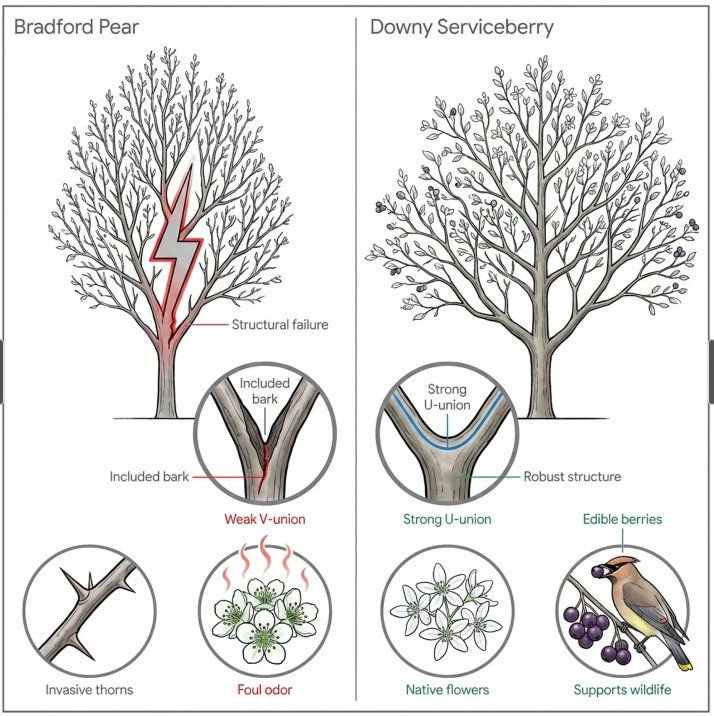
If you have a Bradford pear, the Wake Forest water restrictions make this the right moment to take it down. As Wake Forest Matters reported in March, the Bradford pear is an invasive species. It fails structurally in storms, spreads into thorny thickets along stream banks, and provides no ecological value. When you kill your lawn NC Piedmont native trees — redbuds, dogwoods, and serviceberries — are the replacement that feed pollinators and support birds year-round.
The NC Bradford Pear Bounty program exchanges a removed Bradford pear for a free native replacement tree — up to five per homeowner.
Advertisement
This Saturday, April 18 is also one of the best plant days Wake Forest has had in years. Two events, same morning, both downtown:
The Wake Forest Community Garden Plant Sale runs 8 a.m. to noon at 407 Wait Ave. It’s a pay-what-you-can fundraiser to establish a community garden in downtown Wake Forest. Native and ornamental plants are available. Every dollar supports tools, soil, and seeds for a shared neighborhood green space. RSVP on Facebook.
Then head to Forest Fest at the Town Hall parking lot from 10 a.m. to 2 p.m. The Town is giving away 2,700 free native tree seedlings — Oaks, River Birches, and Redbuds — first-come, first-served. Both events overlap for two hours and are a five-minute walk apart.
The Wake Forest water restrictions take effect Sunday. The timing is not a coincidence.
Finding Your Species List
To build a native plant list for Wake County, visit iNaturalist.org, select “Explore,” filter by “Plants,” and set the location to Wake County, NC. The database reflects what actually grows here. Cross-reference with the NC Native Plant Society and local nurseries — Eliza’s Native Plants in Durham, Fern Valley Natives in Chapel Hill, and Eastern Plant Specialties carry regionally appropriate stock.
Wake Forest Water Restrictions vs. Native Plants: A Practical Comparison
Under Stage 1 of the Wake Forest water restrictions, your conventional irrigated lawn is already at a disadvantage. You get one watering day per week, in the early morning hours. Fescue is shallow-rooted and prefers cooler temperatures. It is entering its worst season. With the extended heat forecast and no rain on the horizon, many Wake Forest lawns will suffer regardless of which day the sprinklers run — and the Wake Forest drought 2026 shows no sign of relenting.
A well-mulched native plant bed can go weeks between waterings once established. Native perennials have root systems built over thousands of years of co-evolution with this specific soil and climate. During drought, they go dormant rather than dying — slowing down, conserving energy, and drawing on reserves that reach deeper than any irrigation system. This is the core reason to kill your lawn: NC Piedmont native plants are built for exactly these conditions. That is what belonging here looks like.
Water Restrictions, Growth, Watersheds, and What Gets Lost
Wake Forest sits on land that indigenous peoples — the Eno, Occaneechi, and other Siouan-speaking nations — managed for centuries before European settlement. The Piedmont they knew was not a lawn. It was a complex, fire-managed native plant community that sustained an extraordinary range of life.
That community is not gone. It is fragmented and stressed, but the genetic material persists in roadsides, stream banks, power line cuts, and patches of remnant forest throughout this county. Every native planting in a residential yard is a small node of reconnection to that system.
Golf Course Problem: A Local Case Study
Right now, before Wake Forest’s Board of Adjustment: 125 acres off Club Villas Drive, the former Wake Forest Golf and Country Club, vacant since 2007. The site — with Horse Creek running through it, three ponds, and acres of wetlands — is the subject of a contested proposal for 170 single-family homes by Mungo Homes, marketed as “Legacy Greens.” As Wake Forest Matters reported on that hearing last week, this is a critical juncture for the watershed.
A golf course is a lawn at industrial scale — a non-native monoculture maintained by irrigation, fertilizer, and constant mechanical intervention. The Wake Forest course could not sustain itself, so it closed. The Board of Adjustment is now being asked, in part, whether the developer can drain the ponds on that land to make way for more irrigated residential development. The better answer is to kill your lawn NC Piedmont and let the watershed breathe.
Horse Creek runs through that property. This is the same stream under state-mandated nutrient reduction rules, and it drains directly into Falls Lake. Hawkshead — listed as a Horse Creek watershed neighborhood — borders the former golf club site to the north. Therefore, what happens to those ponds is not a private development question. It is a Falls Lake water quality question.
Ligon Mill Road and the Pattern Expanding Northeast
The same dynamic is playing out along Ligon Mill Road. As Wake Forest Matters reported in January, the Neuse North Area Plan proposes to absorb the Chesterfield Village corridor — unincorporated land sitting above the Mill Tract, a tributary and wetland system feeding the Neuse River. Ligon Mill Road has already been strip-cut. The natural buffer is fragmenting in real time. Development pressure is moving outward and downslope, into the same watershed systems the Wake Forest drought 2026 is stressing from above.
Every household added to the Raleigh Water system draws from Falls Lake. Each cleared acre reduces the watershed’s ability to absorb rainfall when it finally comes. These are not separate conversations.
What to Do During Wake Forest Water Restrictions: Right Now
The Wake Forest drought 2026 is a disruption — and an invitation. Stop fighting the ground you are standing on and start working with it.
This Saturday, April 18 — two events, one morning:
Forest Fest / Arbor Day Seedling Giveaway — 10 a.m. to 2 p.m., Town Hall parking lot. 2,700 free native tree seedlings (Oaks, River Birches, Redbuds), first-come, first-served. Arrive at 10.
Both overlap from 10 a.m. to noon and are a five-minute walk apart. Make a morning of it.
If you have a Bradford pear, photograph it now and register at treebountync.com for the Bounty program.
This month:
Use your one watering day to deep-water any newly planted natives only. Let the lawn go.
Rent a sodcutter. Start with the front yard. Mulch it heavy. Plant three or four native perennials. See what happens.
Provide input on the Town’s Sustainability Plan before it closes for public comment.
Kill your lawn NC Piedmont — replace it with native plants that belong here. The land will do the rest.
Stage 1 water restrictions take effect April 20. Full details: raleighnc.gov/alerts. Wake Forest water and sewer questions: Raleigh Water, 919-996-3245.
The Kill Your Lawn guide is at crimepaysbutbotanydoesnt.com/kill-your-lawn. Native plant nursery directory at the same site.
Tom Baker IV is the founder and publisher of Wake Forest Matters. He grows native wildflowers under grow lights in his garage and has opinions about Bermuda grass.
Wake Forest Matters is an independent, nonpartisan newsroom covering Wake Forest, NC. We report on local government, schools, business, and community life — free to read and reader-supported. Fearless. Local. Loud.





Pingback: Who Is Tom Baker IV? Wake Forest Matters Founder & Editor