The Wake Forest neighbors facing division threatening our neighborhoods demands honest conversation and mutual respect. (This commentary is offered in the spirit of civic reflection, not political endorsement. Its purpose is to encourage respect, understanding, and neighborly relations in Wake Forest’s public life.)
I believe that everyone in Wake Forest, North Carolina — candidates, elected officials, and all residents alike — should join in a commitment to civility. In an election year marked by tension and division, choosing respect over rancor isn’t a sign of weakness. It’s a signal of strength. When we treat one another as neighbors rather than opponents, we protect our community’s character and reinforce the foundation of our democracy. Sign the Wake Forest Civility Pledge Today
There’s something sacred about local elections. They’re not supposed to be about left or right, red or blue. They’re about who we are to one another — how we live together, care for our town, and hand it forward to the next generation a little better than we found it.
But this year in Wake Forest, something feels different. Something fragile is being tested.
Advertisement
Neighbors who stepped forward to serve have found themselves targeted by online and real-world harassment, anonymous websites, and personal attacks. Instead of honest debate, we’ve seen rumors, half-truths, and hostility masquerading as “engagement.”
This isn’t democracy. It’s cruelty disguised as participation.
Reclaiming What Makes Wake Forest Neighbors Strong
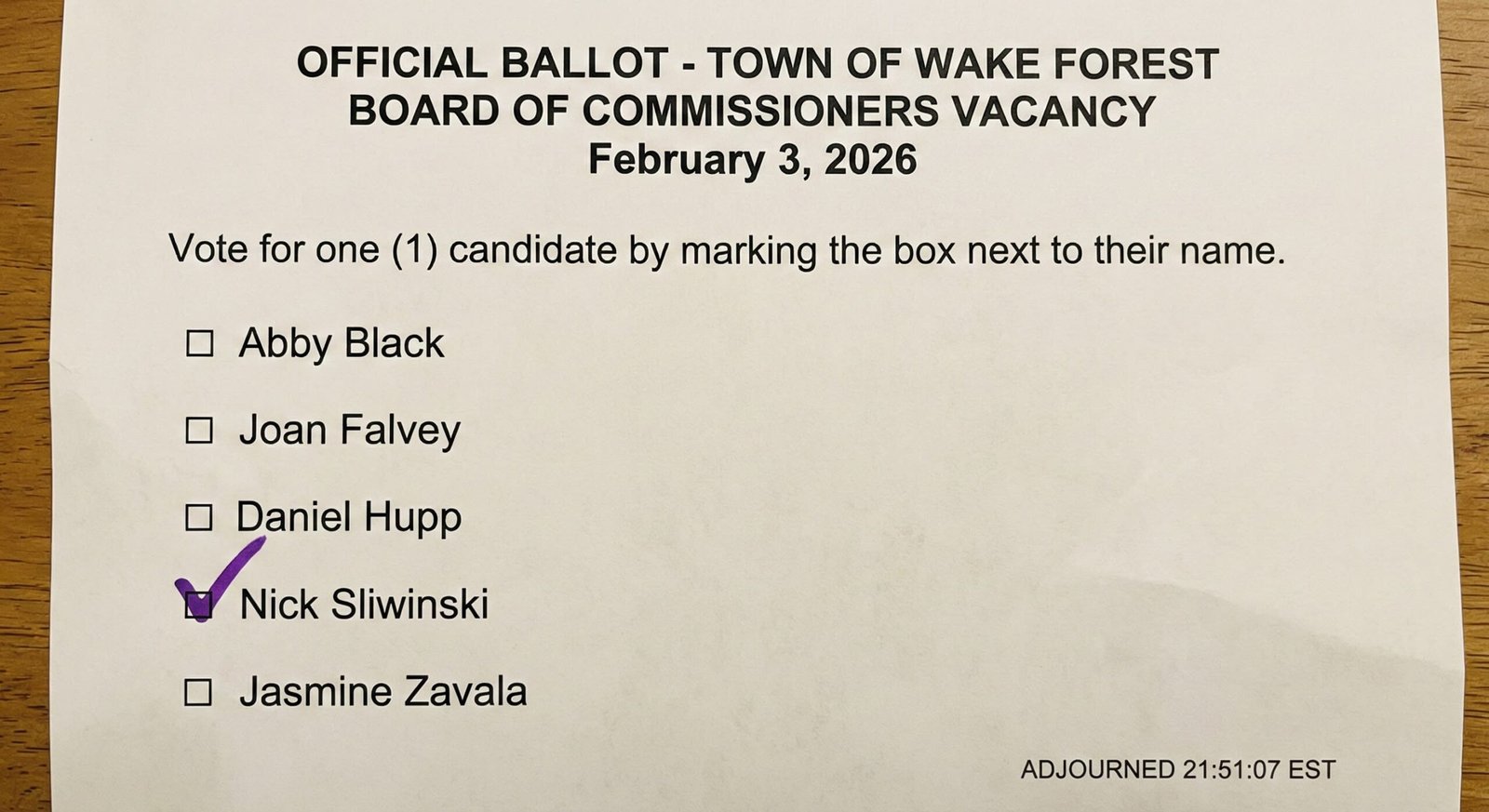
A few days ago, I saw Commissioner Nick Sliwinski’s post calling on his fellow candidates to denounce the hateful messages circulating in this election. It wasn’t a partisan statement — it was a reminder that we can choose better. His call for civility made me realize something simple but profound: this isn’t just a job for candidates. It’s on all of us.
Civility isn’t weakness; it’s the muscle that holds a community together. It’s what allows neighbors to disagree without tearing each other apart.
That’s why it’s time for the Wake Forest Civility Pledge — something that anyone, from elected officials to everyday residents, can sign. A simple promise to disagree without demeaning, to argue without attacking, and to see one another as neighbors first.
Because the only way we fix this is together — not through silence, but through a shared commitment to decency.
When Politics Turns Personal
This election season, several Wake Forest candidates have been subjected to deeply personal harassment that has nothing to do with ideas or qualifications:
When Division Replaces Dialogue
Pam James, a mother and community volunteer, has been the target of an anonymous website that circulates screenshots of her social media posts to portray her as sympathetic to the January 6 insurrection. But attending a political rally — even one that later spiraled into chaos — is not the same as committing a crime. When we start assuming we can read someone’s soul through a single post or photo, we stop being a community. Being a neighbor means allowing for complexity, forgiveness, and grace.
Haseeb Fatmi, the son of immigrants, has endured Islamophobic attacks — comments questioning his faith, demanding he “denounce Islam publicly,” and invoking false claims about “taqiyya” to cast doubt on his honesty. This isn’t policy debate; it’s prejudice cloaked in politics, echoing an old American pattern. The same suspicion once aimed at Catholics, Jews, and other newcomers is now repackaged for a new generation. Each era’s demagogues find its “outsiders” to target and fear, and each time, history reminds us how wrong those fears have been.
Jasmine Zavala, whose family is long-time small business owners here, has also spoken about harassment. When Commissioner Sliwinski called for civility, she commented that she, too, had been targeted online. Her experience as a Latina woman and small business owner reflects another truth: those who are “different” too often become the targets of trolls and agitators who don’t seek understanding, but who want to force division for their own gain.
Nick Sliwinski, a sitting commissioner, has been mocked online — including by party accounts — for not “toeing the line” tightly enough. One meme even portrayed him as a Halloween costume with “30 pieces of silver,” suggesting betrayal. That phrase may seem like harmless biblical shorthand, but in Southern political culture, it carries baggage. For generations, certain Protestant movements fused faith and politics in ways that cast religious minorities — mainly Jews and Catholics — as outsiders. Using that imagery today to punish someone for independent thinking revives echoes of that old intolerance, even if unintentionally.
Vivian Jones, a Mayor with a long record of service, recently reversed course on recognizing LGBTQ History Month. Some reacted sharply, including local party leaders who accused her of lacking courage. But the truth is, we don’t know every factor she had to weigh. She’s served this community faithfully for 24 years and continues to balance competing pressures in ways that are never simple. We can disagree with her decision and still treat her with respect. Accountability doesn’t have to come at the expense of empathy.
A Local Problem, A National Mirror
What’s happening in Wake Forest isn’t isolated. Across America, local officials are describing a wave of fear that’s reshaping what it means to serve.
After the deadly attack on state lawmakers in Minnesota, local leaders from both parties have begun speaking openly about the emotional strain that comes with public life. Many say the hostility they face online follows them home — affecting their families, their mental health, and their willingness to stay in office.
Women and younger officials, in particular, describe the toll of constant exposure: their addresses, workplaces, and even children’s schools can be found with a few clicks. Some have quietly begun carrying firearms — not as a political statement, but as protection from the political climate itself.
Still, amid that anxiety, many of these officials speak with renewed resolve. They’re calling for practical protections — safer public meetings, better privacy laws — but also for something more profound: a cultural renewal that rejects cruelty as a political norm.
That’s the same challenge we face here in Wake Forest. Because democracy doesn’t die in Washington, it erodes in the spaces between neighbors.
Understanding the Wake Forest Community Divide
The Cost of Silence
When harassment becomes the cost of civic service, good people will stop serving. When cruelty becomes normalized, decency withers. And when we stop seeing one another as neighbors, we lose something far greater than an election.
Advertisement
The attacks on Pam, Haseeb, Nick, Jasmine, and Vivian aren’t just about them. They’re about us — about what kind of town we want to be. When we tolerate meanness in public life, it eventually infects everything else.
Democracy doesn’t depend on agreement; it depends on mutual dignity.
The Wake Forest I Know
My family has been in this part of North Carolina since before this town had a name. Through wars, depressions, hurricanes, and hard times, people here survived by a simple code: be a good neighbor.
After the Civil War, during the Great Depression, through World Wars I and II, folks made it by showing up for each other. They didn’t always see eye to eye, but they shared a faith that tomorrow could be better if we took care of one another today.
Roots of Neighborly Tension
That’s the Wake Forest I believe in.
Being a good neighbor means giving each other grace. It means recognizing that people can grow, that intent matters, and that disagreement doesn’t erase decency. It means condemning harassment wherever it comes from — because an attack on one of us is, in truth, an attack on all of us.
Our liberty doesn’t rest on hope alone. It rests on action — on the daily choice to love thy neighbor, to show courage instead of cruelty, and to keep the small flame of community alive.
To those who serve: thank you. To those who’ve been harassed: you’re not alone. To those who’ve stayed silent: now is the time to speak.
Because this is where it starts — not in D.C., not in Raleigh, but here, in Wake Forest.
When we stand up for one another’s dignity, we strengthen democracy itself. When we reject cruelty and choose compassion, we protect what’s most sacred about this place.
Wake Forest Matters is an independent, nonpartisan newsroom covering Wake Forest, NC. We report on local government, schools, business, and community life — free to read and reader-supported. Fearless. Local. Loud.