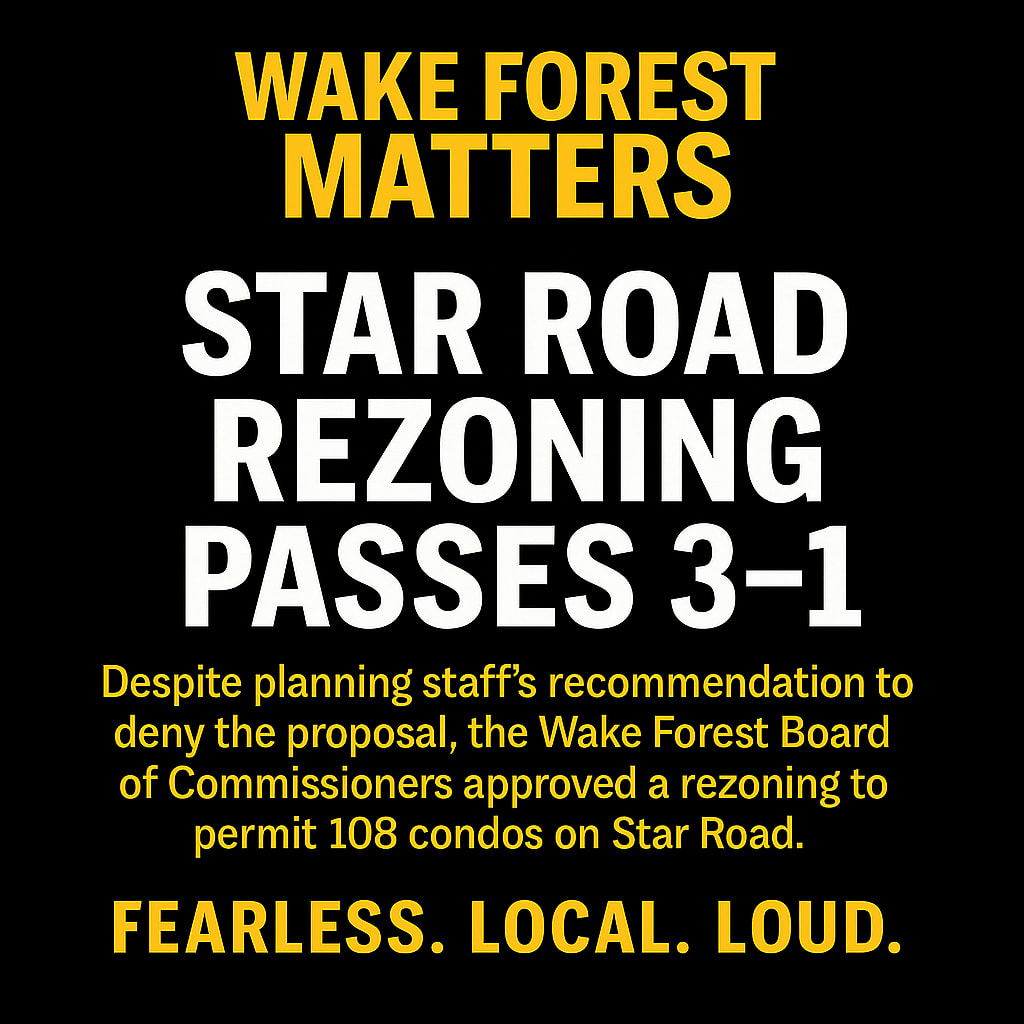
The Wake Forest rezoning vote on Star Road passed 3-1, reshaping development plans for the area. In a 3–1 vote Thursday night, the Wake Forest Board of Commissioners approved a rezoning that will allow up to 108 condominium-style townhomes on Star Road — despite the town’s planning staff and the Planning Board both recommending denial.
The decision underscores the challenge of balancing Wake Forest’s rapid growth with the tools local leaders still have to shape it. Mayor-elect Ben Clapsaddle, currently serving as commissioner, cast the lone “no” vote, citing flawed traffic studies, steep topography, and the lack of workforce or senior housing options.
Advertisement
Vote tally: Wright – Yes • Sliwinski – Yes • Shackelford – Yes • Clapsaddle – No (Commissioner Faith Cross was absent; her written comments opposing the rezoning were read into the record.)
The applicant, SJP Raleigh-Durham LLC, sought to rezone roughly 14 acres at 0 Star Road from Highway Business (HB) to General Residential 10 – Conditional District (GR10-CD). That change allows the land, previously intended for commercial use, to support 108 two-over-two condo units, with 264 parking spaces, 24 bicycle spaces, and generous open space (47%, compared to 10% required).
Town planning staff and the Planning Board both recommended denial, calling the project inconsistent with Wake Forest’s Comprehensive Plan, which designates the area for commerce and employment. The Comprehensive Transportation Plan (CTP) still includes an outdated “backage road” through the site — a remnant that staff plan to delete in the 2026 CTP update.
Community Concerns
Residents turned out to question both the project and the process.
Margaret Watkins, a longtime resident, challenged the reliability of the Traffic Impact Analysis (TIA) — the study estimating how much new congestion the development would add.
“If the traffic studies aren’t consistent, we shouldn’t trust the results.” — Margaret Watkins, Wake Forest resident
Her words struck a chord. Moments later, Clapsaddle echoed the same skepticism, saying it wasn’t fair to future councils to approve a project “on data everyone admits may be unreliable.”
Watkins’ comments reframed the debate from numbers to trust — highlighting how residents experience growth in real time, not in spreadsheets.
Resident Janice Davis raised concerns about the historic Cook family farmhouse, which sits adjacent to the project. The Cook property — a landmark many of us grew up passing on the drive down Ligon Mill Road — is more than an address. It’s part of Wake Forest’s living memory, a reminder that growth isn’t happening on empty fields but beside homes that have anchored this community for generations.
Why Staff Said No
Planning staff cited three key reasons for denial:
Land-use conflict — The site falls within a future “Commerce & Industry” area in the Comprehensive Plan.
Transportation uncertainty — Road alignment changes could affect long-term connectivity.
Precedent — Approving housing on a site earmarked for jobs weakens the town’s ability to maintain employment corridors along Capital Boulevard.
Still, Commissioner Wright moved for approval, saying it represented “the best use for the land” and that he trusted the applicant’s plan. Commissioners Sliwinski and Shackelford agreed.
The Legal Framework: Why the Town’s Hands Are Tied
Wake Forest’s leaders often hear the question: “Why can’t the town just slow all this development down?” The short answer: state law won’t allow it.
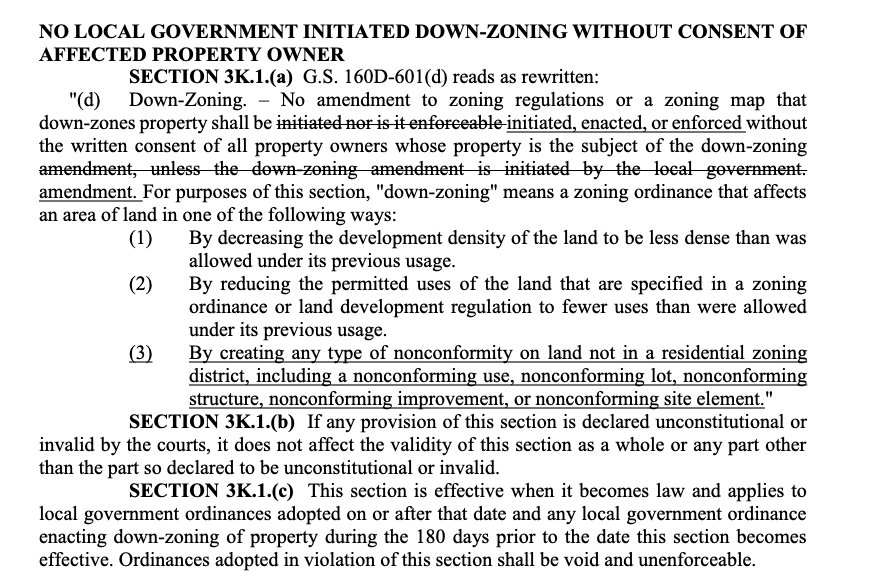
Excerpt from the 2024 North Carolina General Assembly legislation restricting local authority to initiate “down-zoning” without the written consent of affected property owners. This change significantly limits towns like Wake Forest from reducing density or permitted uses once zoning is in place.
In late 2024, the North Carolina General Assembly passed legislation (Session Law 2024-57) making it nearly impossible for municipalities to down-zone property — that is, reduce density or permitted uses — without the written consent of every affected owner. That change effectively removed one of the few “brakes” towns once had to manage growth.
At the same time, state law already prevents cities from controlling rents, which limits mandatory affordability for rental units. And Wake Forest’s Unified Development Ordinance (UDO) — the local rulebook for zoning, density, and design — was in the middle of a rewrite when those state rules changed, forcing planners to adjust course.
So while the town can’t simply say “no,” it still has some leverage through conditional zoning — where it negotiates site-specific conditions, such as open space, greenways, or housing types tied to each development’s impacts.
Why this matters:
The town can’t unilaterally restrict density or uses anymore.
Advertisement
What it can do is negotiate benefits — like setting aside units for seniors, first-time buyers, or essential workers — when a rezoning is requested.
Other NC towns, like Chapel Hill, use inclusionary policies requiring up to 15% of for-sale homes to be affordable, or offer density bonuses for projects that provide them.
Wake Forest hasn’t adopted those measures yet. Still, as housing costs rise and development accelerates, they may become the best available tools for ensuring growth benefits residents across income levels and life stages.
A Vote About Trust — and Priorities
For Clapsaddle and residents like Watkins, the Star Road debate was about more than traffic or zoning. It was about trusting the process — whether the studies, plans, and votes guiding development still reflect the lived experience of Wake Forest residents.
Clapsaddle’s “no” wasn’t anti-growth; it was a call to make growth intentional — ensuring the town builds homes not just for commuters, but for people who want to live, work, age, and stay here.
Beyond Star Road
The meeting also covered the heart of community life:
The board passed a resolution urging federal and state support for upgrades to U.S. 1 (Capital Boulevard).
The mayor and commissioners highlighted civic life — from Diwali celebrations to scout visits and historic preservation projects.
The public meeting was adjourned, and the board held a private session.
What’s Next
The board’s next business meeting is Tuesday, November 18, 2025, at 6 p.m., where they’ll hold new public hearings and presentations — including one on Wake Forest’s downtown social district.
Democracy is a verb. Show up, ask questions, and engage — respectfully and with courage — for the future of our town.
Wake Forest Matters is an independent, nonpartisan newsroom covering Wake Forest, NC. We report on local government, schools, business, and community life — free to read and reader-supported. Fearless. Local. Loud.